
Empire Pipeline | Energy Services | Industrywide Issues | New York | Pipelines | Regulation | Statewide NY
Northern Access Pipe Gets 3-Year Extension to Build in NY
 Speaking of National Fuel Gas Company’s Northern Access Pipeline project, NFG asked the Federal Energy Regulatory Commission (FERC) last November to extend the project timeline by an extra three years, to give them more time to fight with Cuomo in court and actually get the pipeline built once lawsuits from the state are exhausted (see NFG Asks FERC for Extra 3 Yrs to Build Northern Access Pipe in NY). Last Thursday FERC granted that request.
Read More “Northern Access Pipe Gets 3-Year Extension to Build in NY”
 Last week National Fuel Gas Company (NFG), headquartered in Western New York State (operates drilling subsidiary Seneca Resources and pipeline subsidiary Empire Pipeline), issued its first quarter 2019–everyone else’s fourth quarter 2018–update. Via Seneca Resources, NFG drills wells in northcentral and northwestern PA. Via Empire Pipeline, they build and maintain hundreds of miles of pipelines.
 In November, Dominion Energy said that their 600-mile Atlantic Coast Pipeline (ACP) would be delayed, with a partial startup in 2019 and full startup for everything else in mid-2020 (see
  The Pennsylvania Chamber of Business and Industry (PA Chamber) recently filed a brief in Commonwealth Court opposing THE Delaware Riverkeeper in a case that still has us angry and baffled. The case brought by Riverkeeper is clear across the state, hundreds of miles from the Delaware River Basin where Riverkeeper supposedly operates, and attempts to force a local municipality to adopt zoning ordinances it doesn’t want to adopt. And it involves Martians.
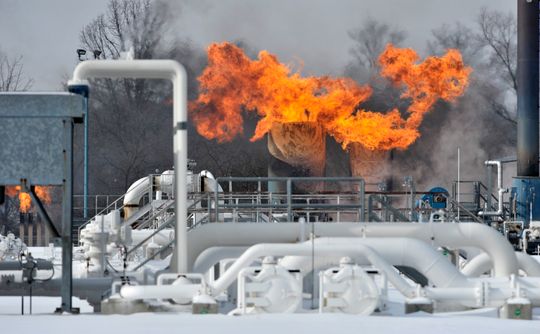 Last week a pipeline at a single Michigan compressor station caught fire and exploded (see
  MARCELLUS/UTICA REGION: CNX scales back production growth and the market panics; Pa. Gov. Tom Wolf to unveil budget with familiar call for a tax on natural gas drillers, but with a twist; Chevron reports fourth quarter net income of $3.7 billion, annual earnings of $14.8 billion; Despite missing big fish, WV benefits from gas boom; OTHER U.S. REGIONS: King County Council approves 6-month moratorium on major fossil-fuel facilities; Bill seeks to curb flaring by charging taxes, royalties; NATIONAL: Brainwashing kids to take action on climate change; Shell buys charging company Greenlots as oil majors prep for rise of EVs; Green New Deal would be a giant leap on the road to serfdom; US midcon propane discounted to Gulf despite freeze; U.S. natural gas prices plummet, defy ‘polar vortex 2019’; Structural shifts propel U.S. gas demand; INTERNATIONAL: Breakneck LNG demand surge in China is history.
 Yes, we told you so. We told you that if our friends in PA were to unwisely reelect Tom Wolf for a second (and thankfully final) term as governor, he would continue to fight for a Marcellus-killing severance tax each and every year of his ignominious second term. Democrats (and some Republicans) just can’t keep their hands off other people’s money–it’s in their DNA.
 In November the Pennsylvania Supreme Court agreed to hear a case, Briggs v. Southwestern Energy, that is hands-down the most important court case to ever happen regarding the Marcellus Shale in PA. And no, we’re not exaggerating. A blizzard of briefs by Southwestern and those supporting Southwestern were filed earlier this week.
 Yesterday CNX Resources, a Marcellus/Utica driller headquartered in Pittsburgh and concentrating on southwest PA, issued its fourth quarter and full year 2018 update, along with looking-ahead guidance for 2019. Like other M-U drillers we’ve recently chronicled, CNX is scaling back its budget for 2019–by 5-10%. But even spending less, the company says it will produce about 5% more gas in 2019.
 Tallgrass Energy, builder and operator of the mighty Rockies Express (REX) pipeline which is a critical link that flows Marcellus/Utica gas to Midwestern markets, dropped a bombshell announcement yesterday. The company said that investment firm Blackstone is buying a “controlling” interest in the company. Which raises the question, will Blackstone indeed “control” the company?
 The U.S. Energy Information Administration recently published its Annual Energy Outlook for 2019. Among the numbers EIA released are predictions about how much natural gas liquids (NGLs) the U.S. will produce between 2018 and 2050. EIA says production will go up 32% over that period, to 5.8 million barrels per day (b/d). Guess where most of that increase will come?
 Here’s an interesting twist on the theme of drillers shorting leaseholders out of royalty money. Usually such cases involve drillers claiming post-production deductions from landowner royalty checks. This time the landowner/rightsholder is Columbia Gas Transmission (pipeline company owned by midstream giant TransCanada), and the claim is that Southwestern Energy (driller) is not paying royalties for gas produced but not actually sold.