
FERC Approves Transco Pipeline Expansion in New Jersey
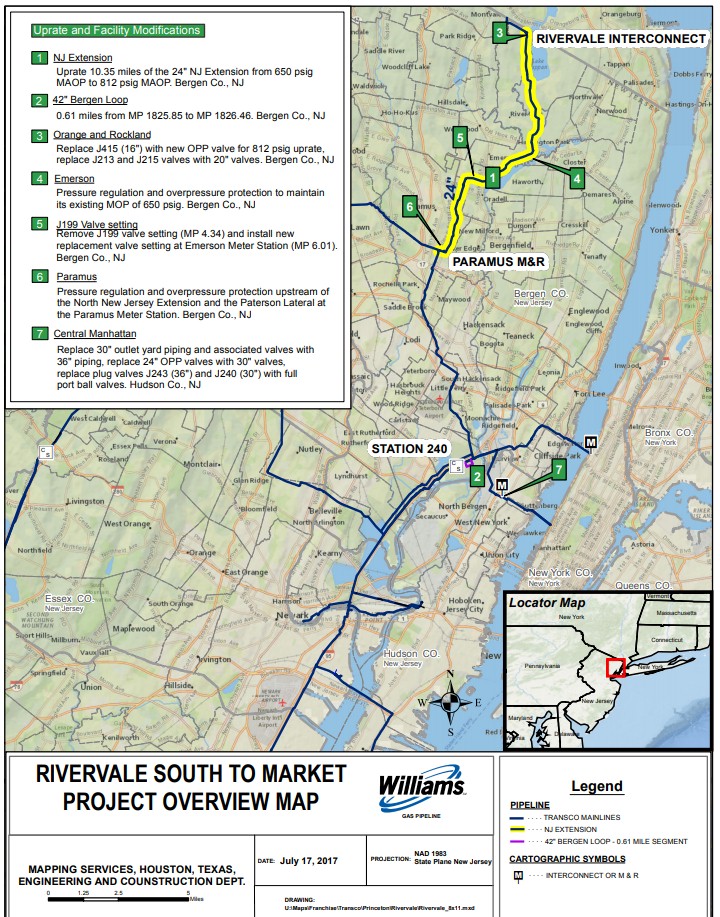
Last Friday, before Federal Energy Regulatory Commission (FERC) Commissioner Rob Powelson left the building for the last time, FERC approved a small but important expansion of the Williams Transco Pipeline in New Jersey, called the Rivervale to South Market project. We first told you about the Rivervale project last year when Williams filed an application for it with FERC (see New Project Seeks to “Uprate” Transco Pipeline in Northern NJ). The Rivervale project will expand the mighty Transco pipeline in northern New Jersey to deliver an extra 190 million cubic feet per day (MMcf/d) of low-carbon, clean-burning Marcellus Shale gas to markets in northern NJ and New York City. The project calls for “uprating” a little over 10 miles of pipeline (same pipeline with more pressure and more gas), and adding a half mile of new looping pipeline–which is more than enough to set off the whackadoodles at the NJ Sierra Club. One of two Democrat FERC commissioners, Richard “Dick” Glick, voted in part against approving the project because he says it will lead to more global warming. Typical lib Dem. Here’s Williams’ good news announcement, and a copy of FERC’s 46-page approval…
Read More “FERC Approves Transco Pipeline Expansion in New Jersey”

 We spotted something that seemed a bit odd to us. In a story about pipelines in WV and the challenges they face, EQT said they continue to engage in some construction activities for Mountain Valley Pipeline, even though the Federal Energy Regulatory Commission (FERC) recently ordered them to stop all construction on the project until further notice (see
  According to Washington County, PA landowner Joe Raposky, EQT has been storing natural gas under his property in Finleyville without permission and without compensation since at least 2007. Last year Raposky asked EQT to compensate him and they refused. So Mr. Raposky has organized over 100 of his neighbors along with landowners who sit over top of other similar underground storage fields in the region, and on July 30 they filed a lawsuit against EQT. PA has some 60 gas storage fields spread across 26 counties in the state. The fields are used to temporarily store and then retrieve natural gas. Storage, which is not something we write about very much, is in fact a big deal when it comes to the natural gas market. Not all gas is used as soon as its extracted and sold along a pipeline. There are two main “seasons” in the natural gas industry–injection season, from April 1 through October 31, when a surplus is stored underground, and withdrawal season, from November 1 through March 31, when more gas is used than is produced. Storage fields like the one in Finleyville are an important part of the natgas puzzle. In some cases, landowners are only now becoming aware of the existing fields under their feet and they (rightly) want to be compensated for the use of their property. Is storage the next big bone of contention between landowners and drillers?…
 In just about every state in the country, before you start digging a hole in the ground for some reason (water well, septic system, laying an underground electric line, etc.)–the first thing you do is call 811 or some similar phone number. The “one call” or “first call” reaches a state-authorized (not necessarily state-run) office where they have, on file, maps detailing any kind of underground cables, pipelines and other infrastructure. If such underground structures exist, a representative of the owner for the underground line will, if necessary, stop by and mark the areas so when you do begin digging, you don’t hit it. Makes sense. A bill introduced in 2016 in the Pennsylvania legislature “enhances” the existing 811 law in PA. One of the “enhancements” is that it removes an exclusion for low-pressure natural gas gathering pipelines from being required to be part of the 811 system, mainly lines run to conventional gas wells. The bill was opposed by the Pennsylvania Independent Oil & Gas Association (see
  The U.S. Senate Environment and Public Works Committee will hold a hearing this Thursday to consider the Water Quality Certification Improvement Act of 2018 (S. 3303). Two weeks ago we told you about S. 3303, a bill that will “fix” the issue of states like New York using Section 401 of the Clean Water Act, which allows states to have a say in where interstate pipeline routes can pass through a state, from abusing their authority by blocking pipeline projects (see
  The answer to the question posed in our headline for which skills are most valued (and missing) in new employees looking to work at companies involved in the Marcellus/Utica industry may surprise you. Would the answer be, detailed industry knowledge, like knowing what mud logging, wire lines and Christmas tree (wellheads) are? Nope. Employers can teach those things on the job. How about subject-specific skills, like knowing how to weld (if you work in the field), or the difference between debits and credits (if you work in the accounting department)? Obviously if you apply for a welding job, or an accounting job, you’ll need to know something about those specific areas. But no, we’re talking about what kinds of skills ALL new employees should have, regardless of which area they work (in the field or in the office)–skills that so often are missing in new hires. Would you believe those skills are: writing, speaking and time management? Yep, according to a study done by RAND Corporation looking at how employers and colleges in the Marcellus/Utica region are preparing workers for the shale workforce, they found a skills gap in workers who don’t know how to properly write, speak and manage their time effectively…
 The “best of the rest”–stories that caught MDN’s eye that you may be interested in reading: Time to contain the sand blowing around Stowe; what DRBC should be doing instead of playing fracking games; bust doesn’t always follow oil and gas boom; US refineries running at near-record levels; new video – Putin’s useful American eco-idiots; top 5 industry shifts fueling the future of drilling; frackers burn cash to keep the oil boom going; China cuts off nose to spite its won face re LNG tariffs; and more!