
President Trump Issues 60-Day Waiver of Jones Act, Includes LNG
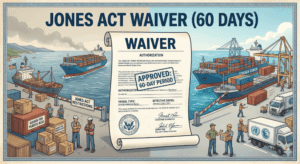 We lead with this story about a government regulatory action because of just how important we see this development. For *years* we have railed against the 106-year-old Jones Act and its requirement that any goods (like LNG) that are transported from one U.S. port to another be on a ship manufactured in the U.S., owned by a U.S. company, and crewed by a U.S. crew. The effect of this law in the modern age is to ban LNG (and other shipments, like gasoline, propane, coal, and other products manufactured in the U.S.) from being shipped cheaply from port to port. The U.S. foolishly allowed its ship manufacturing to slip away years ago to South Korea and other countries. We no longer make cargo carriers for LNG and other energy products. We haven’t made them in decades. Yesterday, President Trump signed a 60-day waiver of the Jones Act, allowing certain goods (such as LNG, fertilizer, and coal) to be transported from U.S. port to U.S. port on foreign-owned, foreign-flagged and crewed ships. Read More “President Trump Issues 60-Day Waiver of Jones Act, Includes LNG”
 Just coming to light for us now is that Iroquois Gas Transmission System petitioned the Federal Energy Regulatory Commission (FERC) in February to reissue authorization for the $152 million Wright Interconnect Project in New York State, aiming to revive a critical link for the previously canceled Constitution Pipeline. Originally approved in 2014, the project seeks to establish a new receipt interconnection and compression facilities at the Wright Compressor Station. By creating 650,000 dekatherms per day (650 MMcf/d) of transportation capacity, the initiative intends to alleviate persistent natural gas supply constraints in the Northeast and New England markets. If approved, the project targets a May 2028 in-service date, utilizing existing company-owned infrastructure to minimize environmental impacts.
  The tagline (remit) of Marcellus Drilling News is “Helping People & Businesses Profit from Northeast Shale Drilling.” Sometimes people can make money apart from leasing land and drilling. As we have pointed out many times, there is a direct connection between shale gas and the power generation market. Gas-fired power plants use (are HUGE customers for) natural gas extracted in the Marcellus and the Utica. AI data centers, which have burst on the scene over the past year or so, have an enormous appetite for electricity. Most of the electricity used to power data centers comes from gas-fired power plants, whether those plants are owned and operated by independent power operators, or (increasingly) owned and operated on-site by the data center itself. This is the story of one farmer in northeastern Pennsylvania who became a millionaire apart from shale drilling—by selling his small farm to a data center company.
  Antero Midstream (AM) recently detailed its 2026 growth strategy, targeting an adjusted EBITDA of $1.19 billion to $1.24 billion, representing an 8% year-over-year increase. This growth is driven by Marcellus Shale infrastructure expansion and the integration of recently acquired HG Midstream assets. The company plans capital expenditures between $190 million and $220 million, primarily for gathering and compression infrastructure across its Appalachian footprint. Key focuses include high-return rich gas gathering projects and dry gas infrastructure development. With strong projected free cash flow, Antero Midstream aims to maintain capital discipline, reduce leverage to approximately 3.0x, and pursue opportunistic share repurchases.
 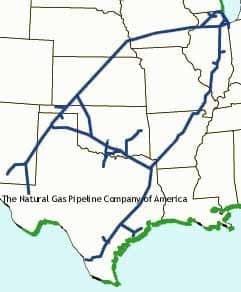 The Natural Gas Pipeline Company of America (NGPL), a Kinder Morgan pipeline subsidiary, flows Marcellus and Utica molecules. While the pipeline’s primary footprint is in the Midcontinent and Gulf Coast, it is a critical takeaway path for Appalachian gas through key interconnections. NGPL’s recent tariff announcement reaffirmed its commitment to offering negotiated rate arrangements for pipeline transportation services, maintaining continuity in its commercial practices. These options allow shippers to develop customized pricing based on factors like contract duration, gas volume, and specific operating needs, providing greater flexibility than standard maximum recourse rates.
  In January, Constellation Energy Corporation finalized its acquisition of Calpine Corporation, becoming the largest private-sector electricity producer in the United States (see
  OTHER U.S. REGIONS: Prince William County Public Schools unveils 62 new propane buses; NATIONAL: Front-month Nymex natural gas rose 1.06% to settle at $3.0650; A new way to measure U.S. energy security; Keystone XL revival gains momentum as new pipeline plan emerges; Times of conflict or war remind us of the importance of U.S. natgas; INTERNATIONAL: Oil settles higher on Gulf escalation; Oil, gas majors cut green spending for first time since 2017; Israel hits Iran South Pars facilities in world’s largest natural gas field; European natural gas prices spike amid attacks on Middle East energy sites; Asian prices may surpass $26 after strike on Qatar LNG plant.