
CNX 4Q17 Results: Drilled 4 New Wells, Completed 19 Wells
 CNX Resources, the gas drilling part of what used to be CONSOL Energy (but now is it’s own separate company), issued their fourth quarter 2017 update earlier this week. What a difference a year can make, at least financially! In 4Q16 CNX lost $300 million. In 4Q17 CNX made a $282 million profit. That’s a swing of $582 million–over half a billion dollars. CNX used $103 million of that money to buy back some of the company’s outstanding shares of stock. CNX produced 118.9 billion cubic feet equivalent (Bcfe) of production during 4Q17, which translates to 1.32 Bcfe per day. That’s new record high production for CNX. Production costs fell to $2.17 per thousand cubic feet (Mcf). During most of 4Q17 CNX operated 2 horizontal shale drilling rigs, adding a third rig in late December. The company only drilled four new wells in 4Q17: one dry Utica Shale well in Monroe County, OH; one deep dry Utica Shale well in Greene County, PA; one deep dry Utica Shale well in Indiana County, PA; and one Marcellus Shale well in Greene County, PA. However, they kept the rigs busy by completing 19 wells–DUCs, or Drilled but UnCompleted wells, drilled prior to 4Q17. CNX proved they can walk and chew gum at the same time over the past three months. While they were drilling 4 new wells and completing another 19 wells, during that same time period they (a) split the company in two, separating the gas drilling business from the coal business, (b) bought and closed on Noble’s 50% share of what was CONE Midstream (now CNX Midstream Partners), and (c) bought back $103 million shares of the company’s common stock. Busy beavers! Here’s the full 4Q17 update from CNX Resources…
Read More “CNX 4Q17 Results: Drilled 4 New Wells, Completed 19 Wells”
 Yesterday Eclipse Resources, a Marcellus/Utica pure play driller headquartered in State College, PA, held an analyst day to share an operational/financial update for 2017. Net production in 2017 averaged 310 million cubic feet per day (nearly a third of a billion cubic feet)–a 36% increase over 2016. Proved reserves at the end of 2017–the gas in the ground that is feasible to extract using today’s technology at today’s prices–was 1.46 trillion cubic feet equivalent, more than double the end of 2016. In 2017 Eclipse drilled 29 wells with an astounding lateral (the horizontal part of the well) length averaging 13,600 feet! Eight of those wells have laterals OVER 19,000 feet!! That’s longer than 3.6 miles!!! Eclipse is the reigning champ/record-holder for drilling the longest onshore lateral in the WORLD. Below is yesterday’s 2017 update along with a whopping 84-page PowerPoint used to discuss the update, chock-full of great charts and graphs…
 On Monday, Dominion Energy CEO Tom Farrell reported that the company’s Lusby, Maryland Cove Point LNG export facility will become operational and begin to export LNG in “early March” (see
  In December 2015 Marcellus/Utica driller Magnum Hunter Resources filed for bankruptcy (see
  2/2/18 Update: Have we been unfair in our characterization of Doug Lawler? Perhaps. We don’t know Doug–have never met him. He started firing masses of people at Chessy before the downturn hit. He arguably inherited a troubled company. We intensely dislike Carl Ichan and other corporate raiders, so we attributed Doug’s actions to Carl’s influence. MDN received a very nice note from a subscriber who personally knows Doug Lawler and has a different perspective to offer, which we’re happy to pass along. He said: “Jim, regarding your article on CHK, Doug Lawler probably learned a lot from Carl Icahn, but knowing Doug the way I do, I can assure you it hurt him to release people at his home office or other areas of operations. He was left with a mess and will take him years to clean it up. Hopefully with oil & gas prices stabilizing and going up, CHK will become profitable.” We thank our subscriber for sending that along!
 On Monday Gulfport Energy (drills mainly in the Utica but also in Oklahoma and Louisiana) issued it’s fourth quarter and full year 2017 results, along with a preview of what they expect to do in 2018. Gulfport has drilled the second highest number of Utica wells in Ohio, second only to Chesapeake Energy. Gulfport’s production in 4Q17 averaged 1.26 billion cubic feet per day equivalent, up 5% from 3Q17 and up a whopping 61% from 4Q16. Gulfport brought 15 Utica wells online in 4Q17. What’s ahead in 2018? The company will spend $770-$835 million in 2018. Astonishingly, Gulfport will not borrow to spend that kind of cash! Their spending will be 100% funded by the cash flow they generate from selling gas and oil and NGLs. Gulfport figures production will average somewhere around 15-19% more in 2018 than in 2017. Using an “average of 2.5 rigs” (how does that work?), Gulfport will drill 36-40 new Utica wells this year with an average lateral length of 11,200 feet. Gulfport plans to bring online 33-37 Utica wells with an average lateral length of 8,000 feet. Here’s the update of what happened in 2017, and what to expect in 2018, for one of the most important players in the Ohio Utica…
 Our lead story today is about Gulfport Energy which highlights some exciting news: This year (in 2018) Gulfport will fund their entire drilling budget out of the cash flow the company generates from selling gas/oil/NGLs (see Gulfport Energy Continues Focus on Utica for 2018, No Borrowing). Thing is, Gulfport isn’t the only Marcellus/Utica driller to advertise the fact that this year they are “living within their means” and not borrowing. Others include Range Resources, EQT and Antero Resources. Wow! We’re finally profitable!! Or are we? MDN spotted some analysis by a hedge fund manager. Writing on the Seeking Alpha investor’s website, Josh Young says (in our words) “hold on a minute” with respect to M-U drillers appearing to be able to grow production without borrowing. Why is Josh not convinced with this good news? Because when you dig deeper into the numbers, you find that “organic growth within cash flow is further from reach” because drillers are using DUCs to spend less on drilling, and grow production, than they otherwise would be. A DUC is a Drilled but UnCompleted well. Many times drillers will drill the initial hole in the ground, but then not “complete” (or frack) the well. Why do that? For a variety of reasons. The biggest reason is usually because the commodity price of gas (or oil, depending on the well) is not favorable. Rather than lose the lease (an expensive proposition), drillers will begin the process by drilling, and then leaving, the well, returning later to complete it when prices go up again. Josh’s thesis is that by using DUC inventory drillers aren’t really funding the entire budget from current year cash flow, because some of the money was spent in a previous year to drill the well. They are, in essence, still borrowing–from a different year. Josh estimates an average of 20% of the “new” wells coming online are DUCs and not truly new wells funded by current year dollars–meaning these companies aren’t as “profitable” as they may seem. Does he have a point? Is it all just financial mumbo jumbo? You decide…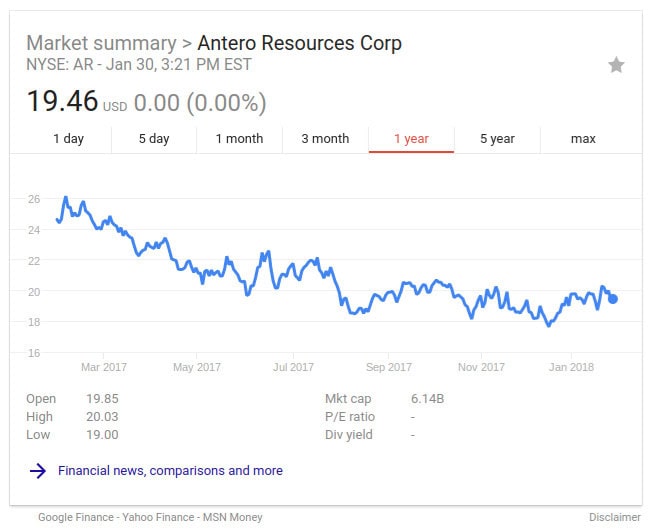

 Yesterday Range Resources released a pair of press releases. One outlines a high level overview for what the company will spend in 2018 and beyond, for the next five years. The other release trumpets Range’s “proved reserves.” As for 2018, Range says they are reducing the amount of money they will spend to drill this year versus what they spent last year. Range previously said they would spend $1.15 billion this year. That’s now been reduced to $941 million. Last year Range spent $1.27 billion, so this year’s spending is down 26% over last year. That’s a pretty hefty decrease. The good news is that Range will spend 80% of this year’s budget on drilling in the Marcellus, mainly in southwestern Pennsylvania. Even though Range will spend and drill less this year, they predict production will grow another 25%. As for the 5-year outlook, Range says almost all growth will come in the Marcellus (not the Louisiana Haynesville, their other drilling location). Range still has some 3,200 locations where they can drill new wells. Range CEO Jeff Ventura says shale has entered a “new era” of shale development where companies (like Range) have “captured the most prolific resources” and will now switch to focus on returns for shareholders. Translation: We won’t be drilling as much as we did in the past so we can concentrate on bottom line profitability. Which explains why Range is spending less this year than last. In the release Range calls the Marcellus its “flagship asset” and clearly signals the company will keep its focus here, in our region. As for proved reserves (how much gas and oil is in the ground, retrievable with today’s technology and at today’s costs), Range says proved reserves as of December 31 increased by 26% from the prior-year, now at 15.3 trillion cubic feet equivalent (Tcfe). That’s alotta gas! We have the Range announcements below, along with an updated PowerPoint slide deck chocked full of useful information…
 At the end of last year Chesapeake Energy offered a $30 million olive branch to Pennsylvania landowners to settle claims the company had screwed them out of royalty money by artificially inflating post-production costs in an elaborate scheme to pocket more money at landowners’ expense (see
  In December 2015 MDN told you about EQT’s application to drill a single shale well in Jefferson Hills (Allegheny County), PA (see
  Residents in western Lawrence County, PA had a bit of a scare when they noticed a red glow in the sky Saturday night. They took to social media to speculate what it might be. Some called 911 to report what may be a big fire. Turns out it was flaring from a couple of Hilcorp Energy Marcellus Shale wells. The wells are already drilled and producing, so why did they flare? Flaring–or burning of natural gas at the wellhead, is a safety precaution to prevent explosions from too much pressure in the well. A Hilcorp rep said what likely happened is that compressors that compress and send the gas down the pipeline sometimes get moisture in them, and with the freezing cold temperatures, that moisture can freeze and lock up the compressors. Instead of gas building up to dangerous pressures because it can’t flow on down the pipe, the automatic flaring mechanism kicked in to burn off some of the gas–creating the red glow in the night sky. It’s good to see technology–especially safety technology–working as designed…
 It’s not often MDN gets to write about a brand new driller (i.e. exploration & production company) arriving on the scene in the Marcellus/Utica region. This is one of those happy days! Salt Fork Resources, started in March 2017 and headquartered in Canonsburg, PA, was started by three men with extensive experience in the Appalachian region. The company was/is backed by Riverstone Holdings, an investment firm focused on power and energy. The reason that Salt Fork appeared on our radar screen is because of a press release from Riverstone announcing they have “upsized” their backing of Salt Fork–that is, they are giving Salt Fork more money to lease more acreage and drill. How much money? The release does not say. We do know that Salt Fork has, so far, amassed a very respectable 20,000 acres “in the core of the dry gas window of the Utica Shale.” We also know, from their website, that Salt Fork is targeting the Utica in both Ohio and West Virginia. Salt Fork is a portfolio company of Riverstone (i.e. Riverstone owns it). The money Riverstone is giving to Salt Fork is equity, not debt–meaning Salt Fork hasn’t had to borrow a dime, a minor miracle for any oil and gas company. Does Riverstone sound familiar? It should. We’ve previously written about their other Marcellus/Utica region investments a number of times (
 “One word: Plastics” (The Graduate) – Mercer County, which is two counties and 50 miles north of Beaver County (located along the border with Ohio) is making plans now for how their county to grab some of the “low hanging fruit” that will appear when the Shell ethane cracker in Beaver County goes online in the early 2020s. You read that right. NOW is the time for counties in the region to make plans and set those plans in motion to attract some of the numerous businesses that will set up shop to be close to the cracker plant. Mercer County officials recently attended a forum where the topic was ancillary development that will happen because of the cracker plant. What is the low hanging fruit that will magically appear with the cracker? Manufacturing–and the jobs that go with it. In particular, manufacturing and jobs in the plastics industry. A regional trade organization–Penn-Northwest Development Corp.–is planning to hit the plastics industry trade shows this year. Penn-Northwest is working with counties like Mercer to help them market themselves to plastics manufacturers…