
Shell Ethane Pipeline Hearing Draws Few Supporters, Many Antis
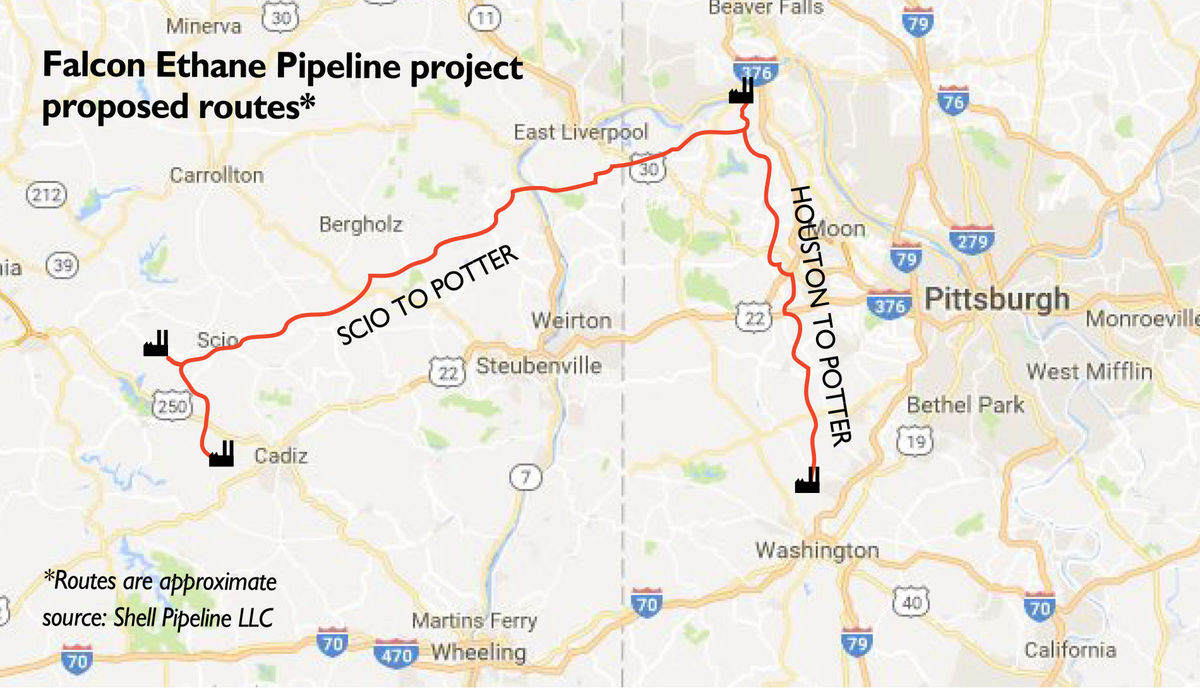
Last night the first of three public hearings held by the Pennsylvania Dept. of Environmental Protection for the planned Shell Falcon Ethane Pipeline project was held in Monaca (Beaver County), PA. About 100 people turned up for the hearing, which lasted an hour and a half. No signs allowed. The only people who could speak had to register first. Of the 23 who did speak, 16 of them (including out-of-town movement antis) spoke against the project, while 7 people spoke in favor. The 97-mile Falcon Ethane Pipeline system has two “legs” that will feed Shell’s mighty ethane cracker plant. Shell is not using eminent domain for any of its leases for the pipeline. Every lease is negotiated and signed with individual landowners. Antis, in large part being organized and agitated by radical groups like FracTracker Alliance, are making a concerted effort to block the pipeline, hoping they can in turn stop the multi-billion dollar cracker plant currently under construction by blocking the pipeline that feeds it…
Read More “Shell Ethane Pipeline Hearing Draws Few Supporters, Many Antis”

 Shell wants to build a 97-mile ethane pipeline to feed the mighty $6 billion cracker plant its building in Beaver County, PA. Shell chose not use eminent domain but instead negotiated with (paid big bucks for) rights of way along the pipeline’s path. Earlier this month additional details came out about the proposed project when the Pennsylvania Dept. of Environmental Protection (DEP) published an application from Shell for stream crossing permits. When the details became known, the Ambridge Water Authority (in Beaver County), an organization that oversees a reservoir that provides drinking water for ~30,000 people, expressed “strong opposition” to the route of the pipeline (see
  Shell Chemicals this week announced the donation of a $1 million gift to the Community College of Beaver County (CCBC). The gift will benefit the school’s process technology program and will be used to construct a new Shell Center for Process Technology Education building. CCBC President Chris Reber called it a “transformational gift” and an “extraordinary investment.” The gift will ultimately help train students to work for Shell and other companies that will benefit from Shell’s ethane cracker plant (being built in Beaver County). This isn’t the first huge gift for the process technology program at CCBC. In December, the Allegheny Foundation donated $1 million toward the first phase of the program’s expansion. Shell’s donation will fund the second phase. Aside from the big $1M announcement, Shell also awarded $2,500 (each) scholarships to 13 students in the CCBC process technology program. Shell has really stepped up to the plate in SWPA. They are investing in local talent and local institutions…
 Once again, in what appears to be a pattern, the Pennsylvania State Dept. of Environmental Protection (DEP) is caving to pressure from virulent anti-fossil fuelers. This time in regard to Shell’s proposed Falcon Ethane Pipeline project. Shell is working on an ethane “pipeline system” with two “legs” to feed the mighty cracker plant being built in Monaca, Beaver County (see
  Shell has had pretty smooth sailing with their proposed 97-mile Falcon ethane pipeline project–a pipeline that will feed the mighty $6 billion cracker plant Shell is building in Beaver County, PA. Shell did not use eminent domain but instead negotiated with (paid big bucks for) rights of way along the pipeline’s path. That process continues. There have been some grumblings here and there, particularly from Big Green groups. But all in all, there has been remarkably little opposition–that is, until now. Shell filed an application to build the Falcon project back in October (see
  On Monday, Dominion Energy CEO Tom Farrell reported that the company’s Lusby, Maryland Cove Point LNG export facility will become operational and begin to export LNG in “early March” (see
 “One word: Plastics” (The Graduate) – Mercer County, which is two counties and 50 miles north of Beaver County (located along the border with Ohio) is making plans now for how their county to grab some of the “low hanging fruit” that will appear when the Shell ethane cracker in Beaver County goes online in the early 2020s. You read that right. NOW is the time for counties in the region to make plans and set those plans in motion to attract some of the numerous businesses that will set up shop to be close to the cracker plant. Mercer County officials recently attended a forum where the topic was ancillary development that will happen because of the cracker plant. What is the low hanging fruit that will magically appear with the cracker? Manufacturing–and the jobs that go with it. In particular, manufacturing and jobs in the plastics industry. A regional trade organization–Penn-Northwest Development Corp.–is planning to hit the plastics industry trade shows this year. Penn-Northwest is working with counties like Mercer to help them market themselves to plastics manufacturers…
 It’s always a shame–in fact it grieves us–to see once-great Christian denominations succumb to a worldly rather than spiritual purpose and mission. It’s sad to see the modern day version of a golden calf erected in place of God. It’s happened again–this time with the Presbyterian denomination in Pittsburgh. An “umbrella group for 140 Presbyterian churches” in Allegheny County are calling on Shell to stop construction of their $6 billion ethane cracker plant project about 25 miles from Pittsburgh. That’s right–just stop now, throwing thousands of people out of work (not very Christ-like) and throwing away the $1 billion+ Shell has already spent on the fully vetted, fully permitted, fully discussed (for years) project. Why do the Presbyterians want work on the cracker plant stopped? Because the plant will produce “plastic products that have been linked to the death of animals and the diminishment of fragile natural habitats.” Yep. The Presbyterians are now anti-plastic. The very keyboard they typed up their tripe on is, of course, plastic. As was the computer and monitor they used, the chair they sat in, the clothes on their bodies and sneakers on their feet–all come from the plastics the Shell cracker plant will produce. Just for icing on the global warming cake, the Presbyterians are also demanding their denomination divest any of their considerable investments from companies remotely related to the fossil fuel industry. It seems that the golden calf of global warming has now replaced God in the Pittsburgh Presbyterian denomination. And yes, we do grieve over that…
 Dominion announced yesterday it has introduced “feed gas” into it’s new $4 billion LNG export plant in Cove Point, Maryland. Feed gas is used for testing purposes and is the final step before the plant goes online into full production later this month. Dominion said the feed gas will come from Shell, and Shell will take delivery of the LNG that results. Following the test, Marcellus/Utica gas will begin flowing to the plant and the LNG produced will begin shipping to Japan and India. We are on the cusp of something we’ve waited for, cheered for, and agonized over for more than three years. Think of the Shell’s feed gas as the dress rehearsal the night before a play opens…
 Yesterday America’s natural gas and oil industry announced “a landmark partnership”–called the Environmental Partnership–to “accelerate improvements to environmental performance in operations across the country.” How will they do that? The first area of focus will be to reduce methane and volatile organic compound (VOC) emissions. The Environmental Partnership includes 26 natural gas and oil producers, including several major Marcellus/Utica drillers (Chesapeake Energy, Cabot Oil & Gas, Chevron and Southwestern Energy). The list of 26 produce a “significant portion” of American energy resources–we’d peg it at around 80% of all production. The participating companies (full list below) will begin implementing the voluntary program starting January 1, 2018. Did you get that? It’s VOLUNTARY. Yet they will do it and they will voluntarily hold themselves and each other accountable–because they are good corporate citizens and (gasp) actually care about the environment. They don’t need the jackboot of government to force them to do it. Here’s how profoundly biased mainstream media reports it: Oil Firms Pledge to Plug Methane Leaks in Bid to Burnish Image (Bloomberg News). Yep, according to the anti-everything people, these companies are only doing it to “burnish” their image. They don’t really care about the environment. They’re evil, nasty fossil fuel companies (icky). MDN readers know differently. These companies are respectable, providing jobs and investment in local communities AND protecting the environment in those same communities–where they live. The other side? Groups like the Sierra Club destroy jobs in the name of “protecting” Mom Earth…
 Although Shell’s mighty $6 billion ethane cracker chemical complex won’t be completed until around 2020, Shell is not waiting with respect to recruiting talent to operate the plant. Shell recently launched a page on their main website dedicated to recruiting people for cracker plant jobs (