
So-Called Peak Oil & Gas (Supply or Demand) is Nowhere in Sight
 In 2025, the U.S. set dual production records, with crude oil output reaching 13.6 million barrels per day and natural gas hitting 118.5 Bcf/d, making America the world’s top producer of both commodities. These milestones represent explosive growth since the early 2000s, driven entirely by the shale fracking revolution. Despite persistent predictions of failure from environmental groups, major publications like The New York Times and Wall Street Journal, and various analysts, the industry continuously defied skeptics through relentless technological innovation — including longer lateral wells, simultaneous multi-well fracking, and electrified equipment. With no production peak in sight, new records are anticipated for 2026. Read More “So-Called Peak Oil & Gas (Supply or Demand) is Nowhere in Sight”
 About a month ago, MDN brought you the exciting news that a father and son who own land in Upstate New York (not far from MDN HQ) have sued New York State for “taking” their right to allow shale drilling and fracking under their land (see
  Halliburton, the world’s second-largest OFS (oilfield services) company, issued its first quarter 2026 update yesterday. CEO Jeff Miller said, “In North America, I see clear signs that we are in the early innings of a recovery.” Cool. Of course, he’s talking about oil drilling, mostly. While the update and earnings conference call did not specifically mention the Marcellus/Utica, they did include information highly relevant to our region. In particular, the company prominently mentioned its electric fracking “e-fleets” and said that the current low price of natural gas represents a significant opportunity for drillers to save money by using it instead of diesel to power fracking equipment.
  Wow! We haven’t been this excited about the long-dead issue of fracking in New York State in a LONG time. Geologist Madison Woodward III and his son Thomas (from Texas) purchased property in New York State in 2011, hoping to develop its natural gas reserves based on geological assessments and successful fracking operations in nearby Pennsylvania. However, New York’s statewide ban on hydraulic fracking, later expanded to include all alternative extraction methods, rendered the Woodwards’ mineral rights worthless. Represented by Pacific Legal Foundation, the Woodwards filed a federal lawsuit yesterday, arguing that the ban constitutes an unconstitutional “taking” of their property under the Fifth Amendment, for which they are owed just compensation, challenging New York’s energy policy and defending property owners’ rights.
 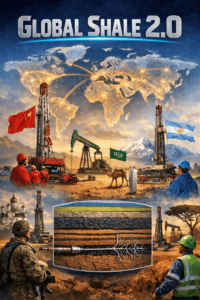 Wood Mackenzie reports that geopolitical tensions, particularly in the Middle East, are driving a renewed global focus on international shale exploration to enhance energy security and diversify supply. Six countries are prioritizing unconventional (shale) resource development: Algeria for European supply, and the UAE, Mexico, Australia, Turkey, and Indonesia for domestic energy independence. This “Global Shale 2.0” differs from past attempts due to improved technology, a clearer understanding of viable plays, and less competition from new Permian-scale discoveries, encouraging investment where regulatory and fiscal terms align with national interests.
  MDN first tipped you back in July 2025 that the Democrat anti-fracking movement in Pennsylvania (and beyond) was rapidly becoming anti-data center (see
  The highly functional and responsible Susquehanna River Basin Commission (SRBC), unlike its highly dysfunctional and irresponsible counterpart, the Delaware River Basin Commission (DRBC), continues to support the shale energy industry by approving water withdrawals and consumptive use for responsible and safe shale drilling. The SRBC also tells shale drillers when to stop withdrawing if low water flow (i.e., drought) conditions exist. That’s what the SRBC did yesterday. The agency, via its Hydrologic Conditions Monitor, warned shale drillers that, at 15 listed locations (all in Pennsylvania), they must stop water withdrawals until streamflow reaches a specific “trigger flow” target (different for each location). Another 9 locations are approaching restrictions.
  Shale drilling in Wayne and Pike counties in the northeastern tip of Pennsylvania has been blocked since 2010 (16 looooong years), denying landowners in those counties the right to benefit from leasing and drilling on and under their land. Those counties (parts of them) are within the Delaware River Basin, and the Delaware River Basin Commission (DRBC) implemented a moratorium in 2010 to block shale drilling. The moratorium became a full-blown, permanent ban on fracking in 2021. The DRBC added a prohibition on the disposal of oil and gas wastewater to the permanent ban in 2022. It’s time to overturn the ban. We have a
 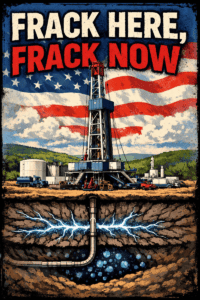 An unidentified natural gas driller has applied to open over 8,300 additional acres of the Egypt Valley Wildlife Area for fracking, potentially making it Ohio’s largest fracking operation on public land. This request follows a January decision that already opened 4,400 acres of the 18,000-acre preserve, which is primarily used for conservation, hunting, and fishing. While the state’s Oil and Gas Land Management Commission (OGLMC) has historically favored industry requests despite significant public opposition, environmentalists and some Democratic lawmakers argue that the expansion exploits public resources and threatens local ecosystems. A public comment period remains open until April 27.
 Patterson-UTI is a leading North American oilfield services company (OFS company) based in Houston, specializing in high-spec land drilling, pressure pumping, and directional drilling. Patterson operates one of the largest fleets of APEX® rigs, focusing on advanced, technology-driven solutions for oil and natural gas exploration. Patterson operates roughly half of the active rigs in the Marcellus/Utica. Patterson CEO Andy Hendricks made a prediction in a recent interview: Rising US natural gas exports and domestic demand from AI data centers will lead to a shortage of fracking equipment later this decade.
 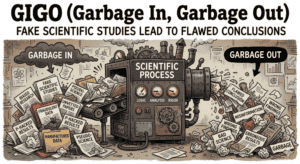 It’s time to make a LOT of noise with the Pennsylvania Department of Environmental Protection (DEP) if you care about Marcellus drilling continuing in the Keystone State. In December, the Pennsylvania Environmental Quality Board (EQB) accepted a petition by radical green groups, including the Clean Air Council and Environmental Integrity Project, to “study” the issue of increasing setbacks for shale drilling so far that it would ban ALL new Marcellus/Utica drilling in the Keystone State, which is no exaggeration (see
  A Syracuse University study (full copy below) reveals that conventional oil and gas extraction in Pennsylvania poses a greater long-term threat to stream biodiversity than modern shale fracking. By analyzing over 6,800 aquatic samples, researchers found that legacy infrastructure (old conventional oil and gas wells) is more strongly linked to declining ecosystem health and the loss of sensitive species. While public concern often centers on newer fracking methods, these findings highlight the persistent impact of older, conventional wells. The study, titled “
 Yesterday, Expand Energy and Evolution Well Services announced a new agreement to deploy Evolution’s 100% electric hydraulic fracturing technology (e-fracking) in Expand’s Northeast Appalachia (northeast Pennsylvania) drilling program. Evolution, headquartered in Houston with a regional office in Pittsburgh, specializes in “electric” fracking — using natural gas from the well pad (instead of diesel) to power turbines that generate electricity to drive fracking pumps. We’ve written about Evolution’s e-fracking work in the Marcellus/Utica for years (
 In an op-ed appearing on the Fox News website, Dan Doyle, the president of Reliance Well Services and Arena Resources, draws on decades of firsthand experience to defend hydraulic fracturing against activist criticism. He argues that fracking is a safe, highly regulated process that is essential to American energy independence and economic prosperity. By debunking common myths regarding groundwater contamination and seismic activity, Doyle emphasizes that technological advancements have significantly minimized environmental risks. Furthermore, horizontal fracking has lowered energy costs for families and reduced reliance on foreign energy sources. Ultimately, Doyle contends that the industry’s benefits to national security and the economy far outweigh the concerns raised by what he characterizes as misinformed rhetoric.