
EQT and Evolution Well Services Break New Performance Records
 Evolution Well Services, headquartered in Houston with a regional office in Pittsburgh, specializes in electric fracking (“e-fracking”) — using natural gas from the well pad instead of diesel fuel to power turbines that create electricity to drive fracking pumps. It’s a much quieter, less-polluting version of fracking. EQT Corporation, the country’s second-largest natural gas producer, uses Evolution Well Services for much (all?) of its drilling. Evolution and EQT issued an announcement yesterday about a series of record-breaking achievements they’ve made in the Marcellus/Utica. Read More “EQT and Evolution Well Services Break New Performance Records”
 Newly elected Republican Congressman Rob Bresnahan defeated incumbent Democrat Matt Cartwright in last November’s election to represent Pennsylvania’s 8th Congressional District, located in the northeastern corner of the state. Bresnahan hit the ground running, particularly in addressing energy issues. His district includes Wayne and Pike counties, where landowners have had their right to drill for natural gas seized by the Delaware River Basin Commission (DRBC). Bresnahan introduced a bill in June that would heighten DRBC accountability and oversight. We call it putting the DRBC on a short leash (see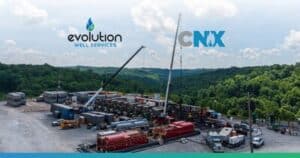
 Three members of the Pennsylvania State House of Representatives, Arvind Venkat (Democrat from Allegheny County), Elizabeth Fiedler (Democrat from Philadelphia), and Craig Williams (Republican from Delaware/Chester counties, Philly suburbs) are planning to introduce legislation to “establish regulatory clarity” to encourage the development of Enhanced Geothermal Systems in Pennsylvania. There’s a lot to unpack in that opening statement. First, this is a bipartisan effort. Second, they want to encourage more geothermal energy development in the state. When you understand that Enhanced Geothermal Systems (EGS) uses the same method of fracking used for natural gas and oil well drilling, it makes this bipartisan effort a real eye-opener.

 The Republicans in Congress have not wasted any time in addressing the ongoing tragedy of states (and municipalities) banning fracking or the right to choose which energy source (like natural gas) to use. We happened to spot details about two new bills just introduced in Congress, one by New York Rep. Claudia Tenney, which targets states like her own that ban fracking by denying the state federal funding as long as the ban remains in place. The other bill was introduced by West Virginia Senator Jim Justice (and Babydog!) along with Nick Langworthy (from NY) in the House to prohibit states or local governments from banning an energy service’s connection, reconnection, modification, installation, or expansion based on the type or source of energy to be delivered. Essentially, you can’t ban the use of natural gas either statewide or locally.
  The propagandists at the partisan Inside Climate News are doing their best to plant the false notion that drill cuttings and frack wastewater coming from shale wells are “radioactive.” Their latest effort in this regard is to defeat the reopening of a landfill in Mercer County, PA. The Grove City landfill would accept drill cuttings (among other landfillable waste). The antis, who oppose all fossil energy based on mythical global warming concerns, label drill cuttings as “radioactive waste.” It’s nonsense. Drill cuttings are leftover rock and dirt from the ground.
  The highly functional and responsible Susquehanna River Basin Commission (SRBC), unlike its less functional and irresponsible counterpart, the Delaware River Basin Commission (DRBC), continues to support the shale energy industry by approving water withdrawals and consumptive use for responsible and safe shale drilling. The SRBC published a notice in the May 31 Pennsylvania Bulletin that the Executive Director of the SRBC renewed 45 general water use permits in April for individual shale gas well drilling pads in Blair, Bradford, Lycoming, Potter, Sullivan, Susquehanna, and Tioga counties in Pennsylvania. The director also approved new water withdrawals for the 146-megawatt gas-fired Hunlock Creek power plant in Luzerne County.
  In 2021, PennEnergy Resources made a request to the Pennsylvania Department of Environmental Protection (DEP) to withdraw up to 3 million gallons of water a day from Big Sewickley Creek (Beaver County) and one of its tributaries for shale fracking (see
  According to opinion researchers at Pennsylvania’s Franklin & Marshall College, the issue of fracking has deepened the schism between Democrats and Republicans in the Keystone State. Pennsylvania’s voter registration statistics have shifted rightward (from Democrat to Republican), which has been traced to shifts in the affiliation of working-class communities, particularly those located in the northeastern and southwestern parts of the state. New research offers a more direct cause for the shift: the decline of coal mining and the rise of shale gas development.
  The U.S. Energy Information Administration (EIA) estimates that the average number of wells completed simultaneously (simul-frac’d) at the same location in the Lower 48 states has more than doubled, increasing from 1.5 wells in December 2014 to more than 3.0 wells in June 2024. By completing (fracking) multiple wells at once rather than sequentially, operators can accelerate their production timeline and reduce costs per well.
  A series of earthquakes (low level, sometimes felt, most of the time not felt) have hit Guernsey and Noble counties in eastern Ohio. According to the latest news we can find, some five quakes have hit since April 22, and another couple of quakes hit earlier in the year, in January/February. There is an existing fault line in the area, near Cambridge, known as the Burning Springs-Cambridge fault zone, formed more than 4.6 million years ago. So, earthquakes in the region are not unknown. The question is, why this most recent flurry? The Ohio Department of Natural Resources (ODNR) claims it’s tied to oil and gas activity in the area.
