
Shell Cracker to the Rescue – Saving the Erie, PA Plastics Industry
 The benefits of the mighty Shell ethane cracker now under construction in Beaver County, PA just keep multiplying. In April MDN brought you news that Penn State Behrend (in Erie County) had been tapped by the PA Dept. of Community and Economic Development (DCED) to be the “lead partner” with a $250,000 grant for developing business and market opportunities for the state related to the cracker (see Penn State to Help Create New Biz Opportunities from Shell Cracker). Erie County, where Behrend is located, is certainly not next door to the cracker. It’s two hours away! There are several other Penn State campuses closer to the cracker. So why was Behrend selected? In a word, plastics. “The strength of Erie’s plastics industry and the success of Penn State Behrend’s School of Engineering, which offers one of only six accredited U.S. plastics undergraduate programs, makes Erie of particular interest to DCED.” A new article says that the cracker will not only preserve the 4,300 plastics-related jobs in and around Erie, there’s reason to believe the plastics industry in Erie will “grow larger and stronger” because of the two-hours-away cracker. Again we ask the question, Why? Answer: Because buying plastics pellets from the Shell cracker two hours away is a whole lot cheaper (due to shipping costs) than buying plastics pellets from the Gulf Coast, as happens now. One would be justified in saying, Shell cracker to the rescue!…
Read More “Shell Cracker to the Rescue – Saving the Erie, PA Plastics Industry”
 Southwestern Energy has taken the next step of appealing the “Briggs” trespass case to the Pennsylvania Supreme Court–a case of tremendous importance. In April, MDN brought you the news that Pennsylvania Superior Court had handed down a decision (known as the “Briggs” case) that has the power to greatly restrict, perhaps even stop, Marcellus drilling in PA (see

 Since taking office nearly four years ago, Pennsylvania’s left-leaning Democrat Gov. Tom Wolf has rigidly blocked any new shale leasing of state forest land. Leases and drilling prior to Wolf brought a bountiful harvest of revenue to state coffers. But Wolf, bowing to pressure from radical environmentalists, refuses any new drilling. In February the state Senate, controlled by Republicans, passed a resolution calling on Wolf to restart drilling in state parks (see
 A lawsuit that began in 2016 is finally bearing fruit, and may lead to blocking efforts by the rogue Delaware River Basin Commission (DRBC) to block fracking in Wayne and Pike counties in Pennsylvania. In May 2016, a landowner in Wayne County filed a lawsuit against the DRBC asking a judge to declare that the DRBC does not have jurisdiction to prevent construction of a natural gas well (see
 Years ago when Sunoco Logistics Partners (aka Energy Transfer Partners) originally proposed and planned the Mariner East 2 twin pipelines from the edge of eastern Ohio through the entire length of Pennsylvania to the Marcus Hook refinery near Philadelphia, the completion date promised was the end of 2016. Little could Sunoco foresee the multiple lawsuits, regulatory hearings and illegal protest actions that would conspire to throw the project off schedule for more than a year and half. When pipeline companies plan such multi-billion dollar projects, they first get customers (drillers) to sign on the dotted line, guaranteeing there will be enough product (and revenue) to make the project worthwhile. Drillers *did* sign on the dotted line, and they’re still waiting. Waiting and now pressuring Sunoco to get the darned thing up and running. The pipeline itself is 98% complete–in the ground and connected. But an all-important 2% is still not complete, most of it in the Philly suburbs–Delaware and Chester counties. Sunoco continues to have problems with underground horizontal directional drilling and with ongoing litigation by towns in the Philly area. What to do, with customers breathing down your back? Sunoco has come up with an ingenious solution that is sure to send the crazies into orbit. Sunoco is asking the federal Pipeline and Hazardous Materials Safety Administration (PHMSA) for permission to use part of an existing 12-inch pipeline in that area that previously carried refined petroleum products (things like gasoline, heating oil, and jet fuel), repurposing the pipeline to carry NGLs (ethane, propane, butane, etc.). This is only a short-term fix until the last bits of the full ME2 is up and running…
 The married couple who started Lancaster Against Pipelines (LAP), Mark and Malinda Clatterbuck, are far-left radicals who pretend to be mom and pop, salt-of-the-earth, neighbor-next-door, aw-shucks common folks who would never engage in “violent” protests. Mark Clatterbuck admits to traveling to North Dakota to participate in the mass action against the Dakota Access Pipeline–a “protest” that turned quite violent and destroyed millions of dollars of property. No, we’re not saying nor implying that Clatterbuck himself engaged in illegal actions while there. We are saying the Clatterbucks’ sympathies lie with protest movements that sometimes result in such actions. The Clatterbucks made some big boasts–that some 1,000 people had pledged to protest and get themselves arrested to stop Atlantic Sunrise, a $3 billion, 198-mile pipeline project running through 10 Pennsylvania counties to connect Marcellus Shale natural gas from northeastern PA with the Williams’ Transco pipeline in southern Lancaster County. Something under 50 people have actually been arrested for illegal actions in trying to stop construction. As the Atlantic Sunrise project nears completion in all locations, including Lancaster County, apparently LAP is feeling neglected. Nobody talks about them anymore. They didn’t/couldn’t stop the pipeline, as they had boasted they would. So in an attempt to grab one more headline, Mark and another LAP protester, Elliot Martin, connected themselves together at a pipeline construction site using a “sleeping dragon”…
 As is so often the case, radical Big Green groups, like PennFuture, attempt to intimidate (i.e. bully) by using threats of legal action, those who dare to use and (gasp) enjoy the monetary benefits of shale drilling. In early 2013 the Pittsburgh International Airport and Allegheny County, PA signed a deal with CONSOL Energy (now CNX Resources) to lease 9,000 acres surrounding the airport for natural gas drilling (see
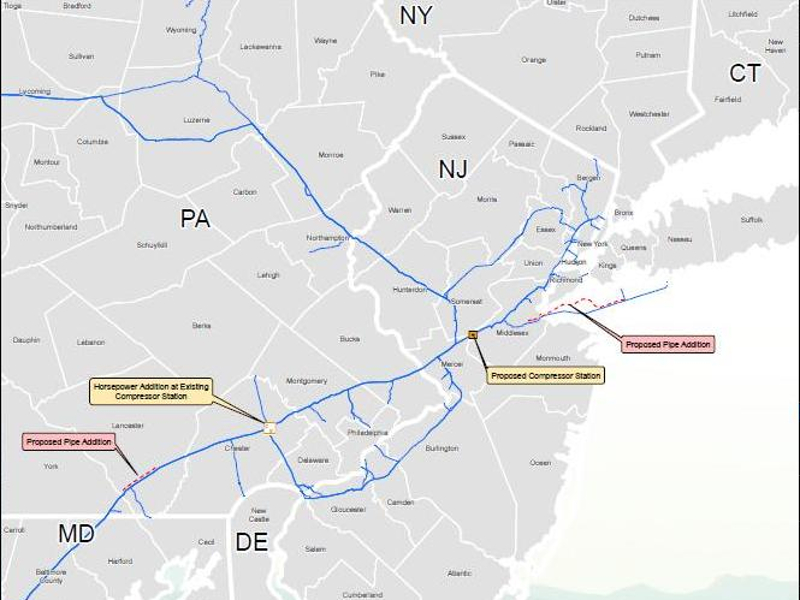


 Sunoco Logistics Partners was drilling horizontally underneath Snitz Creek in Lebanon County, PA for its Mariner East 2 Pipeline project when it experienced yet another “inadvertent return”–nontoxic drilling mud leaking out of a place where it shouldn’t. Sunoco spilled five gallons of nontoxic drilling mud. This is the third time it’s happened in June, and the sixth time it’s happened at the Snitz Creek location in total. Predictably, antis were hysterical. Hysterical, not as in funny, but hysterical as an insane, out-of-control overreaction. Theatrics. Drama. That kind of hysterical. The reaction from antis is organized by “green” groups–in particular by one person from a local green group calling itself Concerned Citizens of Lebanon County. Five gallons of nontoxic drilling mud (the same stuff used to make kitty litter and lipstick) is, quite literally, NOTHING. We’ve seen 5 gallon spills of very toxic gasoline at the local gas station that went unnoticed. Gasoline is far more “toxic” to the environment than what’s happening at Snitz Creek. Why do drilling mud spills keep happening at the Snitz Creek location? Obviously the ground in that area is porous. Every time Sunoco drills under the creek another few feet, drilling mud pops out and drilling activity gets shut down, yet again. This is a recurring situation. We don’t know what the solution is, but not building the pipeline (which is 99% done) is not one of the options. Hopefully Sunoco can find a solution quickly so we can put this ongoing, manufactured, and tiresome drama queen theatrics behind us…
 The PA Independent Fiscal Office (IFO) does a pretty good job of guesstimating how much impact fee revenue will get generated in the coming year, based on permit and producing wells activity this year. How good? Last year the IFO predicted that impact fee (equivalent of a severance tax) revenue would be $222 million for 2017 (see

 The radicals of Food & Water Watch (FWW), a disgusting organization, have done us all a huge favor! FWW is composed of some of the worst of the worst when it comes to anti-fossil fuel nuttery. They oppose everything, including low-carbon natural gas, if it’s called a fossil fuel. FWW issued a new “report” last week taking aim at the growing number of Marcellus gas-fired electric plants sprouting up around the state, replacing dirtier coal-fired plants. Only in the mind of a demented liberal is coal better for the environment than natgas. But we digress. FWW’s report is called “Pernicious Placement of Pennsylvania Power Plants: Natural Gas-Fired Power Plant Boom Reinforces Environmental Injustice.” Those alliterations are just ingenious, aren’t they? As part of the report, FWW published a comprehensive list of 48 planned, under construction, or recently commissioned gas-fired power plant projects in the Keystone State. Wow! What a great list! We’ve extracted the list itself and shared it below (so you don’t have to endure the full report). The focus of the report is the baseless charge FWW (and others) make that new power plant projects are built in poor, black areas–where the downtrodden can’t fight back against the machine that is Big Oil/Gas. FWW includes a map (see it below) that charts where “communities of color” (meaning concentrations of black people) live in the state, along with dots that show where existing and planned gas-fired plants are located. Take a look at the dots for planned plants. Almost none of them are near “communities of color!” Whoops. Some intern wasn’t paying attention when she drafted the report…
 Shell delivered some good news at last week’s Northeast U.S. Petrochemical conference in Pittsburgh: The Falcon ethane pipeline will get built next year (see