Marcellus & Utica Shale Story Links: Thu, Mar 22, 2012
The “best of the rest” – stories that caught MDN’s eye that you may be interested in reading:
Read More “Marcellus & Utica Shale Story Links: Thu, Mar 22, 2012”

The “best of the rest” – stories that caught MDN’s eye that you may be interested in reading:
Read More “Marcellus & Utica Shale Story Links: Thu, Mar 22, 2012”
 One of the companies that has been sniffing around the concept of building an ethane cracker plant in the Marcellus/Utica region is Aither Chemicals. MDN wrote about Aither’s interest in building a cracker plant in West Virginia back in January (see this MDN story). Aither retained a Pittsburgh investment firm to help them secure funding for the project.
It appears Aither has found a couple of partners and will make an announcement on Wednesday about their plan to build an ethane cracker plant in Institute Industrial Park, located near Charleston, WV. One of the partners is the current owner of the site: Bayer CropScience. The other partner is pipeline giant MarkWest Energy.
Read More “Aither Chemicals to Announce WV Ethane Cracker Plant”
Williams announced yesterday that it will buy Caiman Energy subsidiary Caiman Eastern Midstream for $2.5 billion. Caiman Midstream has a major presence in the wet gas area of the Marcellus and Utica Shale play. The acquisition will give Williams a major pipeline gathering network in northern West Virginia, southwestern Pennsylvania and eastern Ohio, along with two processing facilities and a fractionator. Williams says by 2020 the Caiman system will be gathering more than 2 billion cubic feet per day of natural gas along with 300,000 barrels per day of natural gas liquids and condensate.
In addition to the acquisition, the Caiman Energy parent company will partner with Williams in a new joint venture to further develop new midstream infrastructure in the Utica Shale. From the Williams press release:
Read More “Williams Buys Caiman Eastern Midstream for $2.5 Billion”
A helpful article in The Marietta Times helps Ohio landowners better understand the complicated issue of old mineral leases signed decades ago that may still be in force. Before landowners can sign a new lease, the old claims must be officially removed.
The article advises landowners to get a lawyer’s assistance. Leases are often reassigned to new companies–some leases have been reassigned more than a dozen times. In order to get a release, you must first track down the current company that holds the lease, and then get them to sign off.
Read More “Tips for Ohio Landowners with Old Mineral Leases”
The Pennsylvania Department of Environmental Protection (DEP) sent a letter last Friday to WPX Energy (spin-off from Williams) asking them to help three families who live near shale wells being drilled by WPX in Franklin Township (Susquehanna County, PA). The families’ water wells contain high levels of methane.
Read More “PA DEP Asks WPX to Help Families with Water/Methane Issues”
The “best of the rest” – stories that caught MDN’s eye that you may be interested in reading:
Read More “Marcellus & Utica Shale Story Links: Tue, Mar 20, 2012”
 MDN is very excited to announce a new publication: Marcellus and Utica Shale Databook 2012. The Databook is 116 pages filled with information about the Marcellus and Utica Shale, with 90 pages of maps showing where permits and drilling are happening, county by county, throughout the entire Appalachian region. If you want to know what’s happening in the Marcellus and Utica, and how you can take advantage of it, this book is for you.
For full details, including sample pages, go to: MarcellusDrilling.com/Databook.
There’s no doubt that last week’s announcement by Shell that it intends to build a cracker plant in Pennsylvania sent political shockwaves through West Virginia, a state that heavily courted Shell (see this MDN story). West Virginia’s Democrat governor, Earl Ray Tomblin, is doing damage control by leaking information to favored reporters that Shell was not the only game in town, and in fact was a longshot:
Read More “Second Company Interested in Building Cracker Plant IDed”
The Ohio House of Representatives is telling Gov. John Kasich, in essence, “not so fast” with your severance-tax-increase-on-drillers-to-give-everyone-a-tax-cut plan.
Read More “Ohio House Tells Kasich “Not so Fast” with New Severance Tax”
Last June, the Massachusetts Institute of Technology issued a 178-page report called “The Future of Natural Gas” (a copy of the full report is embedded below). Somehow this report escaped MDN’s notice at the time. Seeing that it’s conclusions are that hydraulic fracturing is safe, MDN understands why mainstream media outlets don’t endlessly promote it and quote from it as they do from journal articles penned by anti-drilling professors like Robert Howarth and Tony Ingraffea making outrageous claims like natural gas is worse for the environment than coal (see this MDN story).
A proposed natural gas pipeline extension that would run from Staten Island through Bayonne, NJ, and Jersey City to the West Village in Manhattan has received the endorsement of the Federal Energy Regulatory Commisssion (FERC), the agency that has final say in the $850 million project.
The project has faced opposition from groups in both NY and NJ. A final decision will be made in a vote by the five-member commission.
Read More “New NatGas Pipeline to NYC Receives FERC Endorsement”
The “best of the rest” – stories that caught MDN’s eye that you may be interested in reading:
Read More “Marcellus & Utica Shale Story Links: Mon, Mar 19, 2012”
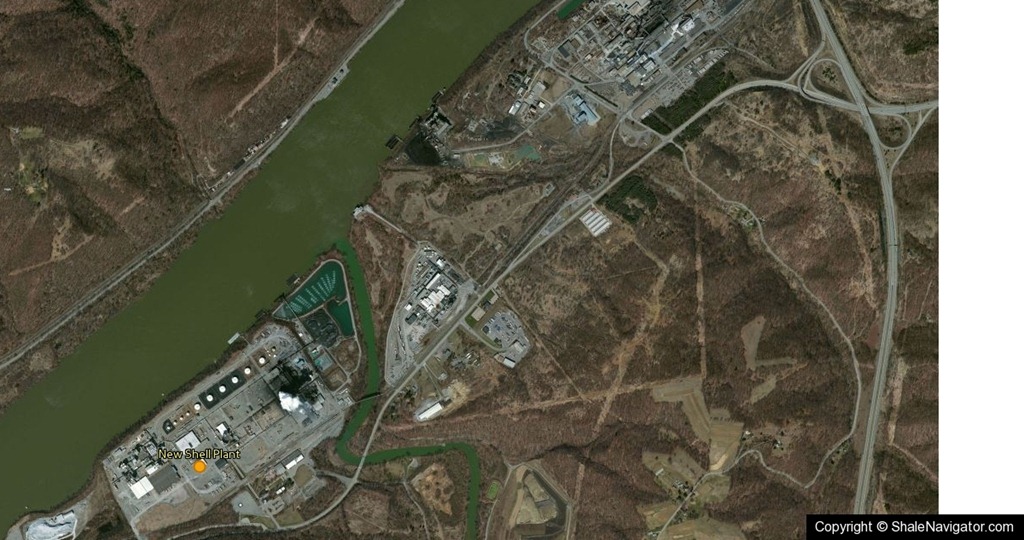 It certainly has been an eventful week. Two stories loomed large. The first was Shell’s announcement on Thursday that they have signed a letter of intent with Horsehead Corporation for a zinc processing plant location in Monaca, PA (Beaver County) as the location where they intend to build a multi-billion dollar ethane cracker plant (see this MDN story). See an aerial photograph of the plant location by clicking the image on the right (courtesy of ShaleNavigator).
Building a petrochemical plant of this size in the Appalachian region is an amazing benefit to the entire northeastern economy and will be for years to come. The only “downside” (if you can call it that) is that construction to build the plant is at least two years away. Still, this is a huge vote of confidence in the Marcellus and Utica Shale and it’s potential. As one commenter pointed out, Shell has run the numbers in their spreadsheets, basing their decision on economics—and their spreadsheets tell them the Marcellus and Utica are winners.
The other major news from this past week was that the Environmental Protection Agency (EPA) released the first round of water test results from their own testing in Dimock, PA and has found the water is safe to drink (see this MDN story). The families suing Cabot Oil & Gas hoping for a big payday are not happy with the EPA results. MDN wondered where Josh Fox and his banjo, and Mark Ruffalo and his “spotless mind” were? They were no place to be found around Dimock—but then Dimock was always just a stage prop for them anyway—a way to gain yet another 15 minutes of national attention.
The EPA test results are not yet all done, but this first round certainly seems to indicate the EPA will perhaps finally butt out of Dimock.
The Dimock situation fosters this week’s poll question: Were you surprised that the EPA found no water problems in Dimock? Not, “Were you happy?” or “Were you distressed?” But, did it surprise you? It would be a surprise if you expected the EPA to find water problems. MDN is interested in knowing what your expectations were with EPA’s testing.
Head on over to the right side of any page and register your vote.
 Last Week’s Poll Results
Last week MDN asked your opinion on whether or not plans like that being promoted by Gov. John Kasich in Ohio to “spread the wealth” by taxing drilling (one group) to give it to another group via lower taxes, is a good idea. The majority said no, it’s not a good idea.
Is it OK to tax shale drilling and share the proceeds with all citizens via an income tax cut?
No (52%, 135 Votes)
Yes (40%, 105 Votes)
Not sure (8%, 22 Votes)
Total Voters: 262
Coming This Week – MDN’s First Paid Publication
MDN editor Jim Willis is super excited to announce MDN’s first paid publication will become available this week. It’s called “Marcellus and Utica Shale Databook 2012.” The Databook is a 116-page comprehensive guide to drilling in the Marcellus and Utica Shale. Chock full of maps showing where permits have been issued, including details on drillers, pipelines and regulations, I believe you will find this new publication indispensable if you have an interest in shale drilling in the Marcellus and Utica. Watch the MDN site this week for a special announcement!
Below are the most recent “top 5” lists and the calendar of Marcellus-related events for the next two weeks.
Happy reading,
Jim Willis, Editor
Read More “MDN Weekly Update – Mar 18, 2012: Shell Cracker, Dimock Water”
 Stop Press: Shell Chemical has selected a location in Beaver County, Pennsylvania to potentially build an ethane cracker plant. Shell announced yesterday afternoon that the company has signed a land option agreement with Horsehead Corporation to “evaluate a site” near Monaca, PA, which is about 35 miles northwest of Pittsburgh, along the Ohio River (see the inset map). The site is about 15 miles from the borders of both West Virginia and Ohio, so Shell chose a location about as close to the tri-state border as it could get.
This is headliner news because the facility itself will mean at least $2 billion of investment to build, creating some 10,000 jobs both to build it and to operate it after it’s built. One of the components of “wet gas” or natural gas liquids found more often in western Pennsylvania and eastern Ohio is ethane. An ethane cracker plant chemically “cracks” the ethane into ethylene, which is a raw material used to make plastics and other materials. With an abundant supply of wet Marcellus and Utica Shale gas, the plant will have plenty of cheap ethane to crack.
Once the plant is built, other businesses that use cheap ethylene to manufacture plastics will also locate in the vicinity of the plant. The multiplier effect will be huge in the entire region—some estimates are as high as $15-$20 billion of new economic activity could come as a result of the plant.
All three states lobbied Shell heavily, offering various incentives to locate the plant in their state. A few weeks ago, MDN readers and MDN editor Jim Willis had some fun predicting where the plant may go. Jim was wrong! He predicted it would be built in West Virginia’s panhandle for a variety of reasons (see this MDN story). However, MDN readers guessed correctly. In a poll taken Feb. 12-18, 42 percent of MDN readers said the plant would be built in PA, 31 percent said OH and 27 percent said WV. Kudos to MDN’s readers!
Read More “Shell Announces Location of Ethane Cracker Plant”
Water test results from the federal Environmental Protection Agency confirm what the Pennsylvania Department of Environment Protection has said all along: Well water in Dimock, PA has not been contaminated by hydraulic fracturing chemicals. The PA DEP investigated claims from some Dimock residents that their water had been contaminated by gas drilling done by Cabot Oil & Gas.
In 2010 the DEP found that Cabot’s drilling had led to methane (natural gas) migration into 19 area water wells—something that Cabot still disputes as the area has been known for decades to contain methane in its water supplies. Methane is harmless to drink, but it is an explosion hazard, so the DEP ordered Cabot to pay the affected homeowners twice the value of their property and install a methane filtration system on each home’s water supply (wells or springs). Eleven of the 19 families affected refused the settlement and decided instead to sue Cabot, holding out for a bigger pay day.
Read More “EPA’s Dimock, PA Water Test Results Show No Contamination”
If proposed new EPA air emissions regulations go into effect later this year as proposed, the number of wells drilled using hydraulic fracturing will drop by half, according to a study commissioned and just released by the American Petroleum Institute (a copy of the study is embedded below). The Obama administration has given lip service support for shale gas drilling, most notably in Obama’s recent State of the Union speech—but the administration’s actions don’t match their words.
According to the study, the new EPA regulations would result in an 11 percent drop in gas production, and a 37 percent drop in domestic oil production. The federal government will also receive $8.5 billion less in royalty payments from reduced drilling.
Read More “API Study: New EPA Emissions Rules Will Cut Drilling 52%”