
Yes! NEXUS Pipeline OK’d by FERC to Begin Service
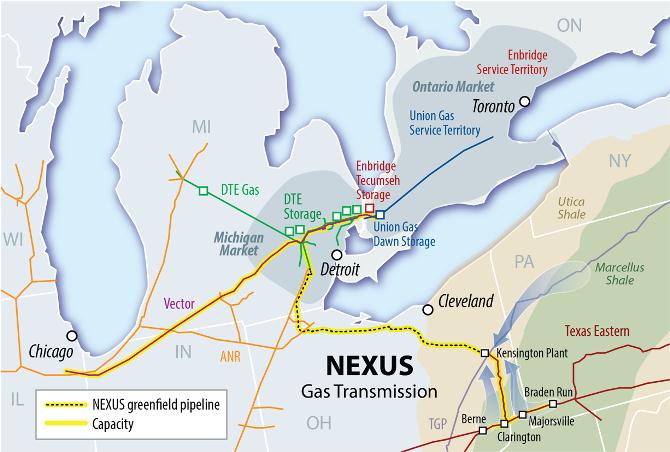
NEXUS, a $2 billion, 255-mile interstate pipeline that will run from Ohio through Michigan and eventually to the Dawn Hub in Ontario, Canada, was the first major pipeline project to gain Federal Energy Regulatory Commission (FERC) approval shortly after a quorum of voting members was reestablished in summer 2017 (see New FERC Quorum Votes Final Approval for NEXUS Pipeline). It didn’t take long for NEXUS partners DTE Energy and Enbridge to get it built. The pipeline has essentially been done since mid-September (about a year to construct), when they asked for permission to start up (see NEXUS Pipeline Asks FERC for Sept 28 Startup to Flow 967 MMcf/d). Yesterday FERC granted that permission.
Read More “Yes! NEXUS Pipeline OK’d by FERC to Begin Service”
 In March 2016, MDN brought you news that Primus Green Energy, a gas-to-liquids (GTL) technology company, planned to build a 160 metric tons per day (MT/day) methanol plant at “a manufacturing site in the Marcellus shale region” in 2017 (see
  Earlier this week the Franklin County (VA) Planning Commission voted 5-0 to allow Roanoke Gas Co. to build and operate a “gate station”–a connection to the under-construction Mountain Valley Pipeline (MVP). Roanoke Gas is laying new pipelines in the area and needs natgas to feed its new customers. Antis showed up at the meeting (what’s new?) to complain and threaten and moan and whine. They actually tried to say there is no “public benefit” for MVP, and that this gate station is simply a ruse to give the appearance of a public benefit.
 In June we told you about a plan by MidWest utility company Vectren to build a 900-megawatt natural gas-fired power plant (and a 50-acre solar farm) to replace a retiring coal plant, in Warrick County, Indiana (see
  The expert analysts at RBN Energy have just published their “fourth and final” in a series of posts looking in detail at E&Ps (exploration & production companies, or “drillers”). One of the groups of E&Ps they examine are “gas-weighted” E&Ps–or drillers who mostly extract natural gas. In looking through the list, you immediately realize every one of them has operations in the Marcellus and/or Utica Shale region. Yes, a few also have operations in other plays, but they all have at least some operations here. The real value in the article is an accompanying spreadsheet comparing various financial metrics (apples to apples)–things like total revenue, lifting costs, production costs, and “pre-tax income,” meaning profitability. How do our drillers compare with each other?
 On numerous occasions we’ve pointed out the lunacy of the “keep it in the ground” gang–those who believe we should end the use of all fossil fuels as soon as possible. Why can’t we do it? For many reasons. Here’s just one: petrochemicals. Did you know that all sorts of products you use every day–things like plastics, fertilizers, packaging, clothing, digital devices, medical equipment, detergents and tires–come from oil and gas? Without oil and gas, we’d quickly descend back into the Stone Age, living short, brutish lives. That point was driven home in a new report titled “The Future of Petrochemicals” (full copy below), part of an International Energy Agency (IEA) series that shines a light on “blind spots” in the global energy system.
 The “best of the rest”–stories that caught MDN’s eye that you may be interested in reading: Utica Summit hears update on $6 billion Shell project; Canada pipeline blast risks Washington natural gas shortage; Hello, Michael: Beware the resiliency of the U.S. oil and gas system; Prices soar as natural gas inventories hit decade low; Exxon puts $1 million into quest for carbon tax and rebate; Tokyo Gas looking away from US LNG; AMLO’s fracking stance seen as bad news for meeting natural gas needs; Shell CEO makes case for natural gas, promises company not going ‘soft’ on fossil fuels.