
Dominion Asks FERC to Allow Feed Gas for Testing at Cove Point LNG
 Fantastic news to report! Dominion has asked the Federal Energy Regulatory Commission (FERC) for permission to begin flowing feed gas (for testing purposes) to parts of the Cove Point LNG export facility. We are now getting close to startup at the facility, which is supposed to go online in the fourth quarter of this year. Cove Point sits along the coast of Maryland. Dominion began work on the $3.5 billion plant in 2015. When complete, the plant will liquefy and export 1.8 billion cubic feet per day (Bcf/d) of Marcellus/Utica Shale gas to India and Japan. Currently there is only one export facility in the U.S. in operation, along the coast of Louisiana (Cheniere Energy’s Sabine Pass). That one facility has fundamentally changed the economics of LNG (liquefied natural gas) here at home and around the world. Just imagine what another 1.8 Bcf/d will do! And it’s ALL from our region. Here’s more about the good news that Cove Point is ready to begin testing…
Read More “Dominion Asks FERC to Allow Feed Gas for Testing at Cove Point LNG”
 Dominion Energy released its second quarter 2017 update and held a conference call yesterday to discuss those results. Dominion is a huge producer and transporter of energy with its fingers in a lot pies. Dominion produces 26,200 megawatts of electricity, owns 15,000 miles of natural gas transmission, gathering and storage pipelines, and owns 6,600 miles of electric transmission lines. Dominion operates one of the nation’s largest natural gas storage systems with 1 trillion cubic feet of storage capacity. They also are a local utility company, serving more than 6 million customers. Yeah, big company, big deal. However, our interest in Dominion is fairly narrow: They are building an LNG (liquefied natural gas) export facility along the shoreline of Maryland. The Cove Point LNG facility will export 1.8 billion cubic feet per day (Bcf/d) of Marcellus/Utica Shale gas–to India and Japan. On yesterday’s call, Dominion CEO Tom Farrell said Cove Point is “95% done” and “remains on-time and on-budget” to begin operations by the end of this year. That’s great news! The other thing we closely watch with Dominion is the $5 billion, 594-mile Atlantic Coast Pipeline (ACP)–a natural gas pipeline that will stretch from West Virginia through Virginia and into North Carolina. With respect to ACP, Farrell said they’ve already purchased 84% of the materials needed for the project and that it remains “on-track to start construction later this year.” Farrell said the pipeline should be done in the “second half of 2019.” More good news! Here’s the latest from energy giant Dominion Energy…
 The radicals at the Sierra Club are taking another run at stopping Dominion’s Atlantic Coast Pipeline (ACP) project in its tracks–before the first inch of pipe is laid. ACP is a $5 billion, 594-mile natural gas pipeline that will stretch from West Virginia through Virginia and into North Carolina. This time Sierra Club nutters are using a novel approach to try and stop ACP. They’ve asked North Carolina regulators to revoke approval of affiliate agreements by Duke Energy to use the gas that will flow through the pipeline. The Sierra Club’s argument is that the agreements, signed in 2014, are no longer valid. Duke doesn’t need as much natural gas (for electric generation) as they thought they would. And therefore to stay locked into the agreement would be an unfair burden to Duke’s rate payers. If Duke were to pull out of the deals, the ACP project would collapse, which is what Sierra Club happens. Duke has responded that the gas will be used for more than electric generation. Given that NC now has a Dem governor who doesn’t like fracking (see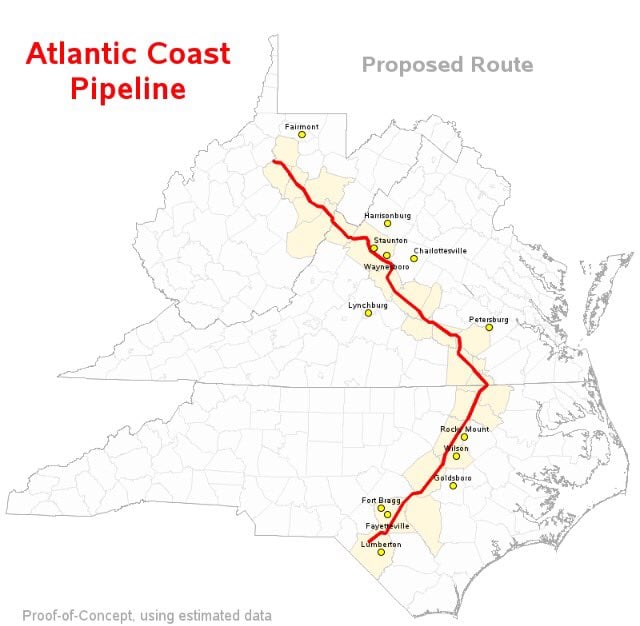
 A very small group of anti-fossil fuelers recently gathered in Samson County, NC to spread lies about the Dominion’s Atlantic Coast Pipeline (ACP) project. ACP is a $5 billion, 594-mile natural gas pipeline that will stretch from West Virginia through Virginia and into North Carolina, bringing Marcellus and Utica Shale gas to the south. The meeting, which local media said had “more than 20” people in attendance, seemed to be mostly representatives from outside Big Green groups pedaling the same tired old lies about pipelines in general, and ACP in particular. Try as they might to spin the meeting as some sort of “movement” among the little guy, the picture accompanying the Dunn (NC) Daily Record can’t cover up the fact there were perhaps a dozen people in the audience–and it looked pathetic…
 In April MDN told you that the Virginia Dept. of Environmental Quality (DEQ) had succumbed to political pressure from the MANY lib Dems in the state that oppose benign pipeline projects, like the Atlantic Coast Pipeline (ACP) and Mountain Valley Pipeline (MVP), and changed their minds about the process they will use in issuing water quality certifications under Section 401 of the federal Clean Water Act (see
  In October 2016, Dominion announced a new pipeline project called Eastern Market Access Project (see
  A lot of communication (letters, phone calls, meetings) fly back and forth between a midstream (pipeline) company and regulatory agencies when an application is filed for a project. Particularly a project like the Dominion’s Atlantic Coast Pipeline, $5 billion, 594-mile natural gas pipeline that will stretch from West Virginia through Virginia and into North Carolina. Companies like Dominion send letters, make phone calls and meet with federal and state regulators, attempting to anticipate and answer questions and concerns. It’s a natural part of the process. So we found it interesting, indeed strange, that the Virginia Secretary of Natural Resources, Molly Ward, sent a letter to Dominion back in April (just now coming to light) in which she tells Dominion to back off and that people in the agencies that work for her “will not base their decisions on requests or suggestions from an applicant.” The Roanoke Times, “reporting” on the letter, opens their article with this sentence: “Attempts by Dominion Energy to sway regulators in the Atlantic Coast Pipeline permitting process prompted a top official under Gov. Terry McAuliffe to notify the utility that state agencies would not heed those efforts.” So now, when a company attempts to provide information, perhaps anticipating issues and concerns for regulators, and reaches out to contact them proactively, that’s called an attempt at “swaying” and is somehow nefarious and underhanded. Should Dominion contact regulators to ask them to NOT approve the project? Ridiculous! Of course Dominion is going to try and convince regulators that the project is worthy/sound/needed/safe/etc. That’s their job! Why would Ward not want her people to hear directly from Dominion? Her people hear plenty from the other side, anti-fossil fuel nutters opposed to the project…
 It takes a lot longer these days to get a big pipeline approved than it used to. In April 2014, Dominion promoted an open season for what would later become the $5 billion, 594-mile Atlantic Coast Pipeline–a natural gas pipeline that will stretch from West Virginia through Virginia and into North Carolina. By September 2014, Dominion said they had enough commitment to move forward with the project (see
  In June 2014, MDN told you about the Dominion New Market Project–a project that will build two new compressor plants and upgrade one other compressor station in upstate New York–to help flow more abundant, cheap and clean-burning Marcellus Shale gas from Pennsylvania (and beyond) into the northeast (see
  Will Virginia in the south become what New York is in the north: a block to Marcellus/Utica gas leaving the region? Perhaps. At least, that’s what radical environmentalists are hoping is what happens. On June 13 Virginia will hold a primary. We recently wrote about its importance (see
  Election matters, and elections for governor really matter–at least with respect to shale drilling and pipelines. Here in New York State, where MDN is written, we are ruled by a corrupt autocrat by the name of Andrew Cuomo. Single-handed Cuomo has decided to ban fracking and block new shale gas pipelines (see
  Leftist anti-fossil fuelers are only too happy to poll anything and everything–except for what really matters. How do the VOTERS in Virginia, West Virginia and North Carolina feel about the Atlantic Coast Pipeline (ACP)? ACP is Dominion Energy’s $5 billion, 594-mile natural gas pipeline that will stretch from West Virginia through Virginia and into North Carolina. The Consumer Energy Alliance (CEA), the “voice of the energy consumer,” set out to answer the question: How do voters feel about ACP? In a poll commissioned by ACP, a majority of voters in all three states support the project–by an overwhelming majority. ACP hired Hickman Analytics Inc., a “Democratic-leaning,” Maryland-based firm to do the polling. Harrison Hickman, founder of the firm, said, “By any measure, whether it’s a policy matter or a voting matter, the pipeline has widespread support.” That’s something you won’t read in most news outlets. Here’s the results of the poll…
  Atlantic Coast Pipeline (ACP), Dominion Energy’s $5 billion, 594-mile natural gas pipeline that will stretch from West Virginia through Virginia and into North Carolina, has begun an outreach program with Local Emergency Planning Committees in several West Virginia counties. The pipeline is not yet fully approved by the Federal Energy Regulatory Commission (FERC). Dominion expects that approval sometime this fall (see