
PennEast Celebrates Lawsuit Dismissal, Takes Swipe @ Riverkeeper
 As we reported yesterday, a federal judge dismissed a lawsuit filed a year ago by THE Delaware Riverkeeper against the Federal Energy Regulatory Commission (see Fed Judge Dismisses Dela. Riverkeeper Lawsuit Against FERC). The lawsuit aimed to shut down the entire agency by defunding it (see THE Delaware Riverkeeper Sues FERC, Tries to Close it Down). The lawsuit claimed FERC can’t objectively make decisions about projects like the Penn East Pipeline (running from the Wilkes-Barre area to New Jersey) because FERC derives some of its operating revenue from the projects it either approves or does not approve. In other words, Delaware Riverkeeper tried to shut down a national agency because they object to a single pipeline project. Liberal U.S. District Justice Tanya Chutkan found Riverkeeper’s arguments lacking, to say the least. It took a day, but PennEast released their own statement about Riverkeeper’s lawsuit going down in flames. It is an interesting response from PennEast and continues a trend in what we’ve previously noticed: PennEast has (finally) taken the gloves off and is pushing back hard against enviro-jihadists like Riverkeeper…
Read More “PennEast Celebrates Lawsuit Dismissal, Takes Swipe @ Riverkeeper”
 Ryan Regec owns 78 acres in Schuylkill County, PA (eastern part of the state). He plans to subdivide the property into smaller properties and sell the building lots–but the Atlantic Sunrise Pipeline is coming through a portion of the property, and Mr. Regec says that means he can’t subdivide and sell it the way he planned. Regec has, in the past, allowed surveyors from Atlantic Sunrise on his property–but recently has refused. Atlantic Sunrise (i.e. Williams) took him to court to force access to complete their surveys, and Williams just won. A judge for the U.S. Middle District Court in PA issued an order allowing Atlantic Sunrise access. A spokesman for the pipeline says the pipeline will only cut through a small portion of Mr. Regec’s 78 acres. Regec claims his subdivision plans will be destroyed. Who’s right?…
 Last year an elaborate midstream drama unfolded before our very eyes. Energy Transfer Equity (ETE) pushed and prodded and poked and cajoled and insisted, and finally with the help of an inside corporate raider, forced Williams to agree to a buyout/merger (see

 New Jersey’s reliably lefty Democrat U.S. Senators, Cory Booker and Robert Menendez, played to their fringe, unhinged base of eco-nut supporters by sending a letter to the Federal Energy Regulatory Commission claiming the PennEast Pipeline project, due to run through a small portion of NJ, “may” cause problems with arsenic–as in releasing the toxic substance into drinking water supplies from digging trenches and erosion. It is a flat out, bogus, BS claim–and they know it. But they were put up to the letter-writing task by some of their Big Green donors, including ReThink Energy NJ and New Jersey Conservation Foundation. It’s nothing new that campaign contributions (i.e. bribes) buy you access. PennEast has responded that the issue has already been addressed in their application with FERC–there is a plan to monitor and protect against any potential disturbance of the ground that would cause arsenic levels to increase. That’s what responsible adults do. They respond in an adult-like, responsible manner. Unlike the other side…
 In June 2014, MDN told you about the Dominion New Market Project–a project that will build two new compressor plants and upgrade one other compressor station in upstate New York–to help flow more abundant, cheap and clean-burning Marcellus Shale gas from Pennsylvania (and beyond) into the northeast (see
  We are super excited to bring you an exclusive report that has just been released by MDN subscriber
  Oilfield services company (OFS) Mammoth Energy Services, headquartered in Oklahoma City, OK, operates in both the Utica Shale and Permian Basin. Mammoth offers services like “completion and production services, natural sand proppant services, contract land and directional drilling services and remote accommodation services.” Mammoth is a baby company, formed in 2014, but growing rapidly. The company booked $243 million in revenue for the 12 months ended June 30, 2016 (see
  TransCanada, one of Canada’s leading midstream/pipeline companies, cooked up a deal last year to pipe natural gas from Canada’s West Coast to the East Coast in order to fend off cheap supplies of Marcellus/Utica gas that will flow into Canada when/if the NEXUS and Rover pipelines get built (see
  A disappointing setback for the much-needed Constitution Pipeline–a $683 million, 124-mile pipeline due to run from Susquehanna County, PA to Schoharie County, NY carrying Marcellus gas. As you may recall, in April 2016, New York’s anti-drilling governor, Andrew Cuomo, decided he would cave to pressure from radical environmentalists and block the building of the federally-approved Constitution Pipeline (see
  A somewhat misguided couple who own land in Harrison County, OH and object to Rover putting a pipeline through their land have decided to break the law. Contractors working for Energy Transfer to clear trees and dig a trench to lay pipeline across their land have been working on their land, on an off, for the past three weeks. Sheila Bittinger and her husband Stanley say they’ve had enough and the couple parked several vehicles across the entrance to their property to prevent any more work on the pipeline. It sounds as if they want to get arrested and that they know this particular bit of “civil disobedience” will result in absolutely nothing. But they’re doing it all the same. If you watch the video (below) you get the impression these are honest, country folks who feel like they’ve gotten a raw deal. We wonder if these landowners have been manipulated by slick lawyers who see a big payday coming from a lawsuit against Rover Pipeline…
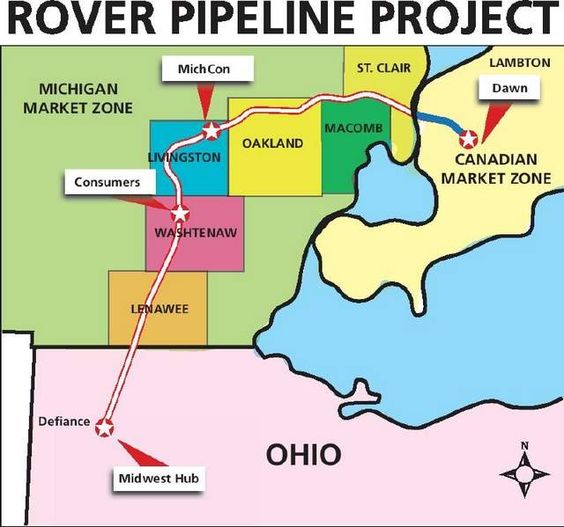
 A group of approximately 250 Ohio landowners, represented by an Ohio eminent domain law firm, is doing its best to stop Energy Transfer’s Rover Pipeline project dead in its tracks. Rover is playing beat the clock to finish tree clearing following a Federal Energy Regulatory Commission (FERC) final approval of the project on Feb. 3 (see
  On Feb. 3, the Federal Energy Regulatory Commission (FERC) approved a long-delayed project–National Fuel Gas Company’s (NFG) Northern Access 2016 pipeline project (see