
Accidents | Beaver County | Energy Companies | Industrywide Issues | Pennsylvania | Processing Plants | Shell
Fire at Shell PA Cracker Complex; COVID Cases Spike at Plant

Last Saturday a small fire occurred in a metal storage container at the Shell ethane cracker plant complex still under construction in Beaver County, PA. The on-site fire department quickly extinguished the blaze (no injuries). Also last week, Shell reported 61 new cases of COVID-19 among workers at the plant. Currently, 97 employees (out of 7,950, or 1.2%) have the virus. Some 238 site employees have recovered from COVID infection and returned to work since the beginning of the pandemic in March.
Read More “Fire at Shell PA Cracker Complex; COVID Cases Spike at Plant”

 Coincidentally, a second dehydration unit fire occurred early Saturday morning, also in Pennsylvania, but this second fire occurred across the state in southwest PA. Our lead story today is about a dehydration unit fire at a well pad in Lycoming County (see Two-Alarm Fire at Alta Resources Well Pad in Lycoming County, PA). The second fire happened at a dehydration unit at a compressor station in Greene County owned and operated by Equitrans Midstream.
 A few weeks ago Enbridge began testing its Weymouth, Massachusetts compressor station project, the final piece of the company’s $452 million Atlantic Bridge expansion project. As sometimes happens when you begin testing, there was a problem. A gasket failure led to an unplanned release of 265 Mcf of gas (see
  It could have been avoided. The Pennsylvania Dept. of Environmental Protection (DEP) has no one to blame but themselves for what happened at Marsh Creek Lake in Chester County, PA, when Energy Transfer (ET), drilling underground to install a pipeline for the Mariner East 2 project, experienced a drilling mud spill in August (see
  Sunoco Logistics Partners (i.e. Energy Transfer) was drilling horizontally underneath Snitz Creek in Lebanon County, PA for its Mariner East 2 Pipeline project when it experienced yet another “inadvertent return”–nontoxic drilling mud leaking out of a place where it shouldn’t. In 2018 the same thing happened and antis blew a gasket over a “spill” of five gallons (see
  Two weeks ago while drilling in Chester County in Marsh Creek State Park, Energy Transfer’s Mariner East (ME) 2X pipeline experienced an “inadvertent return”–nontoxic drilling mud coming up out of the ground where it’s not supposed to (see
  While drilling in Chester County earlier this week in the Marsh Creek State Park, Energy Transfer’s Mariner East 2X pipeline experienced an “inadvertent return”–nontoxic drilling mud coming up out of the ground where it’s not supposed to (see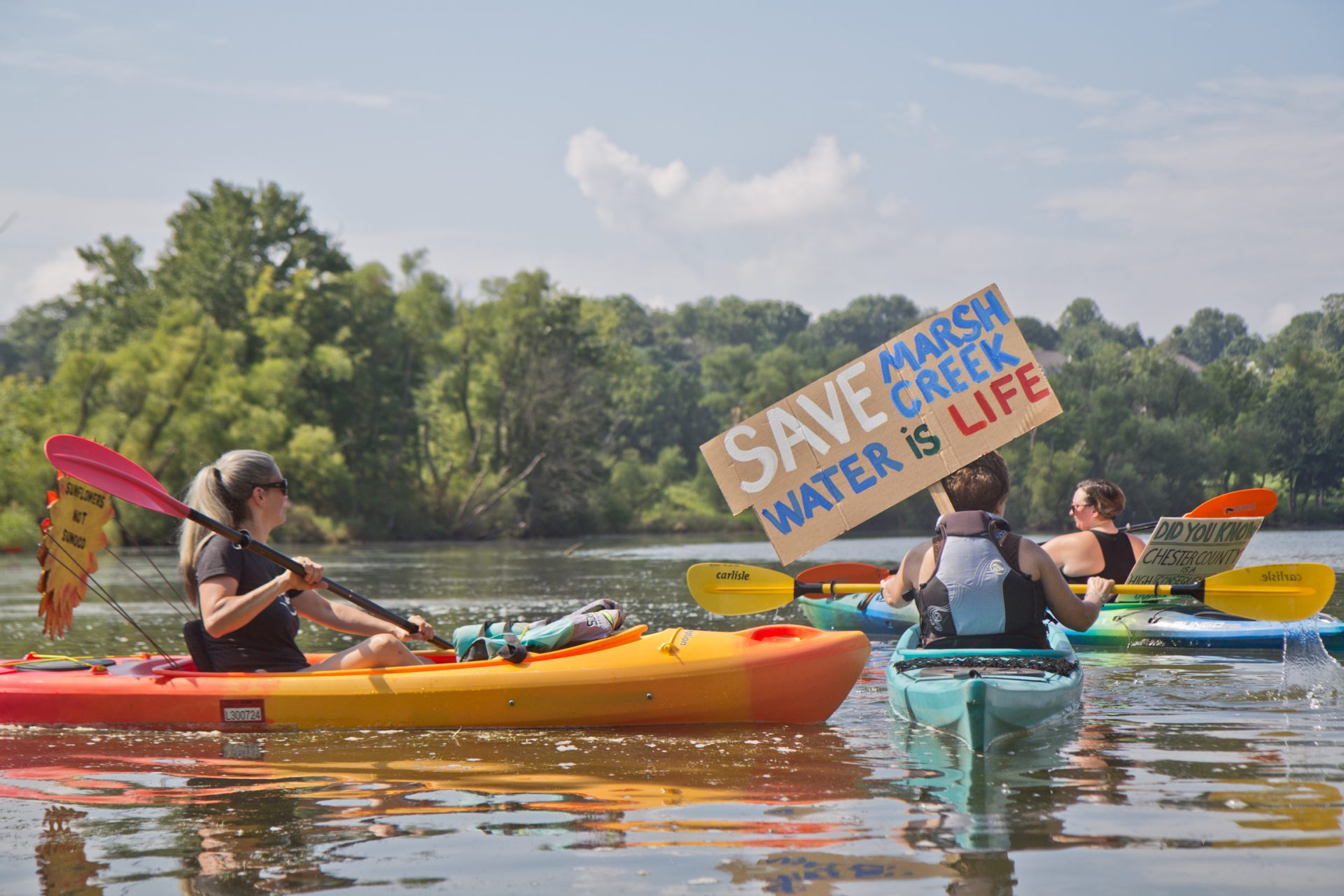
 Underground horizontal directional drilling (HDD) for the Mariner East 2 pipelines (two of them, 2 and 2X) have a history of springing leaks. They’re called “inadvertent returns”–when you drill horizontally underground for a pipeline and the drilling mud you put down the hole pops up in a place it’s not supposed to. The good news is that the drilling mud is non-toxic, the same stuff used in toothpaste. The bad news is that it can overwhelm little fishies and other aquatic life and kill (suffocate) them. ME2X drilling had another such incident earlier this week–in Chester County, PA.
 On August 1, 2019, Enbridge’s Texas Eastern Pipeline Company (TETCO) pipeline exploded in Lincoln County, Kentucky–killing one and sending six to the hospital (see
  On Friday the Pennsylvania Dept. of Environmental Protection (DEP) announced it has fined CNX Resources and its subsidiary CNX Midstream $310,000 for two incidents in which 65 barrels (2,730 gallons) of non-toxic brine (salty water) leaked into the ground and 43 gallons of non-toxic drilling mud leaked into a creek. The DEP says CNX did “not adequately maintain erosion and sedimentation best management practices.”