Homer City Gas Plant Workforce Jumps to 1,800, Headed for 2,000
 The hill above Homer City now has more people working on it than the borough below has living in it. Homer City Generation dropped a Labor Day announcement on Friday: more than 1,800 direct-hire tradespeople and skilled contractors are on site building the 4.4-gigawatt (GW) gas-fired plant and data center campus rising from the bones of what was once Pennsylvania’s largest coal-fired power station. The borough of Homer City has roughly 1,800 residents. That’s a nice bit of symmetry, and it says more about what this project means to Indiana County than any press release paragraph could. Read More “Homer City Gas Plant Workforce Jumps to 1,800, Headed for 2,000”
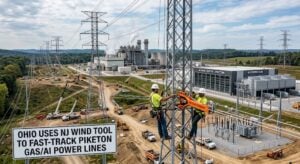 Ohio has asked PJM to dust off a rarely used piece of grid-planning machinery — a tool invented to string wires to offshore wind farms — and use it instead to speed up $4.2 billion in new high-voltage power lines to the 10-gigawatt SoftBank data center and gas plant complex at Piketon. We got our hands on the letter. It’s dated June 15, 2026, from PUCO Federal Energy Advocate Sarah J. Parrot to PJM President and CEO David E. Mills, and it’s been sitting quietly for nearly three months. It surfaced this week because PJM is briefing its Transmission Expansion Advisory Committee (TEAC) on the request today, Sept. 8, to use the “state agreement approach.”
  Pennsylvania’s utility regulators just told the General Assembly what Marcellus drillers have been saying for two years: the electricity business is about to get very busy, and natural gas is going to be the one doing the heavy lifting. On Tuesday, September 1, the Pennsylvania Public Utility Commission (PUC) released its annual Electric Power Outlook for Pennsylvania, this one covering 2025 through 2030. The report is required by state law — the PUC has to collect demand forecasts from the state’s 11 electric distribution companies (EDCs, the utilities that run the poles and wires to your house) and hand a summary to the Legislature and the Governor every September. Usually it’s a snoozer. Not this year.
 Anti-drilling group Protect PT has opened a new front against the biggest gas-fired AI project in Westmoreland County, Pennsylvania. On Aug. 25, Protect PT and two Upper Burrell residents — Allen Uhler and Guy Fuller — filed a land use appeal in Westmoreland County Court challenging the township supervisors’ approval of TECfusions’ work at the former Alcoa/Arconic research campus. Notably, the appeal doesn’t attack the gas turbines or the Marcellus wells feeding them. It attacks a piece of paper. Or rather, the absence of one.
  West Virginia State Treasurer Larry Pack released a report Tuesday that finally puts real numbers on a question a lot of Mountain State residents have been shouting past each other about: when a giant data center lands in your county, who actually gets the tax money? The answer, according to Treasury Strategic Analyst Mark Muchow, is that two projects alone — the Penzance Management campus in Berkeley County and Google’s project in Putnam County — would generate more than $103 million a year in property taxes, and roughly 62% of it stays home with county commissions and county school boards.
 A Chicago-based developer wants to build a pair of natural gas-fired power plants in a Wisconsin farm town of 1,650 people — and together they’d crank out enough electricity to light up two million homes. It’s another data center story, and it’s another reminder that the demand pull for our Marcellus and Utica gas keeps stretching farther west. Invenergy has submitted engineering plans to Wisconsin regulators for two gas-fired plants in Brillion, Calumet County, about 15 miles from Appleton. The 750-megawatt (MW) Union Depot Energy Center would run around the clock. The 1.2-gigawatt (GW) Forest Junction Energy Center would be a “peaker” — a plant that fires up only when the grid is straining. Combined output: 1.95 GW. If built, Forest Junction would be the second-largest gas plant in Wisconsin.
 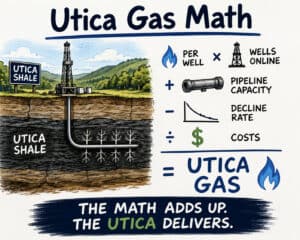 A pile of poster boards in a YMCA gymnasium is not usually where you find the most important number in a $33 billion project. But on Aug. 27, at the Pike County YMCA in Waverly, Ohio, an SB Energy executive told a Columbus Dispatch reporter something that ought to get every Utica producer’s attention: the turbines are already bought. Not ordered. Not “in negotiations.” Bought — for the first phase of what will be the largest gas-fired power plant in American history.
 Nineteen months after TECfusions bought the old Alcoa research campus in Upper Burrell (Westmoreland County), PA, and promised to build 3 gigawatts of gas-fired AI computing capacity, the company announced yesterday that the site is live and delivering GPU capacity to a paying customer. It’s a small first bite of a very large apple—but it’s real, it’s running on gas turbines today, and it sits on top of Marcellus wells the company already owns.
  Back in June, we praised South Strabane Township in Washington County, PA, for doing the hard, unglamorous work of writing data center rules instead of slamming the door shut (see
  A second poll of Pennsylvania voters on data centers landed this week, and the headlines say what you’d expect: six in ten are opposed. Dig into the crosstabs — the detailed tables showing how each group answered — and you find something the coverage skipped entirely. A majority of Pennsylvania Republicans support building data centers. Fifty-one percent for, 42% against (take note, Stacy Garrity). The Philadelphia Inquirer, teaming up with the New York Times and Siena University, surveyed 760 likely Pennsylvania voters from August 17-21. The topline: 62% oppose the construction of AI data centers, 33% support them.