
WV Rolls Out Data Center Welcome Mat as PA Slams the Door
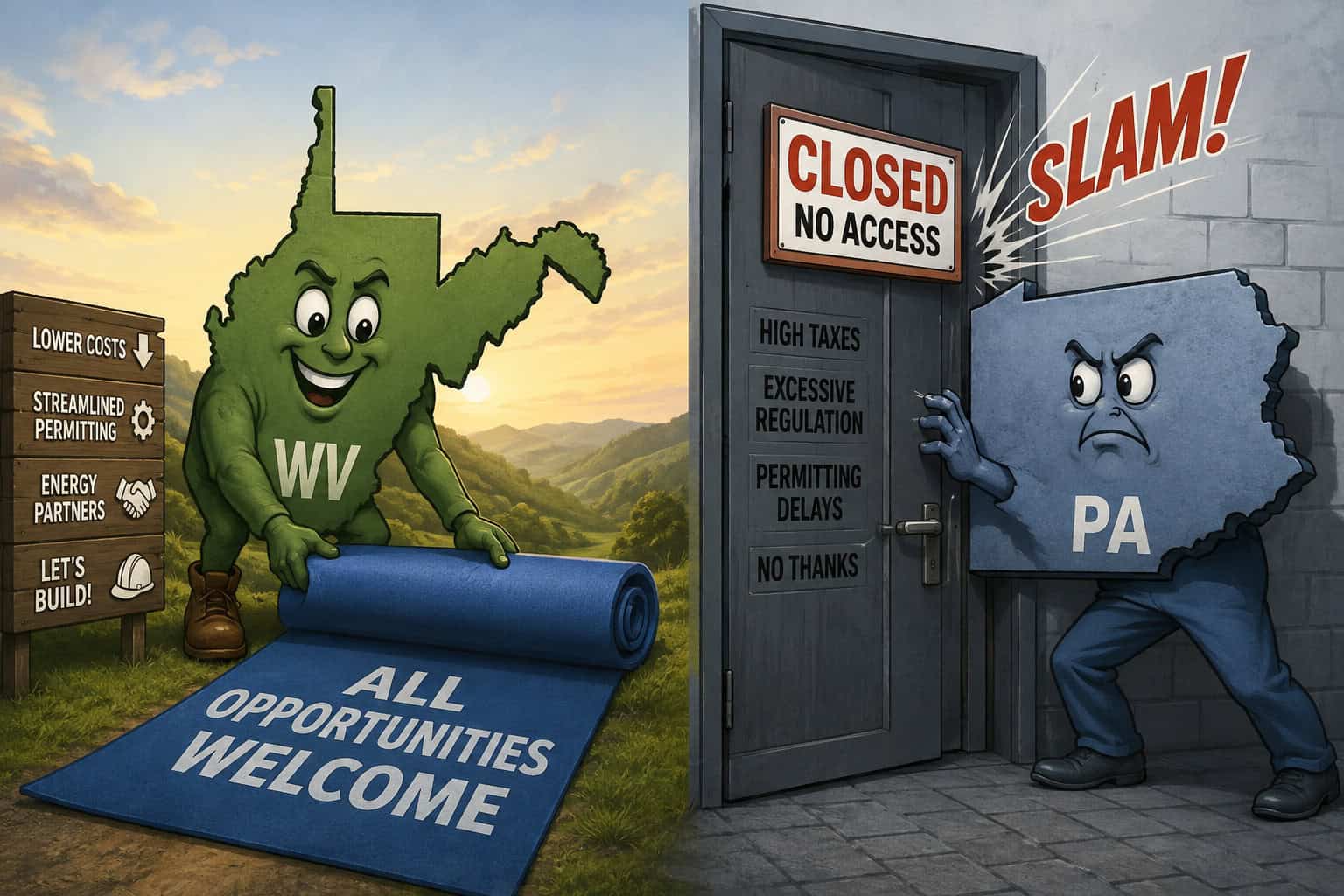 Yesterday we told you how PA Gov. Josh Shapiro’s Executive Order 2026-05 handed every township supervisor a kill switch and wrote natural gas out of the “clean firm energy” column (see Shapiro EO Slams Brakes on PA Data Centers, Gas Plants Too). Now look two states south. On Aug. 11, WV Gov. Pat Morrisey stood at a Charleston podium reading “STANDING ON PRINCIPLES,” flanked by Senate President Randy Smith and House Speaker Roger Hanshaw, and rolled out the West Virginia Responsible Data Center Development Plan — a 20-year framework built to attract hyperscale data centers, not repel them. Same gas underneath. Opposite answers. Read More “WV Rolls Out Data Center Welcome Mat as PA Slams the Door”
 Gov. Josh Shapiro signed Executive Order 2026-05 on Tuesday, imposing what he called “the strictest guardrails in the nation” on AI data centers — and, we’d argue, on the gas-fired power plants that will run them. Two western PA projects lost fast-track permitting status the same day. But the real damage is buried in a 33-page model consent order that got almost no attention. We don’t think it’s unfair or hyperbole to say Shapiro just destroyed the AI data center industry in the Keystone State.
  It’s official. In June, we told you OpenAI was in “advanced negotiations” to lease the gargantuan 10-gigawatt (GW) data center campus rising on federal land in Piketon (Pike County), Ohio (see
  Back in March, we brought you news that the Trump administration had announced “South Mon,” a $17 billion, 4.3-gigawatt (GW) natural gas-fired power hub headed for southwestern Pennsylvania, funded as part of Japan’s $550 billion U.S. investment commitment (see
 A unanimous Ohio Supreme Court has ordered the tiny Pickaway County village of Ashville to let voters decide the fate of a data center and natural gas power plant — a project the village council tried to fast-track by declaring it an “emergency” not subject to a public vote. The court didn’t buy it. But before opponents celebrate too hard, the ruling doesn’t guarantee a vote will actually happen this November — county election officials still get to decide whether the deal is even the kind of thing voters can weigh in on at all.
  PJM Interconnection and Dominion Energy are reviewing a July 22 event in Northern Virginia in which roughly 3,800 megawatts (MW) of data center load — the largest such disconnection in PJM’s history — unexpectedly ripped itself off the grid after a routine, correctly cleared transmission fault, forcing PJM operators to scramble to keep the grid stable. The event has reignited a fight over whether data centers, which are growing explosively across the PJM footprint (including Marcellus/Utica territory), need to be held to new “ride through” standards so they stop treating minor grid hiccups like five-alarm fires.
  Pennsylvania got off easy in the 2026-27 budget. Only one data center bill made it into law, and it was a toothless one. But the Pittsburgh Business Times reports Harrisburg is loading up for another round this fall — and this time the antis have a working blueprint to copy. It’s called New York, where Gov. Kathy Hochul banned new hyperscale data centers last month, and where the anti-fracking crowd has already spent a decade proving what happens when a state tells industry to go away.
  Babcock & Wilcox — the 159-year-old boiler maker headquartered in Akron, Ohio — announced yesterday that it signed an agreement with Siemens Energy to start work on 20 steam turbine generator sets totaling 1 gigawatt (GW) of capacity for gas-fired data center projects. Here’s the part that caught our eye: B&W hasn’t announced signed customers for all of them. The company is buying the factory slots first and lining up buyers second. That’s a real bet on gas-fired power demand — and it’s being made by a company sitting right on top of the Utica.
  A Nasdaq-listed company you’ve almost certainly never heard of says it has signed a binding term sheet to buy roughly 1,800 acres of unleased Marcellus mineral rights in “northern Pennsylvania,” drill a dozen wells on it, burn the gas in on-site turbines, and run a 200-megawatt AI data center behind the meter — with a stretch goal of 1 gigawatt. The company, Alpha Compute Corp. (Nasdaq: ALP), never says which county. We think we’ve figured it out: Tioga County. Here’s what’s actually known, what we deduced, and what nobody should be printing as fact yet.
  Rochester, NY-based Energy Concepts has unveiled a modular natural gas power system called “Plato5X” that lets AI data centers generate their own electricity, make their own water, cool themselves, and capture 90% of their carbon emissions — without touching the local power grid or municipal water supply. Each 5-megawatt module runs on natural gas and is aimed squarely at the exploding AI/data center market, which is straining power grids and water systems across the country (
 Quinnipiac University released a new poll of Pennsylvania registered voters on July 15, and one question in it should worry everyone who makes a living from Marcellus gas. Asked whether they would support or oppose building an AI data center in their community, 74% of Pennsylvania voters said “oppose,” 16% said “support,” and 10% offered no opinion. That’s a jump from Quinnipiac’s February 25 poll, when the split was 68% opposed and 20% in favor. The opposition is bipartisan — 64% of Republicans, 82% of Democrats, and 77% of independents all said no thanks. Three-quarters of voters (76%) say they’re following data center news either very closely (26%) or somewhat closely (50%). And Gov. Josh Shapiro isn’t getting credit either: just 24% approve of how he’s handling data centers in Pennsylvania, while 34% disapprove and a whopping 42% have no opinion. The survey polled 895 registered voters July 9-13, with a margin of error of +/- 4.3 percentage points.
  On July 30, French environmental services giant Veolia announced it had been picked by “a major project developer” to operate and maintain a 350-megawatt (MW) microgrid that will power an artificial intelligence data center campus in Ohio. The press release carried a New Albany, Ohio dateline. It’s a genuinely big deal — a behind-the-meter power plant that will supply 100% of a data center campus without leaning on the grid at all. Here’s the dots nobody else has connected. This is the same Veolia that Antero Resources and Antero Midstream spent six years suing over a botched frack wastewater plant in West Virginia. And Veolia announced this shiny new Ohio contract exactly six days after wiring Antero a check for $371 million. You can’t make this stuff up.