
Kindle Energy Breaks Ground on $1.2B WV Gas-Fired Power Plant
 How many times over the years have we reported on (and cheerleaded for) gas-fired power plants to get built in West Virginia? MANY times. Dozens, maybe hundreds of posts about this topic. Yet, in all the time we’ve been writing MDN (since January 2009), not a single, solitary *new* gas-fired power plant has been built in the Mountain State (although there are four existing, older gas-fired plants). Not one new plant! Until now. Kindle Energy yesterday announced it has broken ground at Wolf Summit Energy, a previously announced fully contracted, 600-megawatt greenfield combined-cycle gas turbine (CCGT) power generation facility in Harrison County, WV. Read More “Kindle Energy Breaks Ground on $1.2B WV Gas-Fired Power Plant”
 PowerTransitions, an independent power producer specializing in redeveloping legacy power facilities, has agreed to acquire five New York gas-fired power plants — Batavia, Hillburn, Massena, Shoemaker, and Sterling — totaling 323 megawatts (MW) from Alliance Energy Group affiliates. Terms of the deal were not disclosed. The deal marks PowerTransitions’ entry into the New York market, bringing its total portfolio to approximately 550 MW across seven stations spanning multiple NYISO zones. PowerTransitions says the acquired sites offer “brownfield redevelopment potential” for new power generation and battery storage. Frankly, this one is a head-scratcher for us.
  Here we go again with SSDD (same stuff, different day). We’re referring to the bullying talk coming from Pennsylvania Governor Josh Shapiro and his threats to pull the Keystone State out of the PJM grid, the largest electric grid in the U.S., covering all or parts of 13 states plus the D.C. swamp. Shapiro first made this same threat more than a year ago, in January 2025 (see
  On Monday, President Donald Trump invoked the Defense Production Act (DPA) to channel federal funding toward domestic energy projects, specifically targeting liquefied natural gas (LNG), petroleum, coal power, and grid infrastructure. Empowering the Energy Department to bypass regulatory and financial hurdles, the move aims to curb rising electricity and gasoline costs ahead of the midterm elections while meeting surging power demands from the AI industry.
  AI data centers are in the news every single day. We don’t think it’s melodramatic to say that AI is changing the world right now. We also believe it’s accurate to say that everyone (yes, you reading this) will use AI at some level (if you don’t already) within the next year or two. AI, or artificial intelligence, requires, in the aggregate, millions of computers. All of those computers need a place to live (i.e., data centers). And those data centers need electricity to run. Tapping into the local electric grid is not a good option because it takes the grid years to plan, build, and add new sources of power. “Hyperscalers” (massive cloud service providers like Amazon’s AWS, Microsoft’s Azure, or Google’s Cloud, offering scalable, on-demand computing, storage, and networking resources) need to build data centers to house the computers that power AI today. Not years from now. This is a conundrum. A Pittsburgh battery company has partnered with a Houston, Texas, turbine maker to provide a natural gas-based solution ready in months, not years.
 In March, South Carolina regulators approved Duke Energy’s proposal to build a 1.4-gigawatt (GW) natural gas-fired power plant in Anderson County, marking the utility’s first new generation project in the state in a decade (see
  Despite being the nation’s leading electricity exporter and a top producer of natural gas, nuclear power, and coal, Pennsylvania residents pay significantly more for electricity — 45% more per kilowatt-hour than in 2018. Why? Sleazy politicians blame “greedy” utility companies and AI data centers, even though the rise in electric prices predates the current data center boom. If you dig just a little, you will find the real answer: it’s due to the policies put in place by the same sleazy (Democrat) politicians who blame others.
  PJM Interconnection, the nation’s largest electric grid system serving 65 million people across 13 states and Washington, D.C., is pursuing an emergency plan to secure 15 gigawatts (GW) of new power supply to avert electricity shortages driven by surging data center demand tied to artificial intelligence (AI). The grid operator looks to pair proposed data centers with new generation through bilateral negotiations running from September to March 2027. Let’s make a deal!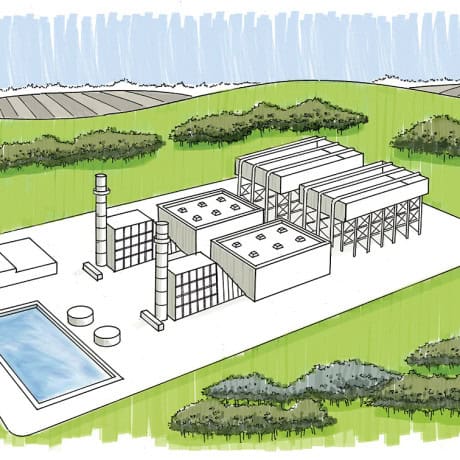
 Homer City Redevelopment, LLC has reached a significant milestone with the commencement of vertical construction, known as “first steel,” at the Homer City Energy Campus in Pennsylvania. Following extensive foundation work, the project has transitioned to above-ground construction, starting with the Gas Insulated Switchgear building. This facility is currently the largest natural gas-powered energy project under construction in the United States, replacing a decommissioned coal plant.
  CERAWeek 2026 was held in Houston, Texas, from March 23–27, 2026, focusing on “Convergence and Competition: Energy, Technology and Geopolitics”. The conference highlighted the accelerated pace of the “energy transition,” centering on energy security, skyrocketing AI power demand, infrastructure bottlenecks, and natural gas as a durable, competitive asset. In reviewing the reports published following CERAWeek, it’s obvious that natural gas was the belle of the ball.
  West Virginia Governor Patrick Morrisey is spearheading what he calls the “50 by 50” energy initiative, a plan for the state to grow its electric energy production from a current 16 gigawatts (GW) of generation to 50 GW by 2050 (see
  Last year, MDN warned readers that the newly elected, incoming governor of Virginia, Abigail Spanberger, is a radical left Democrat (see