
Anti-Drilling/Fossil Fuel | Electrical Generation | Indiana County | Industrywide Issues | Pennsylvania | Pipelines | Regulation
Anti-Fossil Fuelers Trash Talk Homer City Pipeline at DEP Hearing
 At a Pennsylvania DEP hearing in Indiana County, environmental extremists opposed a proposed 5.8-mile, 30-inch natural gas pipeline serving Homer City Redevelopment’s planned $10 billion, 4.5-GW gas-fired power plant and hyperscale data center campus. The pipeline would cross streams, wetlands, and floodways, potentially affecting Muddy Run, Blacklick Creek, and various tributaries. Reminding us of Chicken Little in The Sky is Falling, speakers warned of water pollution, setbacks to acid mine drainage restoration, drought-related water stress, and inadequate transparency around the fast-moving project. Read More “Anti-Fossil Fuelers Trash Talk Homer City Pipeline at DEP Hearing”
 The federal EPA has proposed new rules allowing gas-fired power plants, data centers, and factories to begin constructing non-polluting components like piping, wiring, and cement pads before receiving air emission permits. EPA Administrator Lee Zeldin stated that this aims to streamline critical infrastructure projects and advance technological development, particularly for AI. Critics, including Big Green lawyers, argue these changes undermine the Clean Air Act by making it harder for communities to “protect air quality.” More importantly, Big Green says it will make it harder for regulators to reject permits after significant investment has already been made. Well, duh! That’s the point.
  You have to hand it to Dominion Energy, the company has brass… courage. In June 2023, Dominion announced plans to build four small “peaker” electric generating plants in Chesterfield County near Richmond (see

 President Donald Trump’s proposal for a $33 billion, 9.2-gigawatt gas power plant in Ohio—funded by Japanese investment, including SoftBank—aims to address soaring energy demands from data centers (see
  Last Friday, TC Energy reported a robust first quarter in 2026, highlighted by a 14% increase in comparable EBITDA to $3.1 billion and record delivery volumes across its North American pipeline network. For the Marcellus and Utica shale region, the standout development is the newly announced $1.5 billion Appalachia Supply Project on the Columbia Gas system. Slated for 2030, this expansion will add 0.8 Bcf/d of takeaway capacity to meet surging electricity and data center demand. Appalachia is explicitly identified as a major contributor to the growth in U.S. natural gas production, and is expected to account for over 55% of the growth by 2035.
  In January, MDN reported that Fidelis New Energy and 8090 Industries together had launched a new company, American Intelligence & Power Corporation (AIPCorp), to develop the Monarch Compute Campus in Mason County, West Virginia (see
  Data centers are driving significant growth in natural gas demand in the Midwest, leading to several pipeline expansion projects. East Daley Analytics is tracking 24 GW of potential power generation capacity from Midwest data centers, which could create over 5 Bcf/d of new gas demand in a high-case scenario. The region’s appeal stems from ample land, water resources, and low-cost electricity, with Illinois and Wisconsin showing the largest potential growth (if the Democrat machine in those states doesn’t block it). To meet this demand, over 3.2 Bcf/d of pipeline expansions are planned for six different pipelines. While some of the pipelines flow molecules from other regions, they ALL flow at least some Marcellus/Utica molecules. We have the list of pipelines looking to expand below.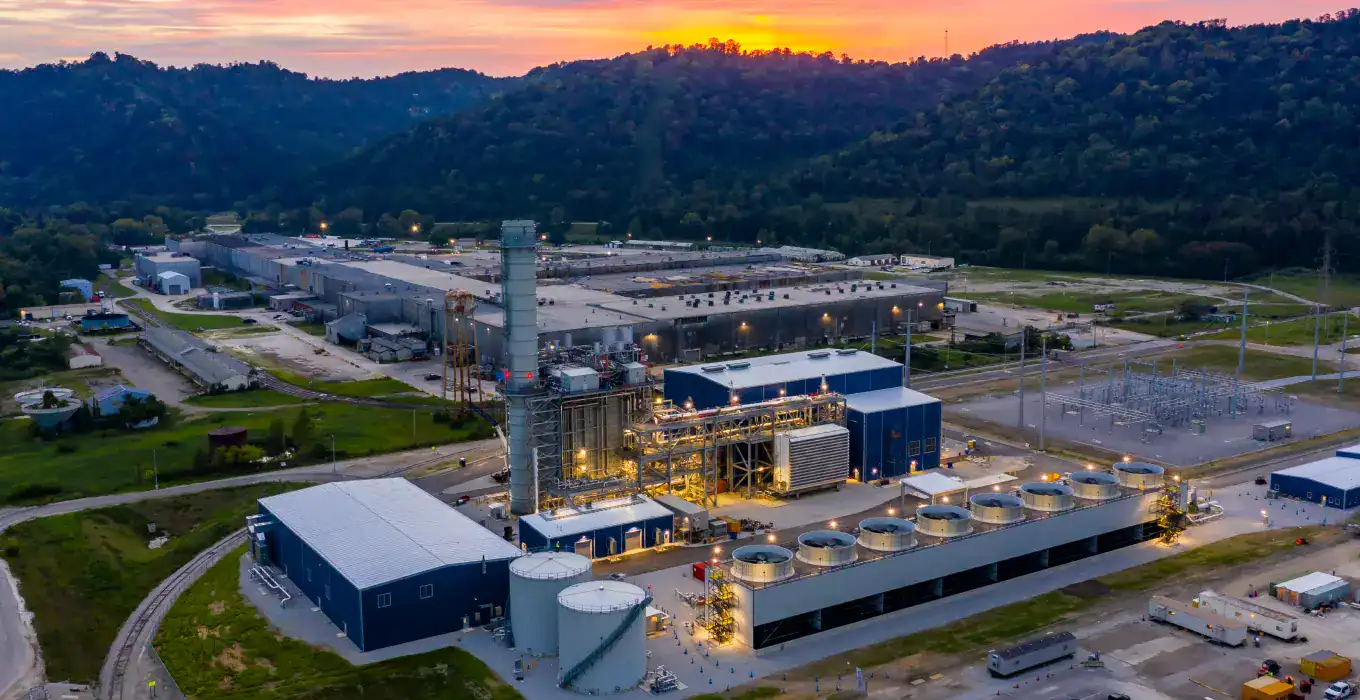
 New York’s electric grid faces its lowest reliability margins in recent history this summer, with only 417 MW available under baseline conditions, according to the New York Independent System Operator (NYISO). This critical situation stems from extreme weather, an aging generation fleet, and a lack of new dispatchable resources. NYISO’s annual Summer Reliability Assessment (copy below) says an extended heat wave of three days or more, with temperatures around 95 degrees, could result in a capacity deficit of -1,679 MW, increasing to -3,370 MW at 98 degrees, potentially leading to blackouts. NYISO can implement emergency measures like purchasing energy or voluntary curtailment to mitigate shortfalls, but the overall margin for error is extremely narrow.
  In March, Hull Street Energy (HSE) entered an agreement to acquire two peaking power plants from Rockland Capital, LP, significantly expanding its Milepost Power portfolio (see
  In February 2024, members of the South Carolina Public Service Commission approved a proposed project to build a 1,020-megawatt (MW) gas-fired power plant in the state’s Lowcountry, in Colleton County (see
  In March, the Trump administration announced “South Mon,” a $17 billion natural gas-fueled facility in southwestern Pennsylvania intended to expand domestic energy production (see
  The Pennsylvania Department of Environmental Protection (DEP) is seeking public comment on an Individual Stormwater Permit for a 5.8-mile natural gas pipeline in Indiana County. Serving the proposed Homer City Generation LP 4.5 GW power plant and data center, the 30-inch pipeline will traverse Black Lick, Burrell, and Center Townships, involving several stream and wetland crossings. The DEP will host a public hearing on May 12 from 5 to 7 PM at the Indiana Theater regarding Homer City Generation’s proposed 5.8-mile natural gas pipeline in Center Township. In response to this new project, local anti-fossil fuel groups are actively mobilizing. So-called “Concerned Residents of Western PA” (CROW) is holding a preparation meeting this afternoon to help “citizens” draft their public comments and build speaking confidence.