
Good News for Marcellus: New Brunswick Commits Fracking Suicide
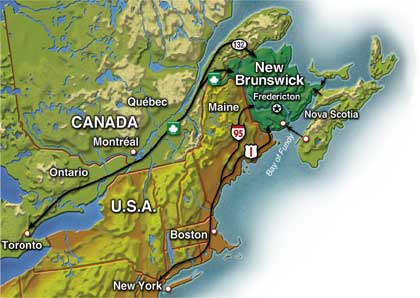
New Brunswick is a Canadian province that shares a border with the U.S. state of Maine. Since 2014 the brainiacs who run the province of New Brunswick have had a fracking moratorium in place–similar to what the State of New York had. Yep, you can see where this one is going. Last week those same brainiacs announced that the fracking moratorium in New Brunswick will go on “indefinitely.” Meaning it’s a ban, not a moratorium. The Canadian’s stupidity is a gift to the Marcellus/Utica because New Brunswick also shares a border with Nova Scotia and there are several LNG (liquefied natural gas) export facilities actively being planned. Those facilities will not get their gas from Nova Scotia or (now) from New Brunswick. The place those facilities will have to get their gas from is the Marcellus/Utica. So thanks, Canada!…
Read More “Good News for Marcellus: New Brunswick Commits Fracking Suicide”
 There’s an old saying that goes like this: “Success has many fathers, but failure is an orphan.” Not long ago MDN reported that Eclipse Resources had drilled what is believed to be the longest horizontal well (on land) in the world–the 3.5 mile “Purple Hayes” Utica Shale well (see
  Last week presidential candidate Donald Trump gave a speech on energy and energy policies at the Williston Basin Petroleum Conference in Bismark, North Dakota. By all accounts, Trump hit the ball out of the park. Before a crowd of some 7,000 people, Trump delighted the audience with a pretty simple message: cut back on regulations that choke America’s exploration and production of energy–and frack a lot more. Which is contrary to “crooked Hillary’s” vision of enacting new regulations to the point that fracking will be banned (see
  Every now and again it’s fun to delve into some of the technical aspects of drilling a Marcellus (and Utica) Shale well. We pick up on some of those particulars from a survey conducted by Hart Energy. Hart surveyed Marcellus and Utica drillers and found that, unsurprisingly, what has worked continues to work: When a Marcellus driller drills and fracks a well, the driller uses slickwater and up to 11 million pounds of white sand. What IS surprising to learn is that Utica drillers who had favored ceramic beads instead of sand are moving away from using ceramic beads and toward the Marcellus tried-and-true slickwater with sand approach. Here’s a few more interesting tidbits, including the fact that Halliburton is king of refracks in the Marcellus…
 There are precisely two counties in all of the State of Maryland that contain Marcellus Shale deposits under them–Garrett and Allegany counties, in the far western tip of the state. Maryland is currently under an idiotic temporary ban (see
  In December MDN called attention to a newly published study by researchers at Dartmouth College (see
  New research from the once-great Duke University actually supports shale drilling for a change–instead of denigrating it. In the past researchers from Duke, using money from the odious Park Foundation, have been bought off in their research efforts. This latest research, which concentrates on the benefits to local governments from shale drilling, wasn’t funded by Park and appears to be objective for a change. Two Duke U researchers conducted a three-year research project (between 2013-2015) funded by the Alfred P. Sloan Foundation. They traveled far and wide, to 16 states and interviewed over 200 local government officials along with gathering data and facts. The conclusion: on balance oil and gas drilling benefit local communities…
 Here’s a little good news, for a change. Research firm Grand View Research (headquartered in San Francisco) has just published a pricey new research report (a single copy will set you back $4,700) that projects the global hydraulic fracturing market will be worth $81 billion by 2024–in just eight short years. Grand View’s researchers say much of that value/revenue will come in the “plug and perf” (i.e. fracking) part of the industry. It will be driven primarily by two countries–the United States and (wait for it….) China. We haven’t heard a lot about fracking in China, but that country is definitely making major moves to unlock vast shale reserves beneath its soil. The Chinese don’t have to worry about silly things like getting permission from citizens–not in a brutal dictatorship like China. They just do it. Although we haven’t seen the full report ourselves, Grand View has shared some of the key, high level insights they gleaned from their research. Here are some interesting facts and tidbits…
 Some great news to share. A landowner in Wayne County, PA–in the Delaware River Basin–has filed a lawsuit against the Delaware River Basin Commission (DRBC) asking a judge to declare the DRBC does not have jurisdiction to prevent construction of a natural gas well. MDN has chronicled, for years, the lawless actions of the DRBC in seizing power it does not have to block shale drilling in essentially two PA counties where there is measurable quantities of shale gas that could be extracted: Wayne County and Pike County. DRBC’s former director, Carol Collier, is a hardened anti-driller who colluded with Josh Fox in making his infamous propaganda film Gasland. Collier is gone and it was thought her replacement, Steve Tambini would bring some order and sense to the organization (see
  Earlier this month MDN brought you the exciting news that Eclipse Resources, a smaller Marcellus/Utica pure play driller headquartered in State College, PA (but drilling mostly in Ohio) has drilled the world’s longest shale well–in the Utica in Guernsey County, OH (see
  What will it take for drillers to begin drilling again? That’s a question getting asked frequently by analysts on quarterly earnings calls with Marcellus/Utica drillers. The short answer is for the price of natural gas to go up and stay up. How high? Here’s some interesting economics from Southwestern Energy CEO Bill Way: every time the price of natural gas increases another quarter ($0.25), it translates into $185 million in cash flow for his company. If the price went up 50 cents, Southwestern would reactivate two drilling rigs. Another key factor in when drillers will start drilling again are DUCs–drilled but uncompleted wells. The DUC inventory is going down–but many drillers still have a year’s worth of DUCs they can leverage before they have to sink new holes…
 We’ve heard of microwaving popcorn (one of our favorite things to microwave), but we’ve never heard of microwaving “nanoribbons.” We suspect you haven’t either. All’s it takes is a 30-watt microwave to nuke nanoribbons and voila–drillers have a new, cheap and better way to seal up tiny fractures in wellbores. Researchers at Rice University have discovered wellbores drilled to extract oil and gas can be “dramatically reinforced” with a small amount of modified graphene nanoribbons–added to a polymer and microwaved. Think of it as nuking a tiny bit of plastic over a rock and the plastic melts into and firms up the rock. It’s quite possible there will be a microwave coming to a well pad near you!…
 According to new numbers just released by our favorite government agency, the U.S. Energy Information Administration (EIA), fracked wells (most of them shale wells) now produce two-thirds of the natural gas produced in the United States. And the U.S. produces the most natural gas of any country on Mom Earth. Even so, Crazy Bernie and Hillary have both pledged to shut it all down (yes, we believe them, they would do it). Here’s the EIA’s story of how the miracle of hydraulic fracturing has taken over in the U.S.–a miracle we can continue if we don’t elect radicals to high office…
 EPIX is on the way. What is it? A joint venture between Weir Oil & Gas, the world’s leading provider of upstream pressure pumping equipment, and Rolls-Royce Power Systems subsidiary MTU, a market leader in heavy-duty industrial power systems based on diesel and gas engines. EPIX will provide the drilling industry’s first integrated system for hydraulic fracturing. Here’s the low down on the Rolls-Royce of fracking…