
Phelim McAleer to Release GasHoax Ahead of Josh Fox’s GASWORK
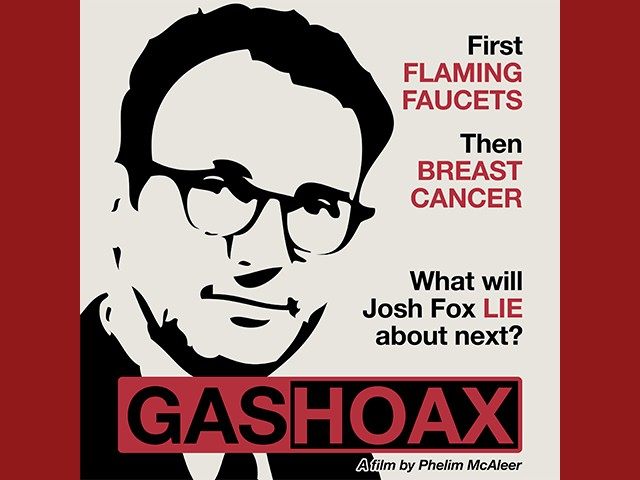
Tomorrow the Joseph Goebbels of the anti-fracking movement, Josh Fox (of Gasland fame) will release a new short fictional movie called “GASWORK – The Fight for C.J.’s Law.” The new propaganda film by Fox supposedly “investigates the dangerous working conditions in the oil and gas fields.” Er, well, yeah–it is dangerous! Which is why there’s such an emphasis on safety training by drilling companies. At any rate, Fox’s piece of propaganda, meant to smear fossil fuels, will air on a teeny tiny network called MSNBC (a network virtually no one watches anymore), at 8 pm Thursday during the “All In with Chris Hayes” program (a program we’d never even heard of before today). It’s important to point out Fox’s history of lies when it comes to the issue of fracking and natural gas drilling. No one does that better than Phelim McAleer, a real filmmaker who made the fabulous documentary FrackNation. Phelim is back to counter Josh’s latest propaganda with his own short film called GasHoax. Phelim plans to release his film tomorrow morning, ahead of Fox’s release, so people can know the true story of who Fox is and how he operates…
Read More “Phelim McAleer to Release GasHoax Ahead of Josh Fox’s GASWORK”
 THE Delaware Riverkeeper, Maya van Rossum, and a bunch of her anti-fossil fuel pals delivered a letter on Wednesday to America’s most liberal governor, PA Gov. Tom Wolf, asking him to immediately suspend all further Marcellus drilling in the state and while he’s at it, stop building any new pipelines. They also “demand” (their words) that Wolf shut down his Pipeline Infrastructure Task Force which he created back in May (see
  A new research paper has just been published that purports to evaluate potential “stressors” on streams from unconventional (i.e. shale) oil and gas drilling–including drilling in the Marcellus/Utica. The paper is titled “Stream Vulnerability to Widespread and Emergent Stressors: A Focus on Unconventional Oil and Gas” (full copy embedded below) and is written by a group of researchers from the University of Arkansas, University of Central Arkansas, University of Wyoming, Wilkes University, the U.S. Geological Survey and Waterborne Environmental Inc. In a cursory review the paper does indeed appear to be heavy on science and absent the usual political arguments. However, the one great negative for this paper is that it is published in the online “journal” PLOS ONE, a publication with very low academic standards and home to a number of previous “fracking will kill you” types of “research” papers (see
  Two years ago MDN reported on a University of Michigan research project called the Hydraulic Fracturing in Michigan Integrated Assessment (see
  Next Tuesday, Sept. 29, West Virginia State University (WVSU) will sponsor a forum on fracking and shale at WVSU’s James C. Wilson University Union in Institute, WV. The forum, titled “Fracking: In the Beginning Was the Source Rock” is free and open to the public. Keynoting the event will be award-winning Wall Street Journal energy reporter Russell Gold, who authored the book “The Boom: How Fracking Ignited the American Energy Revolution and Changed the World.” This is a unique opportunity to hear (and ask questions) of someone with expert insights into the shale revolution in the Marcellus/Utica and beyond–and what he sees on the horizon for the future…
 Question: Where did Robin Hood live? Answer: Sherwood Forest. Everybody knows that! Don’t look now but those evil, vile, filthy frackers want to begin fracking in Sherwood Forest. Yes, THE Sherwood Forest where the mythical Robin Hood once roamed with his merry band of outlaws. Believe it or not, and against all odds, the United Kingdom recently re-elected a conservative government, by a strong majority, and that government is pushing forward with a program to encourage shale drilling in merry ole’ England–including in Sherwood Forest…
 Fresh back from Shale Insight in Philadelphia, MDN editor Jim Willis is always pumped after hearing about the technology and safeguards and careful treatment the shale energy industry uses in extracting shale gas. These people are true professionals who care about the work they do–and they want to do it right. They care about the environment. They want to protect the land and our natural resources. They live in the communities where fracking is done. On the other hand, the people who profess to care about such things, anti-drillers, repeatedly prove themselves to be a) mind-numbed robots who believe whatever their movement leaders tell them, b) stark raving mad. Example: A group of extremists who happen to be “religious” have penned a letter to Pennsylvania Gov. Tom Wolf asking him to stop all fracking in the state because they fervently believe (wrongly) that fracking contributes to the mythological existence of man-made global warming. Mainstream media picks this garbage up and repeat it, like it’s a real news story…
 Let’s be honest, shall we? The Catholic Church has a Marxist as its leader in Pope Francis–which is a truly sad thing for a great and significant denomination. Pope Francis, nee Jorge Mario Bergoglio, is from Argentina and he supports Marxism, as many do in South America. Pope Francis hates capitalism and appears to be more interested in advancing socialist political policies here on earth than he does in serving Jesus Christ and saving souls. The current situation with Pope Francis distresses many Catholics we personally know. The Pope has thrown in his lot with climate change liars–those who say mankind is causing the earth to warm up–because the so-called climate change movement is the new home of anti-capitalists (i.e. Marxists, i.e. Communists). Scientific fact: global average temperatures haven’t risen now for 18 years. Yesterday, The Heartland Institute participated in a Constitution Day event in Philadelphia to call attention to the Pope’s coming visit to Philly (a visit made possible via fossil fuels) and the Pope’s error-filled teachings against fossil fuels and capitalism…
 In March MDN told you the sad story that Canadian waterless fracking company GASFRAC had been sold to an unnamed third party after going bankrupt (see
  The R Street Institute is a non-profit, non-partisan, public policy research organization (i.e. “think tank”) headquartered in Washington, DC with satellite offices in Florida, Texas, California, Alabama, and Ohio. After conducting an extensive review of existing published studies, R Street has found that while every form of energy has its negatives, including fracking, on the whole fracking for shale energy’s benefits far outweigh its negatives. Their findings are published in a new report titled “The Green Side of Fracking” (full copy below)…
 A major defeat for Pennsylvania’s anti-drilling groups, including THE Delaware Riverkeeper, was just handed down by the Pennsylvania Commonwealth Court in a Lycoming County zoning case. In Gorsline v. Board of Supervisors of Fairfield Township, anti-drilling neighbors, including Brian and Dawn Gorsline, Paul and Michele Batkowski and others (collectively “Gorsline”) sued to stop a conditional use permit granted by Fairfield Township to allow Inflection Energy to construct a well pad on the property of Donald and Eleanor Shaheen. The case was weak, but the lowest court in the PA court system–the Court of Common Pleas (i.e. county court)–said the ninny nanny neighbors had a right to strip away the Shaheen’s property rights to allow drilling on their own property. The PA Commonwealth Court obliterated the faulty reasoning of the lower court and has, significantly, redefined how courts should interpret the results of the Act 13 zoning lawsuit that allows local municipalities the right to restrict shale drilling. The Commonwealth Court decision (full copy below) has kicked the legal legs out from under those seeking to use an amicus brief filed by THE Delaware Riverkeeper in the Act 13 case…
 We shouldn’t be, but we’re stunned. We’ve discovered that anti-drillers are funding studies to discover how best to fool you. What words, phrases, stories and lies will resonate the best, and move low information types, to oppose fossil fuels. They study it and actually publish their findings (crow about it) for all the world to see! We’ve known for a long time that so-called peer reviewed research is nothing more than bought-and-paid-for propaganda (read this recent story in the New York Times:
  A very old and trite but true saying: Q: How do you know when a politician, like NY Gov. Andrew Cuomo, is lying? A: When he opens his mouth. Our illustrious man-child governor was in Syracuse yesterday to drop off a bag of money with $50 million, and an impertinent reporter had the gall to ask His Lordship about the secession rally held in Chenango County on Sunday (see
  It is an issue that simply won’t go away. Frankly, we’ve thought (until now) that it was more or less a publicity stunt. Pro-drillers and pro-gun rights residents of New York State have, since Gov. Andrew Cuomo banned fracking last December, called for upstate counties to secede from New York and either form a new state, or join with Pennsylvania. On the surface it may sound silly, but did you know secession has happened in our country three times before? And one of those times was for land that used to be part of New York State? No, we didn’t know that bit of history either. This Sunday, August 30th, a rally will be held in the tiny village of Bainbridge (Chenango County), NY from 1-3 pm for Marcellus/Utica landowners, gun owners and other overtaxed and over-regulated NY residents to demonstrate their support for secession. This is a movement that is gaining momentum. It’s a serious movement. None other than the liberal USA Today files this very serious report…