Obama Blocks Dakota Pipeline Outright, “Abandoned Rule of Law”
 In one final, breathtaking rejection of the rule of law and poke in the eye of those who support fossil fuels, the U.S. Army Corps of Engineers, doing Lord Obama’s bidding, has rejected granting Energy Transfer (ET) an easement to complete the final leg of the Dakota Access Pipeline that crosses federal land. The out-of-state/paid protesters who have assembled at Standing Rock, ND were orgasmic with delight. Their euphoria, however, will be short-lived as ET expects the incoming Trump Administration to quickly reverse the policy and grant permission to complete the pipeline along its original route. Although this conflict is happening far outside the Marcellus/Utica, it is important for us nonetheless as this group of paid, out-of-state protesters, backed by Big Green money (using money from California billionaire and nut Tom Steyer, among others), has promised to leverage a win against the Keystone XL Pipeline and now the Dakota Access Pipeline by coming to the Marcellus/Utica in an attempt to defeat important pipeline projects in our region. Here’s the latest in the dust-up over the Dakota Access Pipeline…
Read More “Obama Blocks Dakota Pipeline Outright, “Abandoned Rule of Law””
 Pipelines are the safest form of transportation on the planet–bar none. Everyone knows it. But anti-fossil fuel radicals attempt to lie about the safety of pipelines in an attempt to get projects canceled–a tactic in their war on fossil fuels. They know as well as anyone that pipelines are perfectly safe, so they lie about safety to try and stop projects. Like the $3.5 billion Mountain Valley Pipeline and the $5 billion Atlantic Coast Pipeline–both critically important projects in the Marcellus/Utica. Note their language in opposing such projects. The aim is not to re-route the projects, but to kill them altogether. There is no reasoning with un-reasonable people like those who are members of the Allegheny-Blue Ridge Alliance, a small group of anti-fossil fuel radicals…
 The Federal Energy Regulatory Commission (FERC) has just thrown a little cold water on two important pipeline upgrades to carry more Marcellus/Utica gas to southern markets. A final environmental impact statement (EIS) was due from FERC for both the Mountaineer XPress and Gulf XPress projects no later than April 28, 2017. FERC says that deadline is going to slip by three months due to reroutes and additional environment information requested. MDN has previously reported on Mountaineer XPress, which includes 165 miles of new pipeline with approximately 2.7 billion cubic feet (Bcf) per day of transportation capacity from existing and future points of receipt along or near the Columbia pipeline system–most of it located in West Virginia (see
  As MDN predicted, yesterday the Federal Energy Regulatory Commission (FERC) approved the NEXUS Pipeline project (see
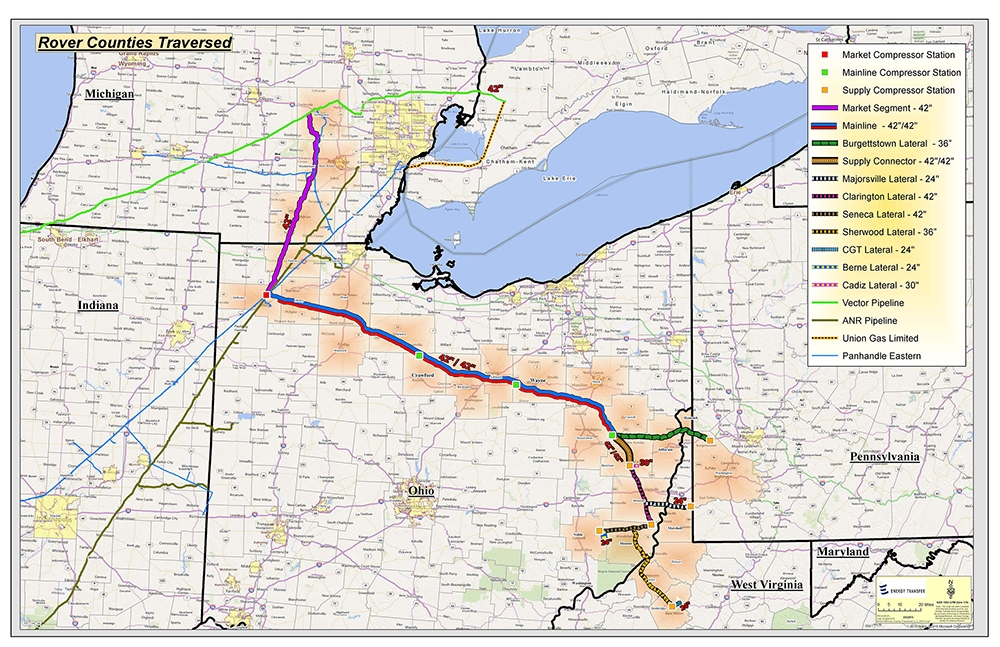
  FERC (the Federal Energy Regulatory Commission) is not happy with Energy Transfer and their Rover Pipeline. There are two major pipeline projects planned for Ohio: NEXUS and Rover. NEXUS got some FERC love today (see today’s lead story). Rover, on the other hand, is getting the cold shoulder from FERC, from a self-inflicted wound. Let us explain. As a reminder, Rover (an Energy Transfer project) is a $3.7 billion, 711-mile Marcellus/Utica natural gas pipeline that will run from PA, WV and eastern OH through OH into Michigan and eventually into Canada. The short version of what happened is that in May 2015 Rover purchased a house in Carroll County, OH, located near where the pipeline, and a compressor station for that pipeline, is due to run. Rover bought the house to use for offices for several Rover affiliate companies. After buying it, they determined it was “ill-suited for its intended purpose” and decided to demolish the house. Problem was/is, that house was under consideration to be added to the National Register of Historic Places. The house was not yet on the list of Historic Places, but was on a list of properties under consideration. Rover should have reported their decision to demolish the house to FERC but didn’t, which has Rover in hot water with FERC and the Advisory Council on Historic Preservation. Will Rover’s action kill the project? No. Will it slow down Rover and end up costing the company boatloads of money? Most likely, although Rover disputes that interpretation of events…
 Kinder Morgan’s Broad Run Expansion Project will expand transportation capacity of natural gas on the existing Tennessee Gas Pipeline system. The project includes the construction of two new compressor stations in Kanawha County, WV, one new compressor station in Davidson County, TN, and one new compressor station in Madison County, KY. Tennessee Gas also expects to increase compression capacity by modifying two of its existing compressor stations in Powell and Boyd counties in KY by replacing existing capacity with new, higher-rated horsepower compression units. The project will provide an extra 200,000 dekatherms per day (Dth/d) of transportation capacity along the same capacity path as the Broad Run Flexibility project, which was placed in service on Nov. 1, 2015. All of the additional gas will come from Antero Resources and their Marcellus/Utica program. The Federal Energy Regulatory Commission (FERC) issued a Certificate to build the project in September. However, several anti-drillers filed an appeal, asking for a stay claiming a removal of 40 acres of forest for a compressor station would irreparably harm Mom Earth. FERC has just ruled against the stay and told the antis Mom Earth will be just fine. Fire up the backhoes!…
 Pipelines have been, and continue to be, a big deal throughout the Marcellus and Utica region. Landowners who are approached about placing a pipeline through their property should (1) never sign the standard contract presented, and (2) never sign anything without first running it by a lawyer. Beyond that, what else should landowners think about/do when negotiating a pipeline easement? Clif Little from the Ohio State University Extension gives us some helpful tips…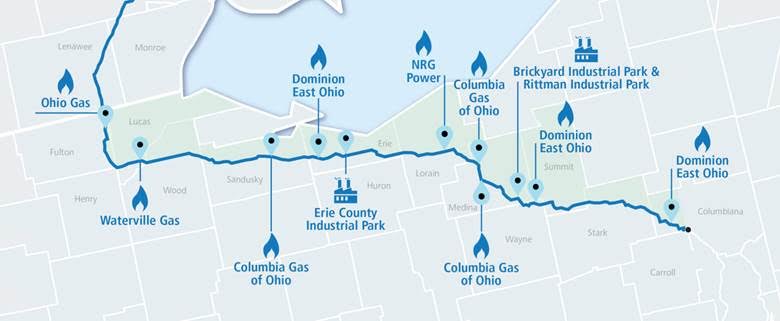
 It’s now apparent that the fix has been in from the beginning–that New York’s corrupt Gov. Andrew Cuomo, colluding with New York’s corrupt Attorney General, Eric Schneiderman, were on a mission to block the construction of the federally approved Constitution Pipeline, due to run from Susquehanna County, PA into Upstate New York (to Schoharie County). Before Cuomo decided to take the breathlessly lawsless act of blocking the pipeline by denying stream-crossing permits (being challenged in court), the Constitution asked for permission to begin clearing trees along the pipeline’s path. In January 2016, Schneiderman immediately objected (see
 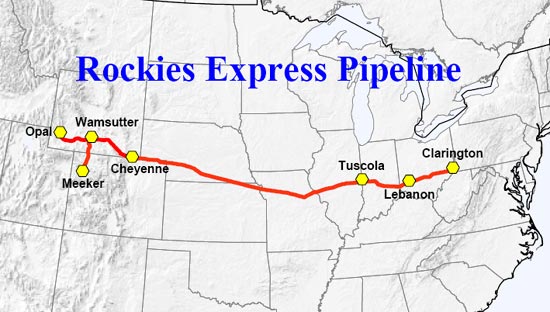 The Rockies Express Pipeline (REX), originally built from Colorado and Wyoming to Monroe County, OH to bring natural gas from west to east, last year reversed the flow for a large and important section of the pipeline. On August 1, 2015 the section of REX from Monroe County, OH to Mexico, MO reversed the flow and began to carry 1.8 billion cubic feet per day (Bcf/d) of Utica and Marcellus Shale gas to the Midwest, including to the greater Chicago area. REX has been hard at work on plans to expand capacity even more by beefing up compressor stations along portions of the pipeline. Their efforts have paid off. REX previously filed a plan with FERC to add another 800 million cubic feet per day (MMcf/d) of capacity along the same portion of the reversed pipeline. Yesterday the Federal Energy Regulatory Commission (FERC) gave REX the go-ahead to start additional compressors added at three locations along the route…
 The city of Green in Summit County, OH has put NEXUS Pipeline on notice that if surveyors show up to survey in the city and if those surveyors don’t have permission from the landowner, or a judge’s order, those surveyors will be arrested and charged with trespassing. Apparently Green hasn’t gotten the memo that pipelines are the safest form of transportation on earth–period. NEXUS, as well as other pipeline projects, face a classic Catch-22 situation. In order to get the Federal Energy Regulatory Commission to grant a certificate to build the pipeline, the pipeline company must first conduct initial surveys to plan the route. With a certificate from FERC in hand, the pipeline then has the power of eminent domain to use on recalcitrant landowners to build the pipeline across their land. The open question is whether or not the pipelines can use eminent domain to conduct the survey ahead of a full FERC certificate. That’s the Catch-22. Surveying doesn’t do a single thing to a property, other than a few guys and gals running around for a short time looking through a transit and taking measurements. It’s a shame that landowners, in some cases, won’t even allow that. So Green has put NEXUS and the world on notice that the city and its residents don’t want to participate in the riches that come from shale. Fine. Let them eat dirt…
 Sunoco Logistics Partners, the builder of the Mariner pipeline projects, has fought a long and hard legal battle to be recognized as a public utility in Pennsylvania–especially with regard to the next big project in the lineup, the Mariner East 2 pipeline. ME2, as it’s called, is a $2.5 billion, 350-mile natural gas liquids (NGL) pipeline that will run from eastern Ohio through the state of Pennsylvania to the Marcus Hook refinery near Philadelphia. From the beginning anti-pipeline fanatics have tried to derail the project by claiming it is not a public utility (with the right of eminent domain) as defined by PA’s statutes. In July 2014 two administrative law judges working for the PA Public Utility Commission (PUC) said ME2 is not a public utility (see
 We spotted a great editorial in the Philadelphia Inquirer (of all places) written by the American Petroleum Institute’s (API) Marty Durbin. Marty used to be the head of the American Natural Gas Association (ANGA) before it merged with and into API. Marty’s column looks forward to Donald Trump’s presidency and to getting back to “smart energy policies” as opposed to the dumb energy policies we’ve gotten under Lord Obama. As we read the column, it dawned on us that the real point Marty is making is this: It’s time to build MORE pipelines in this country! Not less. It’s time to push the advantage and to lock in fossil fuel use for the next couple of generations. Love it! Give Marty’s excellent column a read…
 Are those war drums we hear beating? Perhaps! If you are involved in the oil and gas industry in just about any capacity, it’s hard to miss the story of the Dakota Access Pipeline (DAPL) and the paid criminal protesters who are trying to stop it (see