
Budweiser Beer Warns of Dire Consequences if Spire STL Pipe Closes

You can add a shortage of Budweiser Beer to the list of dire consequences if the Spire STL pipeline in the St. Louis region shuts down permanently one month from now due to a lawsuit brought by the uber-left radicals of the Environmental Defense Fund. Spire STL is a 65-mile pipeline that connects to and flows Marcellus/Utica gas from the Rockies Express (REX) pipeline to residents and businesses in the St. Louis, MO area. Parent company Spire has been warning (for months) of extreme consequences, including no heat and potential death for some residents, if natgas supplies on the pipeline are forced to stop. Now businesses in the region, including Anheuser-Busch, are adding their very loud voice to Spire’s voice.
Read More “Budweiser Beer Warns of Dire Consequences if Spire STL Pipe Closes”
 We suppose it takes a lot to surprise the CEO of one of the world’s biggest pipeline companies. Yet yesterday Williams CEO Alan Armstrong expressed his surprise that even with the dramatic increase in the price of natural gas during the third quarter, demand for natural gas was “inelastic” and remained high. Translation: Williams had all it could do to keep up with flowing natural gas through it’s extensive pipeline system, even with super-high prices. Much of the demand to flow gas came from the Marcellus/Utica.
 Equitrans Midstream, formerly known as EQT Midstream, issued its third quarter update yesterday. The main focus (for us) of the update is new or updated information related to the company’s all-important Mountain Valley Pipeline (MVP) project and those projects connected to MVP–including Hammerhead and Southgate. Yesterday we learned Equitrans still believes MVP, a 303-mile pipeline from West Virginia to southern Virginia, is on track to start up in “summer 2022.” The company plans to begin construction of a related extension of MVP, called Southgate (from Virginia into North Carolina) in 2022 and bring it online in early 2023.
 Last week MDN told you the news that EQT Corporation has sold part of its reserve capacity along the Mountain Valley Pipeline (MVP) to “an undisclosed investment-grade entity for six years” (see
  In a normal world where freedom rings throughout the land and free enterprise and capitalism rule, if the price of a commodity like natural gas soars, new drilling would happen and new pipelines (midstream infrastructure) would get built. In a warped world where wokey leftists demand divestment from “fossil fuels” those things don’t happen. Right now we desperately need more pipelines and more drilling. Neither is happening. RBN Energy explains how lack of new pipeline capacity is holding back new drilling–and why it’s happening, particularly in the Marcellus/Utica…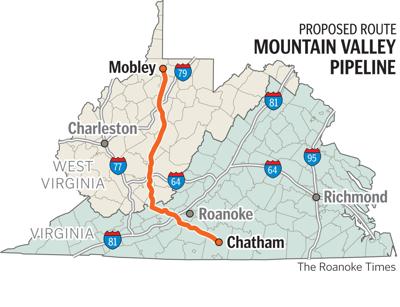
 It’s splitsville for EQT and Equitrans Midstream, the midstream company that was once part of EQT. In releasing details about third quarter performance, EQT announced yesterday it has sold nearly half of its contracted capacity with Equitrans for the Mountain Valley Pipeline (MVP). MVP, when it goes online next year, will ship gas south. It seems EQT is looking West. In the same announcement yesterday, EQT said it has signed a new contract with the Rockies Express (REX) pipeline to ship even more of its gas to markets in the Midwest.
 A short 19-mile pipeline project called the Del-Mar Energy Pathway project, crossing both Delaware and Maryland, began its final phase of construction earlier this year after receiving approval from Maryland for traversing a wetland area (see
  Equitrans Midstream, owner of the 303-mile Mountain Valley Pipeline (MVP) and a related gathering pipeline called Hammerhead designed to feed 1.6 Bcf/d (billion cubic feet per day) of Marcellus/Utica gas into MVP, says an arbitration panel ruled in its favor in a dispute with EQT Corp. over the delayed startup of Hammerhead. According to an 8-K filing, Equitrans said the three-member arbitration panel ruled that the in-service delay beyond October 1, 2020, for Hammerhead was caused by a force majeure, so EQT has no early termination right under the Hammerhead gathering agreement or related right to purchase the Hammerhead project.
 We bet you didn’t know a hunk of metal in the ground could be racist. We’re as surprised as you. Imagine that–an inanimate object can actually discriminate against people of color. Who woulda thought? Yes, we’re being sarcastic in an effort to point out the complete lunacy and fallacy of claims that a small pipeline aimed at delivering natural gas to a facility in Brooklyn so the gas can be liquefied and carted around New York City to prevent gas outages is somehow racist because the pipeline passes through communities that are predominately black or Hispanic. How on God’s green earth is a pipeline delivering fuel to keep people warm in the winter racist? Answer: It’s not.
 Another MVP (Mountain Valley Pipeline) story in the news today. In August 2018 MDN told you about a group of six Franklin County, VA landowners who sued to block the construction of MVP across their property (see
  In July the Federal Energy Regulatory Commission (FERC) approved a plan by Dominion Energy to clean up and “undo” the work done for the company’s previous Atlantic Coast Pipeline (ACP) project (see
  In April 2019, President Trump signed an Executive Order (EO) instructing the Environmental Protection Agency to review Section 401 of the Clean Water Act–the section that grants states (and tribes) the right to have a say in pipeline projects (see
 The Democrat mainstream media was striking out by using the trite phrase of “blast zone” to try and scare people who happen to live near the path of a simple, safe natural gas pipeline, like that proposed in Hanover County, Virginia. As the lefty libs so often do, they’ve changed their language in an effort to change how people perceive such a project. It’s no longer a blast zone, now (drum roll please)…it’s an INCINERATION zone! Yeah baby! You’ll be fried to a crisp if you live near a pipeline and that pipeline experiences a leak and explodes. So pathetic.