
EIA: U.S. Oil & NatGas Production Will Fall in 2021, Rise in 2022
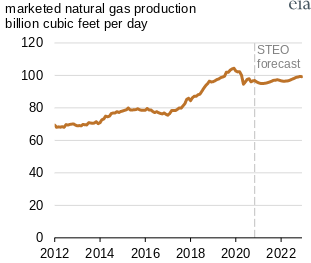 In its January 2021 Short-Term Energy Outlook (STEO) just released, the U.S. Energy Information Administration (EIA) forecasts annual average production of U.S. oil will fall to 11.1 million barrels per day (b/d) in 2021 before rising to 11.5 million b/d in 2022. As for natural gas, EIA says U.S. marketed natural gas production will decline by 2% to an average of 95.9 billion cubic feet per day (Bcf/d) in 2021. Like oil, EIA predicts the fall in natgas production will reverse in 2022 and will rise by 2% to 97.6 Bcf/d.
Read More “EIA: U.S. Oil & NatGas Production Will Fall in 2021, Rise in 2022”
 Researchers at the University of Illinois Chicago have developed a cutting edge catalyst made up of 10 different elements–each of which on its own has the ability to reduce the combustion temperature of methane–plus oxygen. This unique catalyst brings the combustion temperature of methane down by about half, from above 1400 degrees Kelvin down to 600 to 700 degrees Kelvin. What it means is that natural gas can burn cleaner and emit far less carbon dioxide.
 If you recall, the COVID-19 coronavirus pandemic wasn’t really “a thing” (here in the U.S.) until mid-March 2020. That’s when all hell broke loose and the country shut down. Prior to that, natural gas demand was steadily rising and hitting all-time highs (see
  The Enverus U.S. oil and gas rig count slipped by one to 406 over the past week. The Marcellus play stayed even with 32 active rigs. However, in a good sign, the Ohio Utica picked up 2 new rigs to close the week with 8 active rigs (total of 40 active rigs in the M-U).
 According to the data experts at Enverus, the U.S. oil and gas rig count ended the year at 407 rigs, down slightly more than 50% from the same point in 2019. The Marcellus play ended the year with 32 active rigs, and the Utica with 6 active rigs (total of 38 active rigs in the M-U). At the end of 2019, there were 840 rigs operating in the U.S.
 What if we gave the University of Pittsburgh (Pitt) a $2.5 million grant to study a link between peanut butter and childhood cancer. Researchers could only use the money to study any potential link between peanut butter and kids getting rare cancers. Sounds absurd, right? What if there is NO link between peanut butter and cancer in kids? What if there IS a link to some other environmental factor like, say, an old uranium dumpsite nearby? But the remit is ONLY to research peanut butter. Sound silly? Sound stupid? Substitute “shale drilling” for “peanut butter” and you can see how absurd it is for Pennsylvania to announce awarding $2.5 million to Pitt to study a single potential cause for rare childhood cancers in southwestern PA.
 Wood Mackenzie, also known as WoodMac, is a global energy, chemicals, renewables, metals, and mining research and consultancy group. WoodMac writes reports and dishes out expert advice to investors dealing with the energy industry. WoodMac analysts have put their heads together to predict what we should expect in the energy space in the coming year, from oil markets to solar costs and coal exports to electric vehicles.
 For some reason, S&P Global Platts has not tabulated and reported on the latest Enverus rig count numbers for the past few weeks. Have no fear. MDN pulled the latest rig count report directly from Enverus. It shows that over the past week (ending Dec. 16), the U.S. rig count fell by five to 401 active rigs.
 By now it’s a cliche to say that 2020 has been an exceptional year–and not in a good way. For the first time in our memory of writing MDN, we witnessed widespread curtailments or “shut-ins” of wells in the Marcellus/Utica during 2020. That is, drillers voluntarily turned the values off and flowed less gas in a bid to (a) not sell the gas at prices that don’t return a profit, and (b) drive up the price of gas (see
  Yesterday our favorite government agency, the U.S. Energy Information Administration (EIA), published our favorite monthly report, the Drilling Productivity Report (DPR). The latest DPR, which shows estimates for oil and gas production from the seven largest shale plays in the U.S., shows a drop in shale gas production across all plays (including the Marcellus/Utica)–except for a slight production increase in the Haynesville–coming next month in January. The M-U is forecast to drop another 154 million cubic feet per day (MMcf/d) from production levels in December.
 MDN has repeatedly read that Marcellus/Utica drillers (as well as drillers in other shale plays) must drill far less and produce far less in an effort to boost profits for shareholders. Just yesterday we published a story about M-U drillers overspending, by half a billion dollars, in 3Q20 (see
  Although in recent months a number of major Marcellus/Utica drillers have shut-in (or curtailed) some of their natural gas production, apparently those days are over. According to an analysis by S&P Global Platts, M-U gas production in December has (so far) averaged nearly 33.9 Bcf/d (billion cubic feet per day), making December’s month-to-date average the highest on record. In fact, on Dec. 7, two days ago, regional output in the M-U was estimated at 34 Bcf/d, less than 300 MMcf/d below its all-time, single-day record high. What’s going on?