
FERC Issues Rover 8 Commandments to Restart Horizontal Drilling
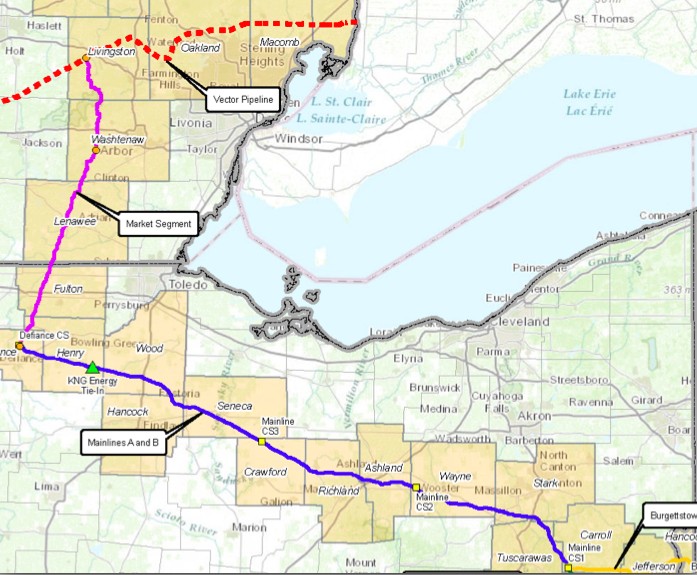
 Rover is a $3.7 billion, 711-mile natural gas pipeline that will run from PA, WV and eastern OH through OH into Michigan and eventually into Canada. While Phase 1A of the pipeline is essentially done and ready to begin service by the end of this month (see Rover Pipe Ready to Flow! Seeks FERC Permission for Aug 31 Start), other important parts of the pipeline are not done. If Rover wants the entire pipeline to be up and running by the end of the year, they must restart underground horizontal directional drilling (HDD) in various locations where it is now stopped. In Ohio, Rover experienced a series of mishaps, the most serious of which spilled 2 million gallons of non-toxic drilling mud in a swamp near the Tuscarawas River back in April (see Rover Pipeline Accident Spills ~2M Gal. Drilling Mud in OH Swamp). An investigation by the Ohio Environmental Protection Agency (OEPA) found the presence of diesel fuel in the drilling mud, which means the mud wasn’t so non-toxic after all (see OH EPA Says Diesel Fuel Found in Rover 2M Gal Drilling Mud Spill). Rover believes sabotage may have been the cause (see ET Says Accident or Anti Sabotage Caused Diesel in Rover Mud Leaks). Since April, FERC has blocked all new underground HDD for the Rover project. Rover has asked (begged, pleaded) FERC, several times, for permission to restart the HDD work–at least in a few select locations. In July FERC gave Rover an initial todo list to get back in its good graces, but still would not lift the ban on HDD (see Frustrated FERC Gives Rover Todo List, HDD Drilling Still Blocked). FERC has finally responded with a list of eight (big) things Rover must do before HDD drilling can restart. We call them FERC’s Eight Commandments…
Read More “FERC Issues Rover 8 Commandments to Restart Horizontal Drilling”

 The Utica Shale’s economic impact on Ohio has been nothing short of “staggering.” In fact the shale revolution has fundamentally changed the United States over the past 10 years. But nowhere is it more obvious than in the Buckeye State. Our friends at Energy in Depth have assembled the results of several research studies of just how much shale has impacted Ohio, and summarized it in a handy infographic download (below). The short version is this: through the first quarter of 2016, if you add the number all up thus far, the “upstream” (drilling) industry in Ohio has invested a whopping $39.2 billion. Amazing! But that’s not all. The “midstream” (pipeline) industry has invested $13.7 billion. But wait! There’s more! The downstream (petrochemicals) industry has invested, so far, $15.3 billion. And there’s far more downstream investment coming, especially if/when PTT Global Chemical decides to move forward with building a $5 billion ethane cracker facility in Belmont County. When you add it all up, the Utica industry has invested $68.2 billion SO FAR. And that’s all private money–not taxpayer money. In fact, millions of dollars have flowed into communities from taxes on the industry. It’s truly hard to put into words just how big a deal this is…
 The CORNballs of Ohio are not happy campers in their quest to try and shut down the $2 billion, 255-mile NEXUS interstate natural gas pipeline that will run from Ohio through Michigan and eventually to the Dawn Hub in Ontario, Canada. CORN stands for Coalition to Reroute NEXUS. CORNballs is what we affectionately call the group–as a way of pointing out their nutty real purpose, which is to try and shut the NEXUS project down. Their aim has nothing to do with “rerouting” and everything to do with shutting it down. In May 2017, the CORNballs revealed their true colors when they filed a lawsuit in federal court in Akron, OH (see
  Those opposing two major Energy Transfer projects–Rover Pipeline and Mariner East 2–will not be happy with the good news coming from ET this week. The company issued its second quarter update and held a conference call yesterday. During the call we learned that Phase 1 of Rover, a $3.7 billion, 711-mile Rover Pipeline project that will run from PA, WV and eastern OH through OH into Michigan and eventually into Canada, is “substantially complete” with Phase 1A expected to be done next week and online asap. Phase 1A stretches from Cadiz to Defiance, which is most of Ohio. Phase 1B is a short segment from Seneca to Cadiz, and once ET gets clearance from FERC to drill horizontally under Captina Creek, it will only take them about 40 days to complete Phase 1B. If ET can convince FERC to allow them to restart more horizontal directional drilling (HDD) work, Phase 2 will be done soon as well–and the entire project will be up and running by the end of the year. More good news for Rover: The temporary ban on HDD work for Rover in two West Virginia counties that began two weeks ago has now been lifted by the WV Dept. of Environmental Protection. As for ET’s Mariner East 2 (ME2) pipeline project that stretches across Pennsylvania, 80% of the pipeline has been strung, more than 70% is welded and over half has been lowered in and covered up. As we reported yesterday and again today, ET subsidiary Sunoco Logistics Partners (building ME2) has brokered a deal with several radical environmental groups that will slow the project down some, but slow and done is better than no progress at all. Here’s an update on the good news about Rover and ME2…
 Gulfport Energy, which is the second most active driller in the Ohio Utica, behind Chesapeake Energy, has (so far) drilled 303 Utica wells and owns 211,000 acres of leases in the Buckeye State. Gulfport, which drills mainly in the Utica (but also the SCOOP, in Oklahoma) reported their second quarter 2017 production numbers on July 31 (see
  In late January, Federal Energy Regulatory Commission member Norman Bay announced he was quitting, in a huff, because President Trump has elevating another commission member to be chairperson (see
  Below is a story of an Ohio landowner who “worked to get good easements and good language” in the contract he signed with Rover Pipeline. But, according to the landowner, once construction began, “everyone seemed to forget” what they promised in the contract. And so landowner Roger Meggyesy has been vigilant to point out violations to third-party pipeline inspectors who report on Rover’s activities to the Federal Energy Regulatory Commission (FERC). As Meggyesy rhetorically asks, “Why do we have to come and fight after the fact?” It is disheartening to read these kinds of accounts. This guy did everything right, got it all in writing–and yet it’s still an uphill fight. We bring you this story because it’s important to air the problems along with highlighting the good stuff when it comes to these big pipeline projects…
 In November 2015 MDN reported on a lawsuit filed by GreenHunter Resources (filed in October 2015) against two former GreenHunter employees and a competitor (see
  A recent ruling from Ohio’s Seventh District Court of Appeals has the potential to affect conventional and unconventional (shale) leases. As with most legal rulings, this one is a bit complex. We’ll do our best to summarize. In Ohio, most oil and gas leases have both a primary term and a secondary term. The primary term is that period of time a driller has to locate and drill for oil or gas–typically five years. The secondary term is that period of time (which can last for decades) under which oil and gas is produced from the well. In most lease contracts, as long as the well is producing in “paying quantities” the lease remains in effect. But when the well does not produce in paying quantities, the lease is terminated and the landowner can seek a new lease. Of course, the definition of “paying quantities” is key. In a previous case, the Ohio Supreme Court defined paying quantities. However, the recent Seventh District Court case, Paulus v. Beck Energy Corp., added to, or should we say “refined” the definition provided by the Supreme Court by providing guidance on what items may be considered when determining paying quantities and lack of production in Ohio…
 Rover is Energy Transfer’s $3.7 billion, 711-mile Marcellus/Utica natural gas pipeline that will run from PA, WV and eastern OH through OH into Michigan and eventually into Canada. On April 13, Rover workers experienced an “inadvertent return” of “horizontal directional drilling fluid”. That is, they sprung a leak and spilled nearly 2 million gallons of drilling fluid (see
  Yesterday the American Petroleum Institute (API) released a new study showing that the natural gas and oil industry supported 10.3 million U.S. jobs and added $1.3 trillion to the nation’s economy in 2015. The study, “Impacts of the Natural Gas and Oil Industry on the US Economy in 2015” (full copy below) found that jobs supported by the o&g industry increased by half a million since 2011, and showed that all 50 states, whether producing or non-producing, continued to benefit from the o&g industry. The study was conducted by PricewaterhouseCoopers (PwC) and commissioned by API. Yes, it’s an industry-funded study. But hey, if we don’t do the research and toot our own horn, you can be sure anti-fossil fuelers won’t do it for us! This is solid, no-nonsense (and real) economic research. We thought it would be interesting to look at the impact of the o&g industry in Pennsylvania, Ohio and West Virginia–the only three states producing Marcellus and Utica Shale gas and oil. Yes, each of those states still has a thriving conventional o&g industry as well and conventional numbers are part of the study–but let’s be honest. The unconventional (shale) sector dwarfs production of the conventional sector. When you look at o&g’s impact in our region, you find that it created 322,600 jobs in PA, 262,800 jobs in OH, and 70,900 jobs in WV. Value added (economic impact) for each state was: $44.4 billion in PA, $37.9 billion in OH, and $8 billion in WV. Add them all together and you get roughly 656,000 jobs and $90 billion of economic contribution in 2015. From one industry–oil and gas. WE LOVE FOSSIL FUELS!…
 In May MDN brought you the news that the Ohio Environmental Protection Agency (OEPA) was going after Rover Pipeline for failing to properly plan storm water management which resulted in heavy storm water runoff into farmers’ fields where Rover is digging trenches (see