
Organic Farm Manure Offered in Opposition to NEXUS in N. Ohio
 We spotted an outrageously fake news story published in something called the Public News Service that quotes an organic farmer in northern Ohio who is opposed to the NEXUS Pipeline–a pipeline that won’t even cross her property. NEXUS is a $2 billion, 255-mile interstate pipeline that will run from Ohio through Michigan and eventually to the Dawn Hub in Ontario, Canada. It is a critically needed pipeline to move Utica and Marcellus Shale gas from an over-saturated market in the northeast to markets in the Midwest and Canada. It is a joint venture between DTE Energy and Spectra Energy. The Ohio organic farmer claims a NEXUS compressor station a mile from her property “will create a toxic cloud” and ruin her crops. She also claims “toxins” leak from pipelines, and that compressor stations “contain dangerous cancer-causing chemicals.” Yes, any time you want to oppose something, throw out the “c” word, to make sure they get good and scared. Other problems caused by pipelines: livestock illness and death; spontaneous explosions; fires; mini-earthquakes. To which we say, what a load of organic bullcrap…
Read More “Organic Farm Manure Offered in Opposition to NEXUS in N. Ohio”
 As recently as July 7th, Energy Transfer Partners, builders of the mighty 711-mile Rover Pipeline project that will run from PA, WV and eastern OH through OH into Michigan and eventually into Canada, said that a portion of Phase 1–from Cadiz, OH to Defiance, OH–will be completed and go online this month, in July (see
  Yesterday the Federal Energy Regulatory Commission (FERC) sent a letter to Energy Transfer regarding the Rover Pipeline project. You may recall that Rover hit some bumps along the way in its aggressive schedule to get part of the pipeline up and running by the end of this month, and the rest operational by the end of November. In Ohio, Rover experienced a series of mishaps, the most serious of which spilled 2 million gallons of non-toxic drilling mud in a swamp near the Tuscarawas River back in April (see
  The Ohio Controlling Board, part of the Office of Budget and Management, has raided (i.e. stolen) $15 million from Ohio’s severance tax fund to use in settling a lawsuit from the late 1990s–a lawsuit that has nothing whatsoever to do with oil and gas. According to the American Petroleum Institute Ohio, the misappropriation of the money is likely illegal. The Controlling Board was set up by the Ohio legislature to handle “necessary adjustments to the state budget.” In other words, it was set up to pick one pocket and put the money in a different pocket. In 1997 Ohio widened a dam spillway in the western part of the state, and the result flooded the property of some unfortunate landowners, who sued. The lawsuit has languished for years, and it’s now time to pay up. The Controlling Board decided to raid/steal the money from the severance tax fund–a fund that’s supposed to be used for things like plugging abandoned orphan o&g wells. Most drilling in Ohio happens on the eastern side of the state. The flooded property in 1997 happened on the western side of the state. Anyone else see a disconnect and sleazy politics going on here? The severance tax fund has become the personal piggy bank for certain Columbus politicians…
 Sounding eerily like a Borg drone from Star Trek (“YOU WILL COMPLY, RESISTANCE IS FUTILE”), the Ohio EPA (OEPA) has asked Ohio’s Attorney General, Mike DeWine, to force Rover to pay the Ohio EPA $914,000 in so-called fines it has unilaterally levied (with no apparent authority to do so) to punish Rover for a series of accidents while constructing the pipeline. Rover has not agreed to the fines and is challenging the OEPA’s authority to levy them. So the OEPA is asking DeWine to use the full weight and force of his office to force Rover to comply. Rover has had the pedal to the metal since receiving a go-ahead from the Federal Energy Regulatory Commission (FERC) in March to begin construction to build a 711-mile natural gas pipeline from PA, WV and eastern OH through OH into Michigan and eventually into Canada (see
  Thumbing their collective noses at Ohio RINO Gov. John Kasich, in May Republican legislators in the House added a “little-noticed provision” in the state budget deal that will give the legislature, and not the governor, the power to select members of the Ohio Oil and Gas Commission (see
  The Gas Technology Institute (GTI), based in Illinois, is doing the Marcellus/Utica region a huge favor. GTI has launched a pre-employment training program to introduce folks to natural gas pipeline operations. The four-week program provides a basic understanding of natural gas, the utility and pipeline industry, and different equipment, procedures and operations used. The program is aimed at students, veterans, displaced coal workers and others with an interest in getting a job with utilities, midstream (i.e. pipeline) companies and their contractors. Here’s the best part: The program is fully funded, so there is no tuition cost for those who qualify. The program is delivered via classroom at three participating colleges: Westmoreland County Community College and Butler County Community College (both in PA), and Washington State Community College (in OH). Here’s the lowdown..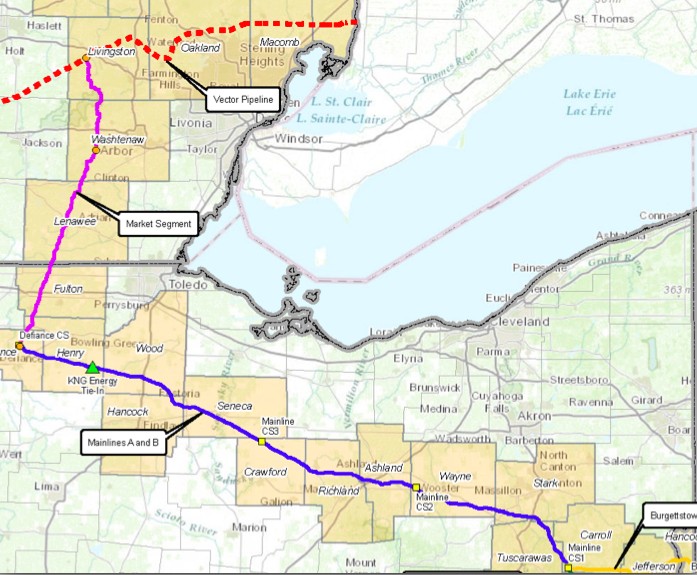
 Phase I of the 711-mile Rover Pipeline project that will run from PA, WV and eastern OH through OH into Michigan and eventually into Canada is supposed to be completed by July 2017, while Phase II is supposed to be done by November 2017. Will Phase I be done by the end of this month? We sure wouldn’t want to take that bet, but we suppose there’s still a slim chance. While building the $3.7 billion pipeline project, Energy Transfer (or more correctly its contractors) hit some snags, including spilling 2 million gallons of non-toxic drilling mud near the Tuscarawas River (see
  In February MDN reported that Marathon Petroleum had begun to build a 49-mile condensate pipeline, called HALI–the Harpster to Lima Pipeline (see
  Being a marketing guy, MDN editor Jim Willis knows that crystallizing a concept into a few key words is critical. You have to be able to convey your meaning in as few words as possible–and those words must be pregnant with meaning. Jim was lucky enough to name this blog/news site Marcellus Drilling News, which (mostly) conveys its purpose–to report on happenings in the Marcellus (later adding the Utica) region. A very smart person who’s given a lot of thought about our industry is Kathryn “Katie” Klaber. Katie owns her own consulting firm–The Klaber Group. But before that, she was founder and president of the Marcellus Shale Coalition (a well-named organization). Katie lives and works in Pittsburgh. In a recent article for the Pittsburgh Business Times, Katie ponders over Pittsburgh (and our industry’s) “identity crisis”–by which she means our lack of good branding. Sometimes our industry and region is referred to as “Appalachia.” But that term often connotes the mountains of West Virginia, spreading out into Kentucky. Sometimes we are referred to as the “Marcellus/Utica basin,” which gets a lot closer to meaningful, but connotes drilling and leaves out the downstream. And sometimes we’re called “the Northeast.” But folks in Ohio consider themselves Midwesterners, not northeasterners. Why is it important to lock down an accurate, pregnant-with-meaning description for our entire industry (upstream, midstream and downstream), and our geographic region? According to Katie, it comes down to two words: capital investment. We need to brand ourselves and do it sooner rather than later, if we want to grow business in our neck of the woods…
 Last year MDN brought you the story of researchers who found microbes (bacteria) living nearly two miles down in Utica Shale wells. They dubbed one of the never-before-seen bacterial “lifeforms” in the well Frackibacter. We immediately labeled it a different name: Frackenstein (see
  Ohio is about to pass and adopt it’s latest biennial budget. Part of the budget bill includes language to exempt Ohio’s city and town parks from the state’s unitization (i.e. forced pooling) laws. In Ohio, if 65% of the landowners in a proposed unit have agreed to lease their land for oil or gas drilling, the other landowners in the unit can be forced to join the unit to allow drilling under (not on) their land. There are all sorts of requirements before forced pooling occurs, including a $10,000 fee paid by the driller, and a hearing to review efforts made to enroll said recalcitrant landowners. But in the end, it is possible to force landowners who don’t want drilling, to have it. The justification is that those who don’t want it are harming those who do want it by not agreeing to join the unit. Should the action of someone with a few acres deny benefits to all of his neighbors? We’re not saying we support the concept of forced pooling–just giving you our best interpretation of the arguments used to support it. We understand those arguments. We also understand the sanctity of private property. Until now, local towns and municipalities in Ohio were treated like any other landowner. But now, with the new budget, they will get a special exemption. Local municipalities cannot be forced to participate–unless they want to participate–in a drilling unit…
 Yesterday Energy Transfer Partners, the builder of the Rover Pipeline, once again asked the Federal Energy Regulatory Commission (FERC) if they could pretty-please-with-a-cherry-on-top resume horizontal directional drilling (HDD) in a couple of key locations in Ohio, so they can finish phase one of the pipeline somewhere close to on-time. Rover is a $3.7 billion, 711-mile Marcellus/Utica natural gas pipeline that will run from PA, WV and eastern OH through OH into Michigan and eventually into Canada. It is a critical piece of sorely needed infrastructure for the Marcellus/Utica industry. As soon as ET received approval for the project in February, they began building it. But they hit a few snags along the way, including an “inadvertent return” (i.e. leak) of 2 million gallons of drilling mud in a swamp next to the Tuscarawas River (Stark County, OH). Following that leak and other leaks, FERC told Rover to stop any new underground drilling not already under way (see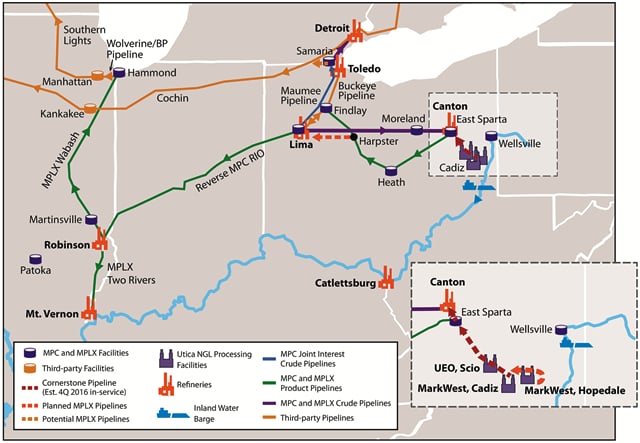
 Here is a short list of radical environmental groups that are despicable and loathsome in every sense of the word: Sierra Club, Center for Biological Diversity, Earthworks, Freshwater Accountability Project, Friends for Environmental Justice, Indigenous Environmental Network, Indigenous Iowa, Keep Wayne WILD, Louisiana Bucket Brigade, Ohio River Citizens’ Alliance, and Oil Change International. They have dedicated themselves to stopping work on, and ultimately blocking, Energy Transfer’s (ET) $3.7 billion, 711-mile Marcellus/Utica Rover natural gas pipeline that will run from PA, WV and eastern OH through OH into Michigan and eventually into Canada. The problem, however, is that ET has given these groups an open door to pedal their anti-fossil fuel nonsense. Indeed, ET has given them an open door to block further progress on building Rover. How? By rushing construction that has led to a string of accidents and incidents, alienating the thin-skinned Ohio Environmental Protection Agency (OEPA) and a number of landowners. One of the accidents, perhaps the most prominent accident that’s been the focus for much of the radical’s efforts, was a 2 million gallon spill of drilling mud into a wetland near the Tuscarawas River back in April (see