
ETP Says Much (Not All) of Rover Phase I Will Go Online in July
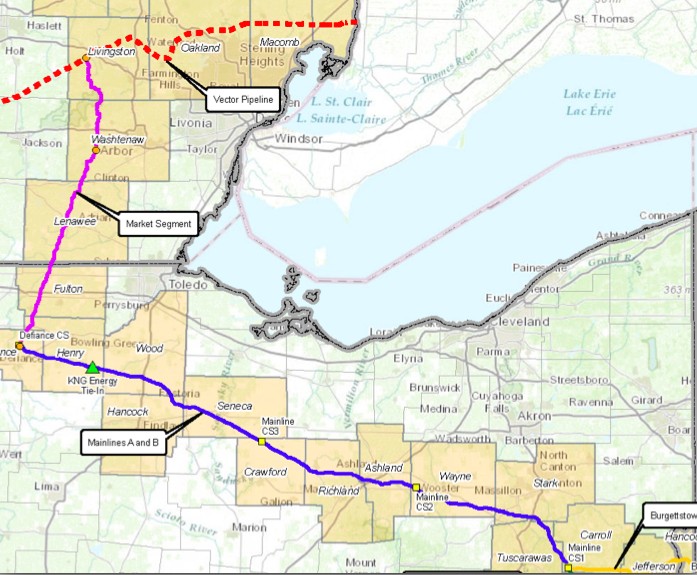
Last Friday MDN brought you the news that Energy Transfer is changing some of its previously planned underground horizontal directional drilling (HDD) to trenching in order to keep the 711-mile Rover Pipeline project that will run from PA, WV and eastern OH through OH into Michigan and eventually into Canada, on schedule (see Rover Pipeline Converts Some Horizontal Drilling to Trenches Instead). Phase I of the project is the section from eastern Ohio, Pennsylvania and West Virginia to the Midwest Hub in Defiance, OH, via what is called Rover’s “Mainline A” segment. That entire segment was supposed to be completed this month–July 2017. Ain’t gonna happen. However, Energy Transfer says a significant portion of Phase I–from Cadiz, OH to Defiance, OH–will be completed this month. That’s a pretty big portion of the Phase I project–essentially spanning the state from eastern OH to northwestern OH. If ET can pull it off, it will be an impressive feat, given delays imposed by the Federal Energy Regulatory Commission…
Read More “ETP Says Much (Not All) of Rover Phase I Will Go Online in July”
 NG Advantage wants to build a “virtual pipeline” operation in ultra-liberal Broome County, NY, in a suburb of Binghamton. The location NG picked, after considering up to six locations in the region, was selected because of it’s proximity to major highways, proximity to the Millennium Pipeline, and availability of high-power electric lines. A virtual pipeline is nothing more than a compressor plant (series of compressor plants) that grabs gas from a pipeline, in this case the Millennium, and compresses it and loads it onto special tractor trailers that then deliver the gas to industrial customers like manufacturing plants, hospitals, and even small regional systems servicing homes. The location NG selected, in the Town of Fenton (within spitting distance of Hillcrest and Port Dickinson) was approved by the Town of Fenton after a detailed review. The area they selected is zoned industrial and is, in fact, a former dump site. However, residents from nearby neighborhoods (Hillcrest and Port Dick) were not aware of the project (so they claim) and when construction began to clear the dump site, and residents learned what was going to be built at the site, some of them demanded court action to oppose it. So far we’ve had two court cases asking county-level court (called “Supreme Court” in NY) to stop the project, which it temporarily did (see
 It’s been a while since we’ve updated you on a little-known (but rapidly becoming better known) company called JKLM Energy. In May 2016, the last time we wrote about JKLM, we told you the company had successfully drilled and was flowing gas from Potter County, PA’s first Utica Shale well (see
  Here’s not something you read every day, especially in Lebanon County, PA where local media seems only too interested in covering negative stories about pipelines: “What I have heard has all been positive – that the workers were willing to go beyond anything that might be expected of them and do little special things for the landowners.” That statement is from a town official in Lebanon County, talking about Mariner East 2 pipeline construction workers who are busy in the Lebanon County installing the first of two ME2 pipelines. Of course, not everyone is happy. But then, not everyone is always happy with anything–even a sunshiny day! Here’s what’s happening in Lebanon County with ME2…
 While the construction of the Mariner East 2 natural gas liquids (NGL) pipelines in Lebanon and Lancaster Counties appears to be sailing along with very few issues (see today’s companion story), the project did hit a small bump in the road in nearby Chester County, PA. A dozen families reported their water wells became cloudy–or lost pressure–after underground horizontal directional drilling (HDD) by Sunoco Logistics Partners in attempting to install pipes underground in places where digging trenches will not work. The company put up five families in local hotels for several nights. Sunoco also provided bottled water for all of the affected families. The working theory is that bentonite clay (i.e. drilling mud) is the source of the cloudiness. Fortunately, bentonite is non-toxic and used to manufacture many products, including toothpaste and kitty litter. The incident, while troubling and inconvenient for the families involved, has not set back the project–at all. Drilling and construction of the pipeline resumed on Saturday…
 In April MDN told you that the Virginia Dept. of Environmental Quality (DEQ) had succumbed to political pressure from the MANY lib Dems in the state that oppose benign pipeline projects, like the Atlantic Coast Pipeline (ACP) and Mountain Valley Pipeline (MVP), and changed their minds about the process they will use in issuing water quality certifications under Section 401 of the federal Clean Water Act (see
 Events related (or of interest) to the Marcellus and Utica Shale, primarily pro-drilling events.
 The “best of the rest” – stories that caught MDN’s eye that you may be interested in reading. In today’s lineup: CONSOL CEO says Trump Admin wants to facilitate Marcellus/Utica; the recent surge in northeast gas production; 11 more Utica permits in Ohio; Mountaineer NGL looking for NGL storage customers; US will speed up approvals for o&g exploration on federal land; OFS companies go on the hunt for artificial lift; and more!
 Here’s a story of some Catholic nuns who have forsaken their vow to serve Christ, and instead have taken up a vow to serve radical environmentalism–which is apparently their new religion. A group of nuns in Lancaster County, PA invited the radical group Lancaster Against Pipelines (whose organizer participated in the illegal blockage of the Dakota Access Pipeline) to build a “prayer chapel” in the middle of a cornfield that belongs to the Adorers of the Blood of Christ (as they are called). The chapel is meant to stand in the way of Williams’ Atlantic Sunrise Pipeline, slated to go through that field. The so-called prayer chapel is little more than a few portable benches and a pop-up shelter like the one you would use when camping–just about big enough to cover a gas grill and leave enough room for two or three people to stand under it. The “prayer chapel” is obviously a statement thing. Knowing it will get torn down at some point, the sisters and their radical friends didn’t want to waste a lot of money on the project. Essentially this is a setup for a photo op when the bulldozers come through. It’s truly a shame to see how those who have dedicated themselves to the work of Jesus Christ have been co-opted and distracted from their far higher, and much better, calling. Unfortunately, the nuns are rank hypocrites. They themselves use–and promote the use of–natural gas for their own ministry on the very same parcel of property…
 Phase I of the 711-mile Rover Pipeline project that will run from PA, WV and eastern OH through OH into Michigan and eventually into Canada is supposed to be completed by July 2017, while Phase II is supposed to be done by November 2017. Will Phase I be done by the end of this month? We sure wouldn’t want to take that bet, but we suppose there’s still a slim chance. While building the $3.7 billion pipeline project, Energy Transfer (or more correctly its contractors) hit some snags, including spilling 2 million gallons of non-toxic drilling mud near the Tuscarawas River (see
  Earlier this week MDN told you the news that corporate raider Jana Partners, along with the Cohen family (of Atlas Energy fame), are colluding to try and stop the merger/sale of Rice Energy to EQT (see
  When EQT and Rice Energy announced a deal in June for EQT to buyout and merge in Rice to create the largest natgas-producing company in the U.S., it seemed like a match made in heaven (see
  As we do every month (and have for more than two years), MDN tracks how many rigs oilfield services company Patterson-UTI Energy reports operating–as a proxy for rig count health in general and rig count health in the Marcellus/Utica in particular. Patterson recently bought out and merged in Seventy Seven Energy (see
  In February MDN reported that Marathon Petroleum had begun to build a 49-mile condensate pipeline, called HALI–the Harpster to Lima Pipeline (see