
Antis Ask FERC to Block Dalton Expansion Project, Using Greek Pipe
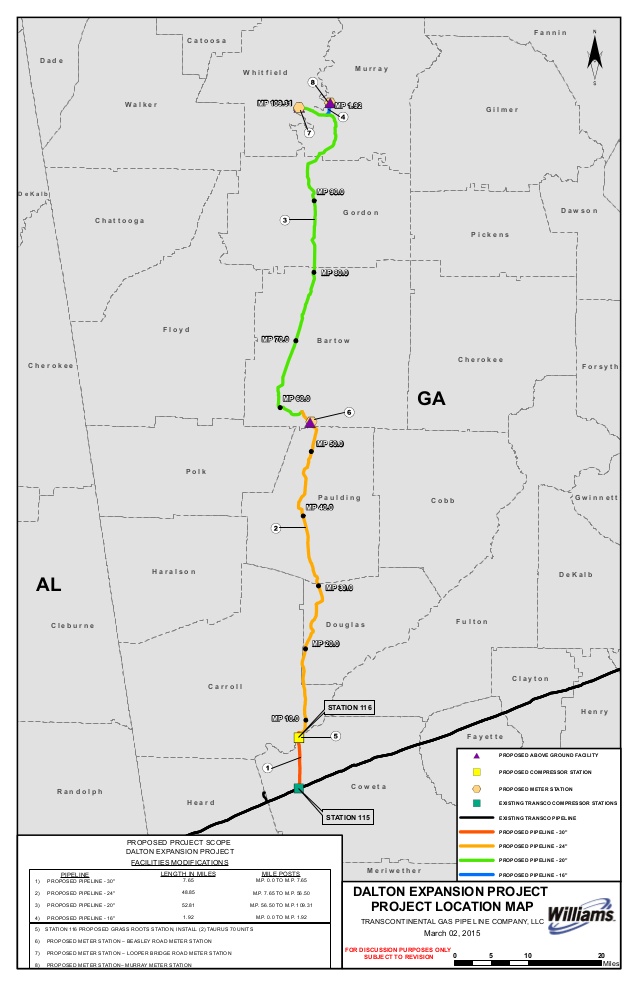
In March 2015, Williams announced that its Transco pipeline subsidiary had filed an application with the Federal Energy Regulatory Commission (FERC) for its Dalton Expansion Project, which will expand the Transco and flow more Marcellus Shale gas from New Jersey all the way to Mississippi, primarily for electric generation plants, but also for local natural gas distribution by utilities (see Williams Files with FERC to Expand Transco Pipeline from NJ to MS). Most of the Dalton project will be built in, and benefit, the State of Georgia, by delivering natural gas to an existing electric generating facility in northern Georgia operated by Oglethorpe Power Corp., delivering gas for local distribution company Atlanta Gas Light, and delivering gas for the City of Cartersville. Transco has customers signed up under binding contracts for 100% of the Dalton Expansion Project, which will increase Transco’s capacity by 448,000 dekatherms per day of natural gas. FERC approved the Dalton Project last summer (see Marcellus/Utica Gas Heading to Georgia via FERC-Approved Pipeline). Antis are now attempting to use a creative new way to stop construction. They noticed that some of the pipe being used came from Greece, so they’re asking FERC to stop the project because it doesn’t use American-made pipeline…
Read More “Antis Ask FERC to Block Dalton Expansion Project, Using Greek Pipe”
 Last week we pointed out that of all the major pipeline projects we had hoped the Federal Energy Regulatory Commission (FERC) would approve before Norman Bay quit the Commission in a huff, that NEXUS (runs through Ohio) did not get a go-ahead (see
  There may, finally, be movement by the recalcitrant Delaware River Basin Commission (DRBC) to finally, after eight years, begin to move in the direction of guidelines to allow shale drilling in two northeastern PA counties: Wayne and Pike. Why is there movement now? Because last year landowners launched a lawsuit against the DRBC, a lawsuit the DRBC now senses they may lose (see
  New Jerseyans, who don’t seem to want new natural gas pipelines, will see lower electricity rates this year–thanks to Marcellus Shale gas that flows through pipelines to electric generating plants–in New Jersey. Last Friday the NJ Board of Public Utilities approved the results of the state’s annual electricity auction. The annual auction sets wholesale electricity prices that the state’s electric utilities will pay and pass through to all NJ residential customers who have not chosen a third-party electric supplier. It is the eighth consecutive year that electric prices are either stable, or have gone down. The reason for the lower rates: “cheaper prices for wholesale natural gas.” And guess where NJ’s cheap natgas comes from? Yep–the Pennsylvania Marcellus…
 Events related to drilling in the Marcellus and Utica Shale, primarily pro-drilling.
 The “best of the rest” – stories that caught MDN’s eye that you may be interested in reading. In today’s lineup: Cash blowing in the wind with NY’s wind-power giveaway; natgas is great for Mahoning Valley; uptick in downstream energy jobs; fake report from anti groups says New England pipe not needed; the world’s hottest oil play (hint, it’s not Saudi Arabia); Williams doubles down on the Marcellus; investor honeymoon with OPEC falters; and more!
 Forced pooling legislation in West Virginia has been put forward five times in the past seven years–and each time it has failed to win enough votes in the WV legislature. In its most recent incarnation (last year), forced pooling would allow drillers to form a “unit” for drilling (typically one square mile, or 640 acres) from a group of properties where at least 80% of the mineral rights owners have signed a lease (see
  One year ago (February 2016) MDN told you about an exciting new market for Marcellus and Utica Shale gas that may open up in the next 2-3 years in the Midwest (see
  In the midstream (i.e. pipeline) world, it seems like nobody owns 100% of anything. Big midstream companies like Williams and Kinder Morgan (and others) are composed of subsidiaries and (sometimes) MLPs–master limited partnerships. And beyond the companies within companies (like a Russian nesting doll), often pieces of pipeline systems are co-owned with other companies, even competitors! In 2014 Williams bought out Access Midstream, the renamed and former division of Chesapeake Energy called Chesapeake Midstream (see
 In August 2013 an extensive investigative article about a then-director for the Pennsylvania Game Commission, William A. Capouillez, appeared in the Philadelphia Inquirer (see
  Each month MDN tracks how many rigs oilfield services company Patterson-UTI Energy reports operating–as a proxy for when/if the drop in rig counts for the Marcellus/Utica will turn around. Patterson operates a number of rigs in the northeast, as well as other areas of the continental United States (and Canada). Patterson’s rig count kept sinking month by month until June 2016 when things turned around. Since last June, Patterson has reactived and began running new rigs (higher rig count) in each successive month. Just last week Patterson released their numbers for January and once again it was good news (see
  For those of us in a certain generation, you will recognize this: Fred, Daphne, Shaggy, Velma…and of course, Scooby-Doo! If you were raised watching cartoons on Saturday morning, and you watched Scooby-Doo, do you remember the name of the van they traveled around in? That’s right, the Mystery Machine! An image of the Mystery Machine is what floated through our brain as we read about the latest venture in researching air quality in Pennsylvania near drilling sites. Researchers from Drexel University (in Philadelphia) set out across Marcellus territory in “Drexel’s Mobile Laboratory, a Ford cargo van equipped with all the equipment necessary for measuring concentrations of chemicals and particles in the air at 1-10 second intervals while driving.” The Mystery Machine! And what, pray tell, did our intrepid Marcellus sleuths find be-bopping around the countryside? In the recently published study, “Analysis of local-scale background concentrations of methane and other gas-phase species in the Marcellus Shale” (full copy below), researchers say they found that even though the number of Marcellus wells being drilled has slowed quite a bit over the past few years, the amount of fugitive methane in the air has increased. And the increase can’t be explained by a general global increase in fugitive methane. The increase in fugitive methane in the Marcellus is due, our methane sleuths say, to the “increased production of natural gas from the region which has increased significantly over the 2012 to 2015 period.” The researchers conclude that “because everybody knows how evil and nasty fugitive methane is for global warming” (our words), this study is yet more evidence that Marcellus shale drilling (and pipelines, etc.) leak so much methane as to make any benefits we get from extracting and burning methane, over say coal, muted–even lost. Because we can’t put a cork in it, by extracting and using methane we’re making poor old Mom Earth even sicker. Which is, of course, total bunkum…
 Two days ago Eclipse Resources, a Marcellus/Utica pure play driller headquartered in State College, PA that drills mostly in Ohio, released an update for fourth quarter and all of 2016. However, it was an operational and not financial update. Consider this the “good news” from 2016. Among the highlights: Production averaged 229 million cubic feet equivalent (MMcfe) per day, which was above their previous estimates of what it would be. Year-end proved reserves increased by 35% to 469 billion cubic feet equilvanet (Bcfe). Eclipse idled most of its drilling rigs in the first half of 2016 given the low price of gas, but they did drill one notable well early last year–the monster Purple Hayes well in the Ohio Utica–with a lateral (the horizontal part) that reached out 18,500 feet–an astonishing 3.5 miles (see