
Antero Resources 1Q16: Production Up 18%, Sells Gas for $4.54/Mcf
 Antero Resources is one of the very few Marcellus/Utica drillers (actually drillers of any play) who is still making money in this severe downturn in prices (see Antero Resources Stands Above the Rest – Nets $941M in 2015). Yesterday Antero released their first quarter 2016 operational (not financial) update. Among the gems: Production continued to increase–to an average 1.758 billion cubic feet per day. That’s up 18% from 1Q15 and up 17% from 4Q15. The key to how they make their money was also revealed. Antero’s gas sold for $2.08 per thousand cubic feet (Mcf) BEFORE hedging. But Antero hedges most of its production, so the price they received AFTER hedging was $4.54/Mcf. The company says they sold 99% of their gas to “favorably priced markets.” They must have really good financial people at Antero! Other fascinating tidbits: Drilling and completion costs have sunk to under $1 million per 1,000 feet in the Marcellus, and $1.14 million per 1,000 feet in the Utica. Here’s the full update from yesterday with loads of useful details…
Read More “Antero Resources 1Q16: Production Up 18%, Sells Gas for $4.54/Mcf”
 Stone Energy, an independent oil and natural gas exploration and production company (E&P) headquartered in Lafayette, Louisiana drills mainly in the Gulf of Mexico but also has a presence in the Marcellus/Utica Shale with 75,000 acres of leases. Last year Stone quit drilling in the northeast and actually shut-in part of their production due to low prices (see
  Last week MDN brought you the fantastic news that the Federal Energy Regulatory Commission (FERC) had approved Williams’ Transco Pipeline project called the Garden State Expansion–a pipeline project to connect gas that will come through the yet-to-be-built PennEast Pipeline to a yet-to-be-built pipeline in New Jersey called the Southern Reliability Link pipeline (see
  We have an interesting update to share with you regarding the former Ormet Aluminum Plant site located on the shoreline of the Ohio River in Monroe County, OH. The plant closed its doors as an active aluminum plant in 2014 after Ohio regulators and Gov. John “foreigner hunter” Kasich failed to get high electric rates reduced for the plant, and refused to allow Ormet to burn coal to produce their own electricity until they could begin using natural gas to create electricity from gas wells drilled on the property (see
  A Delaware court has granted a motion by Williams to hurry-it-up with their recently filed lawsuit against Energy Transfer Equity (ETE)–the company trying to buy Williams. No, Williams is not trying to fend off the purchase. They’re trying to ensure Williams stockholders (and the managers of Williams) get the agreed-to price. Last week Williams sued ETE and its CEO Kelsy Warren for issuing private shares of stock to select investors to help finance the deal (see
 In the natural gas world there are two seasons: winter (when you use natural gas) and summer (when you “inject” or store natural gas). The “winter strip” goes from November to March, and the “summer strip” runs from April through October. Storage levels are a key factor in the pricing of natural gas. Economics 101: the price for commodities like natgas is purely a function of supply and demand. If you have more supply than demand, the price goes down. In the northeast part of the country we just came through the mildest (temperature-wise) winter in a generation. We used a lot less natgas than we normally would. That means the gas sitting in storage didn’t get drawn down nearly as much as it usually does. That’s what you would expect, and the U.S. Energy Information Administration (EIA) has confirmed it. We ended the winter heating season at the end of March with “record high levels” of natgas sitting in storage. And now we begin the process of storing more. If all other factors remain equal–meaning there’s no new or sudden increase in demand this summer–it doesn’t take a genius to figure out how record high storage levels will affect the price. Here’s the EIA with their latest on storage…
 The sudden slowdown in drilling activity not only affects drillers, oilfield services companies, midstreamers and the many supply chain companies (restaurants, hotels, fencing, etc.) that service them–it also affects trade associations. Last November America’s Natural Gas Association merged with the more flush American Petroleum Institute (see
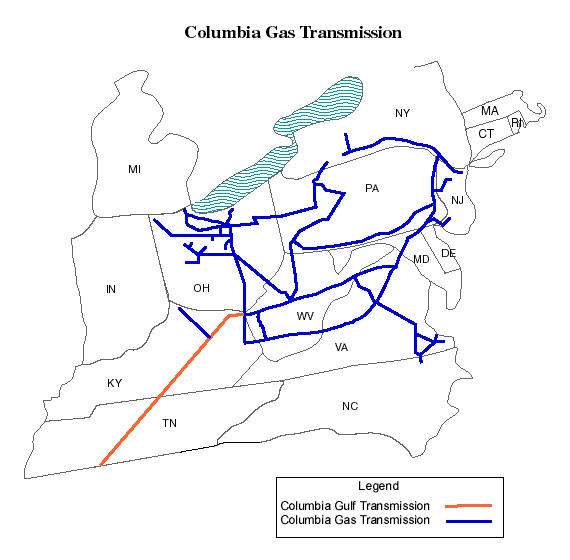
 Pennsylvania State Rep. Martin Causer (R-Turtlepoint) testified before the U.S. House Committee on Agriculture in Washington, DC on Wednesday, April 13. Causer was there to tell the House Agriculture Committee that new pipelines are desperately needed in the farm country he represents. We have a copy of Rep. Causer’s masterful testimony below…