
Cosmetics Firm, Church Fund Anti “Camps” Against Atlantic Sunrise
 Ding dong–Lush is calling. A British cosmetics company (think UK version of Avon), looking to get bought-and-paid-for publicity here in the states, has donated $22,000 to the anti-Atlantic Sunrise Pipeline group, Lancaster Against Pipelines (LAP). Anti-drilling losers like those in LAP would flare out if not for the backing of companies and Big Green groups with deep pockets. Which cosmetics company did the donating? The name is Lush. You’ve never heard of them and almost certainly have never purchased any of their forgettable products–which is why they donate money to groups like LAP, to get far more exposure than advertising can buy. There’s enough nutjobs out there that will buy products from companies like Lush to make “donating” money for “causes” to these groups a profitable venture. Another funder of LAP? The Universal Unitarian Church in Lancaster, which forked over $5,000 of parishioner contributions to LAP. Hello IRS! Will you please investigate the non-profit Universal Unitarian Church for giving money to an overtly political cause? Who else is donating money to the small group of LAP rabble-rousers?…
Read More “Cosmetics Firm, Church Fund Anti “Camps” Against Atlantic Sunrise”
 Here’s an interesting story. A religious commune of Hare Krishnas in Marshall County, WV steadfastly refused to sign an easement with Rover Pipeline to allow the pipeline across ~3,000 feet of commune-owned property. Rover had offered the Krishnas $7,000 for the easement, but no dice. You may recall that the Krishnas have no problem accepting oil and gas money, and have done so by leasing their land for shale drilling–even though the official view of the Krishnas is that “gas drilling is exploitative, that it is unsustainable and ‘contributes to the culture of death and toxicity’” (see
 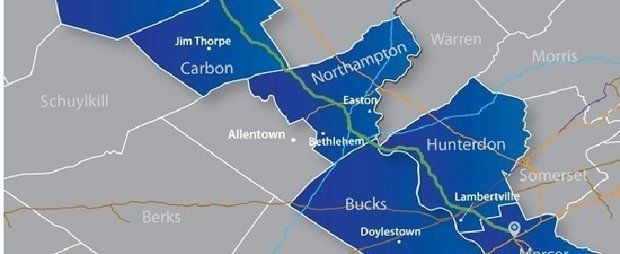 PennEast Pipeline is a $1 billion, 118-mile pipeline from Luzerne County, PA to Mercer County, NJ. Along the entire length of the pipeline, there will only be one compressor station–located in Carbon County, PA. This past Wednesday the PA Dept. of Environmental Protection (DEP) conducted a public hearing on the compressor station plan. Nominally the hearing is to elicit feedback from the public. However, as is so often the case, these are not really hearings but theatrical performances where anti-drilling kooks put on the equivalent of a circus act. But antis weren’t the only ones who showed up for the hearing. Plenty of supporters were there too…
 The Delaware River Basin Commission (DRBC), charged with overseeing potential impacts on the Delaware River and the various tributaries that feed it, has stepped outside of its legal bounds with plans to review the PennEast Pipeline, part of which will run through the Delaware River Basin area. In 2014 the DRBC tried to tell PennEast and its sponsors that the pipeline will need their approval before it can be built (see
  Yesterday MDN editor Jim Willis had the pleasure of attending, and moderating two panel sessions, at the Oil & Gas Awards 2017 Northeast Industry Summit in Pittsburgh. (Jim is back in Binghamton today, very tired!) When the sessions are made available via video, Jim will post them here on MDN. In the meantime a few words about the sessions and presenters, and about what we consider some pretty big news coming out of yesterday’s meeting. The day began with MDN friend George Stark, Director of External Affairs for Cabot Oil & Gas, making an impassioned plea for everyone in the industry to get involved with telling the great story of our beloved industry. Don’t think it’s someone else’s role–it’s the role of every single person in the industry, from janitor to secretary to CEO. George gave a rousing, opening address. George was followed by a panel discussion led by MDN friend Charlie Schliebs, Managing Director of Stone Pier Capital. Charlie’s panel tackled some interesting topics about mergers and acquisitions, bankruptcies, and where they see the price of natural gas going over the next several years. After Charlies panel was a panel discussing pipeline projects. The moderator was Fred Lowther, a partner at powerhouse energy law firm Blank Rome. Fred, who once worked on the Iroquois Gas Transmission Pipeline project when it was being built, said over the years since that pipeline was built he’s often joked they failed to do a “celebrity impact statement” when building it. Liked that line! After Fred’s panel was a talk given by Michael Krancer, also with Blank Rome (and former Secretary of the PA Dept. of Environmental Protection). Mike is always a take-no-prisoners presenter. We’ve always loved the way he thinks and expresses himself. Yesterday was no different. It was during Mike’s talk that we found what we believe was the most important thing said yesterday. It has to do with PA’s proposed General Permit 5A. Mike said if GP-5A is enacted as written, it will result in a 12-18 month moratorium on production in Pennsylvania…
 MDN has highlighted the importance of the Ohio Supreme Court’s decision with regard to the Ohio Dormant Mineral Act (DMA). In September the OH Supreme Court ruled in three DMA cases, saying all of the other cases come under those three (see
  We spotted an article on the Hot Air website about a court challenge in Colorado that may (or may not) have implications for shale drilling in places like New York State. Several years ago the ultra-liberal Boulder County, CO banned fracking. Landowners in the county are unconstitutionally denied the right to use their land as they see fit. So Colorado’s Attorney General, Cynthia Coffman, has just sued Boulder County to have the frack ban declared illegal. IF the case were to get appealed to a federal court and IF the case decided that Boulder County does not have the right to ban fracking, might that not serve as a precedence for New York and a statewide ban? We know, we know. It’s a stretch and a lot of IFs. But it is an intriguing idea–and a case worth watching…
 Last year the federal Environmental Protection Agency (EPA) under Barack Hussein Obama once again far exceeded its constitutional limits by enacting a new methane regulation that requires oil and gas operators to install all sorts of expensive equipment in a vain attempt to sniff out so-called fugitive methane (see
 The “best of the rest” – stories that caught MDN’s eye that you may be interested in reading. In today’s lineup: Hundreds rally against fracking in Maryland; no new Utica wells in OH for Hess in 2017; phones “ringing off the hook” with biz opportunities in OH, thx to fracking; Utica Shale Academy students get certs; Marcellus Shale exports from Philly jump in 2016; Exxon now spends 50% of drilling budget on shale; US shale pokes OPEC in the eye; no peak oil for America, or the world; OPEC fails to deliver on promised target cuts in production; and more!