
60 New Shale Well Permits Issued for PA-OH-WV Dec 1 – 7
 After a pathetic showing two weeks ago (just 8 permits), last week was a barnstormer—the most permits we’ve seen issued in a single week since we’ve been chronicling permits here on MDN. But, there’s a catch. Last week’s report for the combined three states shows 60 (!) permits issued, with 22 going to Pennsylvania, 24 to Ohio, and 14 to West Virginia. However, Ohio’s numbers are inflated because the Ohio Department of Natural Resources (ODNR) reported numbers last week that stretch back three weeks in time. You may recall Ohio didn’t issue permits for two weeks in a row. They actually issued permits but didn’t report them. So, this report includes 6 permits for the two missing weeks. Still, removing six from the total means 54 permits were issued last week, which remains a record high. Could the spike in the spot price for natural gas in the M-U be the reason? Read More “60 New Shale Well Permits Issued for PA-OH-WV Dec 1 – 7”
 The highly functional and responsible Susquehanna River Basin Commission (SRBC), unlike its highly dysfunctional and irresponsible counterpart, the Delaware River Basin Commission (DRBC), continues to support the shale energy industry by approving water withdrawals and consumptive use for responsible and safe shale drilling. The SRBC also tells shale drillers when to stop withdrawing if low water flow (i.e., drought) conditions exist. Or when a body of water is frozen or blocked by ice. That’s what the SRBC did yesterday. The agency, via its Hydrologic Conditions Monitor, warned shale drillers that, at 58 listed locations (all in Pennsylvania), they must stop water withdrawals until streamflow reaches a specific “trigger flow” target (different for each location) or until the ice thaws.
  Tailwater Capital LLC, an energy and infrastructure private equity firm based in Dallas, Texas, yesterday announced it has closed on the acquisition of a majority interest in Central Midstream Partners, LLC (originally established as Central Crude). Central Midstream provides liquids transportation, storage, and terminal services to support demand-pull customers across the Gulf Coast and in the Utica region. We have to confess we had not heard about nor written about Central Midstream before this announcement.
  Epsilon Energy, a relatively small company, used to concentrate most of its effort on developing Marcellus Shale wells. However, over the past few years, the company has expanded into other plays and now owns assets in the Anadarko (Oklahoma), the Permian (Texas), the Powder River Basin (Wyoming), and the Western Canadian Sedimentary Basin (in Alberta, Canada). Epsilon typically does not do its own drilling. It joint venture partners with (gives money to) other companies, like Expand Energy in the Marcellus, and the other company does the drilling. Epsilon announced yesterday that it has sold its subsidiary that owned the Oklahoma assets for $2.5 million to an undisclosed private buyer.
  A month ago, MDN reported that Energy Transfer was holding off on a final investment decision (FID) for its Lake Charles LNG export project until 80% of the project had been sold to equity partners (see
  U.S. natural gas production and demand reached record highs in 2025, with the U.S. Energy Information Administration (EIA) projecting continued growth in output and LNG exports through 2026. Driven by surging international demand in Europe and Asia, the U.S. has become the world’s largest LNG exporter. This natural gas resurgence is bolstered by the Trump administration’s support and significant investments from major energy firms prioritizing gas as a so-called transition fuel (it’s actually a destination fuel). Consequently, U.S. natural gas pipeline capacity is set for its biggest one-year expansion since 2008. Surging demand from LNG exporters, data centers, and manufacturing is driving a $50 billion investment boom.
 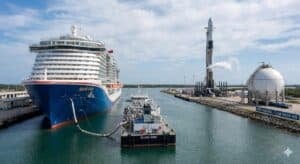 Representatives from Chesapeake Utilities and BHE GT&S, a subsidiary of Berkshire Hathaway Energy, presented a proposal to the Port Canaveral Authority to construct a new liquid natural gas (LNG) liquefaction facility in Brevard County. The project, targeting a 2029 completion date, aims to supply essential fuel for both cruise ships and the burgeoning space industry’s rockets. While LNG is currently trucked in to support rocket launches, this facility would provide dedicated local infrastructure to meet the growing demands of the world’s busiest cruise port and the active space sector.
  OTHER U.S. REGIONS: Drew Barrymore joins MSC Cruises to celebrate new LNG-powered ship; Consumers Energy defends customer protections for data centers against challenge from Mich. AG; New York was a leader on climate issues, under Hochul things changed; The Gulf of America is back; NATIONAL: Natural gas prices are down 20% in just a week; Winners from S&P Global Energy’s 27th Annual Platts Global Energy Awards; Voltagrid & Halliburton make 400 MW power commitment re data centers; US gas inventories down by 177 Bcf; One state’s green mandates can become another state’s nightmare; U.S. E&Ps continue to maintain investor support despite commodity price plunge; Supremes have chance to end climate lawfare; INTERNATIONAL: Crude settles at October lows; The Christmas gift that climate Grinches can’t abide.