
Virginia’s Biggest NatGas-Fired Power Station Goes Online
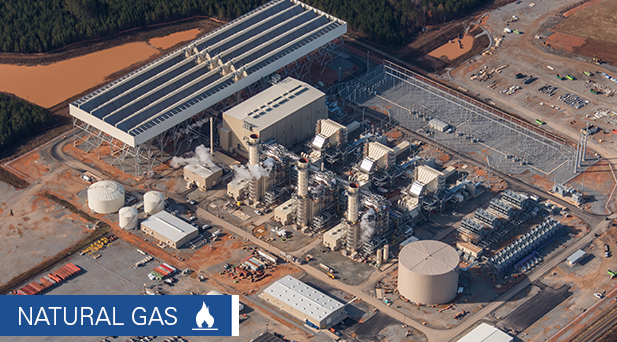
In March 2015, Dominion announced plans to build the State of Virginia’s largest natural gas powered electric generating plant, in Greensville County, VA (see Virginia’s Largest Electric Plant to be Powered by Marcellus Gas). The $1.3 billion state-of-the-art natural gas-fired electric generating station generates 1,588 megawatts of electricity. Construction began in June 2016 (see Dominion Begins Building Virginia’s Biggest NatGas Power Station). And finally on Saturday, Dec. 8, the plant went online. Dominion’s own 600-mile Atlantic Coast Pipeline (when completed) will provide cheap, abundant, clean-burning Marcellus/Utica Shale gas to power it. Until Atlantic Coast is up and running, where will the gas come from to power it? We couldn’t find confirmation on the source of gas that feeds it now–but we’re guessing it’s Marcellus gas, making this a hugely important new market for our gas.
Read More “Virginia’s Biggest NatGas-Fired Power Station Goes Online”


 We bring you the following story purely for your (and our) entertainment. Dominion Energy, a huge company with its fingers in many energy pies (pipelines, LNG exports, power generation, utility company), is teaming up with the world’s largest pork producer, Smithfield, to “harness methane gas from thousands of malodorous hog lagoons.” That is, they will capture methane from pig poop and use that methane to “heat homes and combat climate change.” (Excuse us while we get up off the floor from laughing so hard!) The story comes from the well known fake news purveyor Washington Post, so we can’t be 100% sure of its accuracy. But we’ll go with it, simply for laughs.
 The move to dissolve MLPs (master limited partnerships) and replace them with a corporate structure continues. In March, the Federal Energy Regulatory Commission (FERC) took “significant action” to address the Trump tax cut legislation enacted last December (see
  In a pattern that has repeated itself with both the Mountain Valley Pipeline and (now) the Atlantic Coast Pipeline (ACP), a key permit that allows ACP to build under and through streams and rivers and wetlands has been, for now, revoked. The permit is called a Nationwide Permit (NWP) 12 and was previously issued by the U.S. Army Corps of Engineers to allow ACP to build through streams, etc. in all three states where it runs–West Virginia, Virginia and North Carolina. Earlier this month the U.S. Fourth Circuit Court of Appeals put a temporary stop on constructing the pipeline across/under/through streams and rivers in WV (see
  Security at energy companies is no longer an afterthought, no longer an annual “audit” that’s done to ensure you have good policies in place. It’s now something that must be actively managed day-to-day. Threats come in all sizes and types, from nutty pipeline protesters who tip over into violence, to Russian and Chinese hackers looking to screw with our electric grid and steal our secrets. Knowing this, Dominion Energy, a huge company with its fingers in many energy pies–from pipelines to electric generation (wind, solar, natural gas, nuclear) to local electric and gas delivery (utility company)–has just hired the former FBI division chief for Richmond, Va. as its new Chief Security Officer–a newly created role in the company. Our prediction: You’ll see more CSOs in the future.
 There is a political mess brewing in North Carolina–a mess that has made for some strange bedfellows. Rabid anti-fossil fuelers are supporting Republicans in a bid to target NC’s Democrat governor because his administration granted a permit for Dominion Energy’s Atlantic Coast Pipeline (ACP) in the state. We first reported on this developing situation back in September (see
  In January Dominion Energy announced a deal to buy out and merge in South Carolina-based SCANA Corporation (see
  There is a fascinating bit of politics playing out in Virginia. The state’s previous governor, Terry McAuliffe, favored pipeline projects like EQT’s Mountain Valley Pipeline (MVP) and Dominion’s Atlantic Coast Pipeline (ACP). What’s strange about McAuliffe’s support is that he’s a far-left Democrat. Yet he resisted calls from his nutroots base to shut both pipeline projects down. McAuliffe was replaced in January 2018 by Ralph Northam, another liberal Democrat (lib Dems get elected in Virginia because of a high population of libs who live around the D.C. area). Once again the nutters came out in force to pressure the new governor to oppose MVP and ACP. And once again, the new governor is not caving to the pressure. In fact, Gov. Northam has just canned two board members who voted to delay a vote on an ACP compressor station!
 If there’s one more black person living in a given rural community than white, and if a pipeline company wants to put a compressor station in that community as the best location to push gas through the line, the very act of building that compressor station in that community is racist. That’s the horse manure being pedaled in Buckingham County, Va. Last week the State Air Pollution Control Board held two days of public hearings where antis, detecting they may lose the battle to stop a compressor station for Dominion Energy’s 600-mile Atlantic Coast Pipeline, trotted out their so-called “environmental justice” argument. Last Friday the board decided to delay a vote on whether to approve the compressor station, until their meeting on Dec. 10.
 We’ve covered, it seems endlessly, news about two important new pipeline projects coming in the Marcellus. One is EQT Midstream’s (now Equitrans Midstream) Mountain Valley Pipeline (MVP), a 303-mile pipe from West Virginia to southern Virginia. The other is Dominion Energy’s 600-mile Atlantic Coast Pipeline (ACP), from West Virginia through Virginia and into North Carolina. MVP will, when it’s done, carry 2 billion cubic feet per day (Bcf/d) of natural gas to southern markets, and ACP will carry 1.5 Bcf/d. Both pipelines chart a similar path south. And both pipelines are now stalled, dogged by frivolous lawsuits filed by so-called environmental groups. Both have announced delays for their final completion dates. Our friends at RBN Energy look in detail at both projects, and what a delay may mean for drillers in the Marcellus/Utica. Are more pipeline constraints on the way in our region?
 It would be great when you are drilling a well, or building a pipeline, that when a state government inspector swings by to check up on the project, they don’t spot any problems. Especially for big projects like pipelines that run hundreds of miles. It would be nice, but not reality. Something always happens here and there. Unforeseen. Like weather with torrential rain, resulting in runoff from a ditch you just dug. The inspector swings by the next day and notices water and dirt where it’s not supposed to be, and voila, a “notice of violation” (NOV) is issued. It happens. That’s the way the world works. For Mountain Valley Pipeline (MVP) and Atlantic Coast Pipeline (ACP), both with segments in West Virginia, NOVs have been and no doubt will continue to be issued. How many NOVs would you imagine have already been issued for each project in WV? How many is “too many” and indicates the project builders are being sloppy?
 In September, MDN told you that Dominion Energy had sold two “merchant” (non-regulated) natural gas-fired electric generating plants for $1.23 billion to Starwood Energy. And at the same time, Dominion announced it was shopping its 50% ownership stake in Blue Racer Midstream (see
  Dominion Energy shared two bits of big news yesterday during their third quarter 2018 update. The first is that they’ve agreed to sell their 50% stake in Blue Racer Midstream (see Dominion Sells Its 50% Share in Blue Racer Midstream for $1.5B). The second bit of news, big news (for us), is that Atlantic Coast Pipeline (ACP) is now officially delayed–from late 2019 to “mid-2020” for a full startup. The price tag for ACP is going up too: $7 billion (up from $6.5 billion). But it’s not all bad news for ACP. Some pieces of the project will still go online in 2019, just not all of it. Dominion is taking a “phased in-service approach” to bringing the project online. The delays are due to the “FERC stop work order and delays obtaining permits necessary for construction.” We put it this way: The delays due to a myriad of frivolous lawsuits from Big Green groups means everyone will now pay more. Thanks Big Green.