Washington Co. Brine Spill Doubles in Size, Cleanup Drags On
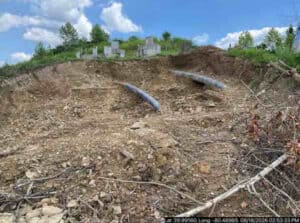
Remember that shale wastewater pipeline leak we told you about in West Finley Township, Washington County, back in July (see HG Energy Washington Co. Pad Leaks Up to 1,000 Barrels of Wastewater)? It’s worse than first reported; it still hasn’t been cleaned up, and the company DEP keeps writing violations to isn’t the driller you’d expect. It’s a New York City loan vehicle. When we first covered this on July 16, the Pennsylvania Department of Environmental Protection (DEP) said a failed piece of equipment in a cement vault had let loose somewhere between 21,000 and 42,000 gallons of brine — that’s produced water, the salty stuff that comes back up out of a shale well — near the WFN-6 well pad. Drone crews spotted it July 8. Two things have changed since then, and both are worth your attention. Read More “Washington Co. Brine Spill Doubles in Size, Cleanup Drags On”
 A second poll of Pennsylvania voters on data centers landed this week, and the headlines say what you’d expect: six in ten are opposed. Dig into the crosstabs — the detailed tables showing how each group answered — and you find something the coverage skipped entirely. A majority of Pennsylvania Republicans support building data centers. Fifty-one percent for, 42% against (take note, Stacy Garrity). The Philadelphia Inquirer, teaming up with the New York Times and Siena University, surveyed 760 likely Pennsylvania voters from August 17-21. The topline: 62% oppose the construction of AI data centers, 33% support them.
 The PJM market monitor asked federal regulators to kill Hull Street Energy’s purchase of two gas-fired peaking plants unless Hull Street promised not to point them at data centers. On August 13, FERC said no — and said the monitor hadn’t supported its argument. Thirteen days later, the deal closed. Hull Street Energy (HSE), a private equity firm in the Washington, D.C. area, announced yesterday that it completed the acquisition of the Lee County Generating Station in Dixon, Illinois, and the Tait Electric Generating Station near Dayton, Ohio, from Rockland Capital. HSE calls the pair the “GridFlex Portfolio” and has folded it into Milepost Power, its thermal generation platform.
  Eureka Resources sold the business at all three of its shuttered Pennsylvania frack wastewater plants. What it did not sell — and legally could not sell — is the obligation to finish hauling the waste out. The Department of Environmental Protection (DEP) put that in writing last week, and added five words that ought to get somebody’s attention in Williamsport: DEP “is considering alternative enforcement measures.” The news comes, again, not from Eureka and not from a DEP press release, but from the Middle Susquehanna Riverkeeper Association, which keeps sending the agency questions and publishing the answers. DEP Northcentral communications manager Megan Lehman replied by email Aug. 20; the Riverkeeper posted the exchange Aug. 24.
  The single most important piece of pipe for Marcellus/Utica wet gas drillers is about to get a lot cheaper to use — and Enterprise Products Partners (EPD) just said so out loud. On its second quarter earnings call, EPD told analysts that the tolls it charges on ATEX, the 1,230-mile ethane pipeline running from Washington County, PA to Mont Belvieu, TX, now often cost more than the ethane moving through it. Enterprise executive Justin Kreider put it plainly: “There is going to be some degree of a rate reset.” A new analysis from East Daley Analytics puts numbers behind that comment — and finds that roughly half of ATEX’s capacity comes up for renewal in 2028.
  A new report from Global Energy Monitor (GEM) — a group that says it exists “in support of the worldwide movement for clean energy” — was written to sound an alarm about a runaway natural gas buildout. Buried in one of its charts is the best news Appalachian landowners have gotten all year. Pennsylvania, Ohio, and West Virginia together added almost exactly as much new gas-fired power capacity in the first six months of 2026 as the entire state of Texas.
  A federal appeals court in Washington on Tuesday threw out all eleven claims that environmental groups and Louisiana fishermen filed against Venture Global’s CP2 LNG export terminal and the pipeline that will feed it. The terminal sits 1,300 miles from Washington County, Pennsylvania — but buried in this decision is a holding that should make every Marcellus/Utica pipeline developer very happy. The case is For a Better Bayou v. FERC, No. 24-1291 (consolidated with Nos. 24-1292 and 25-1157). It was argued March 24 and decided August 25. Senior Judge Douglas Ginsburg, a Reagan appointee, wrote for a unanimous panel that also included Judge Karen Henderson (George H.W. Bush) and Judge Patricia Millett (Obama).
  The International Gas Union (IGU), Snam, and Rystad Energy released the 2026 Global Gas Report this morning (full copy below), and there’s one line in it Marcellus/Utica readers shouldn’t skip past. The record 4,147 billion cubic meters (bcm) of natural gas the world produced last year was driven, in the report’s words, overwhelmingly by North America — and the three basins it names are the Permian, the Haynesville, and Appalachia. That’s us. A bcm, by the way, is a billion cubic meters, or roughly 35.3 billion cubic feet (Bcf). North America’s 54 bcm of added supply works out to about 1.9 trillion cubic feet, or a little over 5 Bcf/d of new gas in a single year.
  Five Senate Democrats have escalated their fight over Cheniere Energy’s $370 million IRS “alternative fuel” tax payout, formally asking Treasury’s internal watchdog to investigate. Sen. Jeff Merkley (D-OR), joined by Senate Democratic Leader Chuck Schumer (D-NY) and Sens. Chris Van Hollen (D-MD), Edward Markey (D-MA), and Sheldon Whitehouse (D-RI), sent an Aug. 20 letter to Acting Treasury Inspector General for Tax Administration (TIGTA) Heather Hill. The letter asks TIGTA to determine how and why the IRS decided LNG tankers qualify as “motorboats” under the Alternative Fuel Excise Tax (AFET) credit—and, notably, whether the call was made to reward President Trump’s campaign donors.
 A federal appeals court has handed XTO Energy (ExxonMobil’s shale subsidiary) a win in a long-running Western Pennsylvania royalty lawsuit, ruling Monday that XTO did NOT give up its right to push some landowners into private arbitration — even though it spent 55 months litigating the case before it asked. The case is Salvatora v. XTO Energy Inc., a cousin of the Kriley case MDN has also followed. Same defendant, same Pittsburgh courthouse, same plaintiffs’ firm, same complaint: landowners say XTO shaved too much off their royalty checks for “post-production costs” — the gathering, compression, and processing charges that move gas from the wellhead to a buyer.
 A new Penn State study went looking for radium from fracking in southwestern Pennsylvania drinking water. It tested 91 private wells and springs in Washington and Greene counties and found exactly zero samples above the EPA limit — and the radium it did find carries the chemical fingerprint of the rock the water sits in, not Marcellus brine. You wouldn’t know that from Penn State’s press release headline, which falsely blares, “