PA Issues Final Permit for Atlantic Sunrise, Construction Sept 20
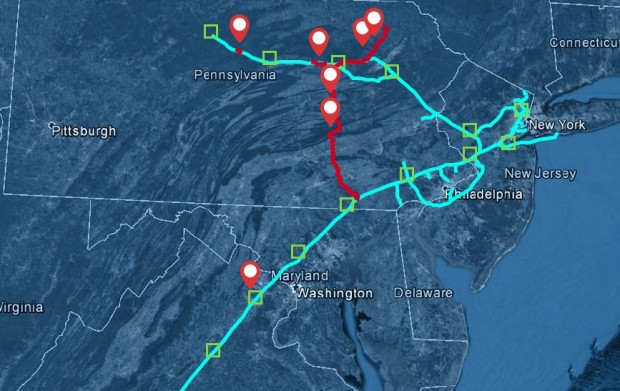
 Atlantic Sunrise Pipeline is primed and ready to begin construction after receiving its very last required permit from Pennsylvania–an Air Quality Plan Approval for air emissions related to construction activities in Lancaster County. The PA Dept. of Environmental Protection (DEP) issued the Air Quality permit last Friday. You may recall Atlantic Sunrise, a $3 billion, 198-mile pipeline project running through 10 Pennsylvania counties to connect Marcellus Shale natural gas from northeastern PA with the Williams’ Transco pipeline in southern Lancaster County, received water crossing permits from the DEP and U.S. Army Corps of Engineers a few weeks ago (see Atlantic Sunrise Pipe Gets Water Permits from Army Corps, PA DEP). In August the DEP held a public hearing in Lancaster to accept public comment on the air permit. A small group of anti-pipeline protesters acted like petulant 5-year olds and walked out of the hearing (see Big Green Groups Stage Walkout at PA DEP Atlantic Sunrise Hearing). No matter. Their antics didn’t affect the DEP. According to Williams, the builder of the pipeline, they now await an order from the Federal Energy Regulatory Commission (FERC) to begin construction. They expect to receive that order any day now. They hope (and expect) to begin construction next Wednesday, Sept. 20th…
Read More “PA Issues Final Permit for Atlantic Sunrise, Construction Sept 20”
 Turns out the rumors were true. The Delaware River Basin Commission has now been totally corrupted by Big Green groups and plans to vote tomorrow, Sept. 13, on a resolution that begins the process of implementing a permanent ban on fracking in the Delaware River Basin. This is not the end, but the beginning of the end, of any hope for landowners in Wayne and Pike counties in PA. Their property rights will (like those of us who live in New York) be stripped away. Except in Wayne and Pike, it will be a permanent stripping away. At least in NY we have the hope of one day ejecting Lord Cuomo from office and reversing the ongoing moratorium. However, even though this should be a total win for radicals like THE Delaware Riverkeeper (aka Maya van Rossum), the radicals are STILL not happy! Can you believe it?! Part of the proposed resolution and rulemaking to follow will consider allowing frack wastewater disposal within the DRBC’s fiefdom. That just can’t stand according to Maya and her rad pals. Here’s the DRBC announcement, news coverage of it (with quotes from radical groups), along with a copy of the proposed resolution that will be voted on tomorrow…
 In March, the West Virginia Dept. of Environmental Protection (WVDEP) issued a federal water crossing permit for the Mountain Valley Pipeline (MVP)–a $3.5 billion, 301-mile pipeline that will run from Wetzel County, WV to the Transco Pipeline in Pittsylvania County, VA (see
  The New York Dept. of Environmental Conservation (DEC) is tap dancing to explain why they refused to grant a water crossing permit for a 7.8-mile pipeline in Orange County to Millennium Pipeline Valley Lateral Project, yet a few days before that refusal they granted a water crossing permit to Millennium for the Eastern System Upgrade, which includes 7.8 miles of looping pipeline in yes, Orange County! The Millennium Pipeline stretches ~244 miles from Independence in Steuben County, NY to Buena Vista in Rockland County, NY. The Millennium, which is supplied by local production (much of it Marcellus Shale gas) and storage fields and interconnecting upstream pipelines, serves customers along its route in New York’s Southern Tier region and helps meet the energy needs of northeast markets. In August 2016, Millennium filed an application for what it calls its Eastern System Upgrade (see
  On August 30th the New York Dept. of Environmental Conservation (DEC) issued a refusal to grant a water permit to Millennium Pipeline to build a tiny, 7.8 mile pipeline spur from the main Millennium Pipeline to an under-construction natural gas-fired electric generating plant in Orange County (see
  It was just yesterday that MDN highlighted a story written by friend Tom Shepstone on his Natural Gas Now website theorizing that the Delaware River Basin Commission, long influenced by big money coming from the Haas family via the William Penn Foundation and their surrogates, is planning to implement a full ban on fracking in the Delaware River Basin (see Tom’s story:
  TransCanada’s WP XPress pipeline project has just scored an important permit from the U.S. Dept. of Agriculture (USDA) Forest Service that allows the project to move forward in the Monongahela National Forest. In Jan. 2016, Columbia Pipeline Group (now owned by TransCanada) filed a full, official application with the Federal Energy Regulatory Commission (FERC) for approval of the $850 million WB XPress Project (see
  In July MDN told you that puppets of the PA-based Community Environmental Legal Defense Fund (CELDF) have once again gotten enough signatures to put a so-called Community Bill of Rights (i.e. frack ban) ballot measure on the ballot this November in Youngstown, Ohio–for the 7th time (see
  Dominion Energy and Duke Energy hopes lightening will strike twice. In August, DTE Energy and Spectra Energy (now part of Enbridge), sent a letter to the new FERC quorum urging fast action to approve NEXUS Pipeline, a $2 billion, 255-mile interstate pipeline that will run from Ohio through Michigan and eventually to the Dawn Hub in Ontario, Canada (see
  It looks like Big Green has succeeded in conflating a mole hill into a mountain in Pennsylvania. In early August, Sunoco Logistics struck a deal with with several Big Green groups to provide stricter regulation for Mariner East 2 Pipeline’s underground drilling (see
  As we reported last week, a Broome County, NY judge ruled yesterday that the Town of Fenton (Binghamton area) Planning Board did not take a hard enough look at environmental and traffic issues related to their approval of NG Advantage’s plan to construct a facility in the town to compress and load natural gas onto tractor trailers for delivery to regional customers who desperately need the gas–what is called a “virtual pipeline” (see
  On Friday Williams announced a new pipeline project sure to spur controversy in nutty New Jersey. On Friday Williams filed an application with the Federal Energy Regulatory Commission (FERC) for the Rivervale South to Market project. The Rivervale project will expand the mighty Transco pipeline in northern New Jersey to deliver an extra 190 million cubic feet per day (MMcf/d) of low-carbon, clean-burning Marcellus Shale gas to markets in northern NJ and New York City. The project calls for “uprating” a little over 10 miles of pipeline (same pipeline with more pressure and more gas), and adding a half mile of new looping pipeline–which is more than enough to set off the environmental whackadoodles at the NJ Sierra Club. Here’s the good news that more fracked shale gas will be on the way to the NYC metro area in time for the 2019/2020 winter heating season…
 In April 2015 Kinder Morgan’s Tennessee Gas Pipeline (TGP) subsidiary filed an application with the Federal Energy Regulatory Commission (FERC) to build 8.2 miles of new looping pipeline in Tioga County, PA and beef up two compressor stations in Bradford County, PA. The $142 million project is called the Susquehanna West Project. It will increase capacity along the 300 Line section of TGP, bumping it up by 145 million cubic feet per day (Mmcf/d). All of the extra capacity is spoken for by Statoil and the wells they’ve drilled in NEPA. Last September, FERC approved the project (see
  Environmental radicalism has now fully metastasized at the New York Dept. of Environmental Conservation (DEC). The organization is nothing more than a political tool of the environmental far-left (and corrupt Gov. Cuomo), as evidenced in the DEC’s latest outrageous decision to deny federal water crossing permits to a 7.8 mile pipeline to feed an electric power generating plant in Orange County, NY–a plant currently under construction. The reason for the rejection? NOT because of any so-called harms to the environment due to crossing streams–the reason for the permits. No. But because, says the DEC, the Federal Energy Regulatory Commission (FERC), which evaluated the power plant project, didn’t take into consideration the plant’s potential contribution to mythical man-made global warming. In other words, the DEC just admitted they have denied a WATER permit based on other (political) criteria–not the criteria on which they were legally bound to decide. We predict the DEC will get crushed when this is all over and done. But the problem is, it will take years to litigate. Meanwhile, the Competitive Power Ventures (CPV) Valley Energy Center will complete its construction and go online in early 2018–powered by much-dirtier fuel oil instead of clean-burning natural gas. Congratulations to all of the antis, and the DEC, who oppose the power plant project. You’ll now have even MORE so-called global warming (and air pollution in the region) because of your lunacy…