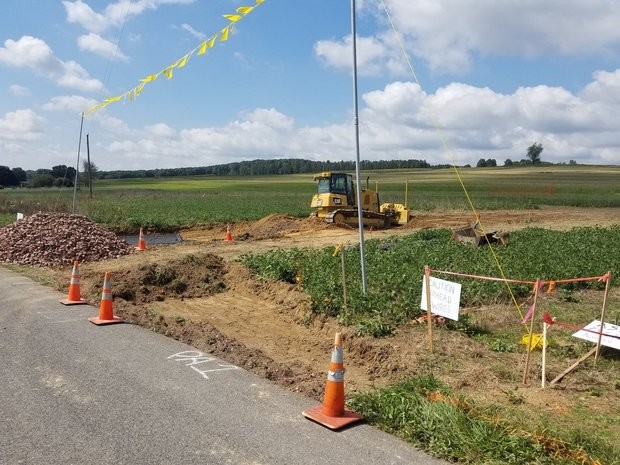
PennEast Pipeline’s Sole Compressor Station Approved by PA Town
 PennEast Pipeline has just achieved yet another milestone on its way to getting built. At a meeting last Thursday, the Board of Supervisors for Kidder Township (Carbon County, PA) voted 5-0 in favor of issuing a permit to PennEast to site the one-and-only compressor station the 120-mile pipeline will need. Proving yet again that most Pennsylvanians are in favor of this project, contrary to the mainstream/leftist media drumbeat against it. PennEast is a $1 billion primarily 36-inch pipeline from Dallas (Luzerne County), PA to Transco’s pipeline interconnection near Pennington (Mercer County), NJ. The company expects final Federal Energy Regulatory Commission (FERC) approval any week now. There are still a few hurdles left–mostly in New Jersey. But those hurdles are certainly surmountable. The radical Sierra Club and THE Delaware Riverkeeper are adamantly opposed and continue to try and throw up legal (and regulatory) roadblocks. No matter. This important pipeline will get built–and this compressor station approval is one more bit of evidence that it will get built…
Read More “PennEast Pipeline’s Sole Compressor Station Approved by PA Town”
 The Marcellus industry is closely watching three pieces of legislation sitting in the Pennsylvania legislature, bills that the industry fervently hopes do not pass. One of the bills is House Bill (HB) 557, introduced by Rep. Garth Everett, which would amend/fix the Oil and Gas Lease Act to ensure landowners get a minimum royalty of 12.5%, regardless of post-production deductions (see
  NEXUS Pipeline, a $2 billion, 255-mile interstate pipeline that will run from Ohio through Michigan and eventually to the Dawn Hub in Ontario, Canada, is about ready to begin construction–any time. NEXUS got final approval for the project from the Federal Energy Regulatory Commission (FERC) in August, the first major pipeline to get approved following a newly restored quorum at FERC (see
 Looks like begging works. TransCanada, one of Canada’s leading midstream/pipeline companies, cooked up a deal last year to pipe natural gas from Canada’s West Coast to the East Coast in order to fend off cheap supplies of Marcellus/Utica gas that will flow into Canada when/if the NEXUS and Rover pipelines get built (see
  The Andrew Cuomo-corrupted New York State Dept. of Environmental Conservation (DEC), run by NRDC gang member Basil Seggos, has just slammed the door on New York towns using brine from the Pennsylvania Marcellus. Earlier this week the DEC posted new final regulations as part of “strengthening” the state’s solid waste regulations, referred to as Part 360. Brine is another name for produced water. When you drill a hole deep in the ground, well below the water table (which sits at maybe 200 feet down), over time water from the depths (a mile or more down) will come to the surface. This is not wastewater used in fracking (called flowback), but naturally occurring water (brine). It’s called brine because it contains a lot of minerals–far “saltier” than ocean water. There are a number of ways to dispose of all that water coming out of drilled wells for years after they are drilled–dispose of it via an injection wells, recycle it, or in some cases, treat it and use it as a deicer on roadways. Many towns use brine for that purpose. The DEC’s new regulations stipulate that if a town wants to use brine from conventional oil and gas wells, that’s fine (with certain restrictions). But if the brine comes from a Marcellus Shale well–it’s banned. Keep in mind there is virtually no chemical difference between the two. Which leads us to the conclusion that this is one more very intentional swipe at the shale industry by a state that is closed for business…
 From the day the first backhoe began digging in Ohio, it has appeared that Ohio EPA director Craig Butler has had a grudge against Rover Pipeline. We’re not saying Rover hasn’t had its fair share of environmental transgressions that need to be monitored and rectified. But Butler has been on a one-man mission to punish Energy Transfer, the builder, demanding (without legal authority) insanely high “fines” from ET Rover. At first it was $400,000. Then $900,000. Now Butler says ET owes the state $2.3 million! Butler is trying to draw in Ohio’s Attorney General into the confusion in order to shake down Energy Transfer and make them pay. Yesterday Butler held a conference call with the media (MDN wasn’t notified/invited) where he made wild allegations. What seems to have precipitated Butler’s media bender is a decision by the Federal Energy Regulatory Commission (FERC) on Monday to allow ET to resume horizontal directional drilling (HDD) in most Ohio locations, after banning it for several months (see
  At a staged media event yesterday, Ohio EPA director Craig Butler had no end of insults for Energy Transfer and their Rover Pipeline project, making wild claims that the company now owes the state $2.3 million in fines (see today’s companion story). However, at the same media event, Butler had faint praise for another project–NEXUS Pipeline. The OEPA issued a federal water permit for the project on Tuesday. NEXUS is a $2 billion, 255-mile interstate pipeline that will run from Ohio through Michigan and eventually to the Dawn Hub in Ontario, Canada. The project is co-owned by DTE Energy of Detroit and Spectra Energy (now part of Canadian company Enbridge). NEXUS got final approval from the Federal Energy Regulatory Commission in August, the first major pipeline to get approved following a newly restored quorum at FERC (see

 Rich, snobbish homeowners in an “upscale” Philadelphia suburb development are asking an appeals court to stop Sunoco Logistics from building the Mariner East 2 pipeline through the edge of their high-priced development because, they claim, the digging is disturbing the dirt (which is what digging does) and disturbing the dirt is causing lead and arsenic to become dislodged. The lead and arsenic are supposedly in the dirt as a result of pesticides used when the land was an apple orchard. The claim is flat out BS–Barbara Streisand. The Andover Homeowners Association in Thornbury Township (Delaware County) is the same group that a few weeks ago acted like five year-olds by intentionally stepping over a painted line put there to protect them from a ME2 construction zone (see
  In 2012 the North Carolina legislature cleared the way for the state to allow horizontal fracking of shale (see
  Although the primary focus of Marcellus Drilling News has always been on Marcellus and Utica Shale gas (and oil) as found in the northeastern U.S., the Utica Shale also underlies part of Canada’s Quebec province. And from time to time we highlight news concerning the Utica in Canada. There hasn’t been much news to highlight over the years since Quebec has had a moratorium on fracking at least as long as New York’s moratorium (NY’s ban as of today has been 9 years, 1 month and 29 days). But as we reported back in December, something of a minor miracle happened–the Quebec National Assembly voted to pass Bill 106, ostensibly to support Quebec’s “clean power plan” (see
  A Pennsylvania Senator from Wilkes-Barre, John Yudichak (Democrat) has floated a “memoranda” among his Senate colleagues asking them to join him in sponsoring a resolution (copy below) for an “independent performance review” of the state Dept. of Environmental Protection (DEP) and its shale permitting program. Since Tom Wolf assumed office as governor of Pennsylvania in January 2015, the DEP has been in a downward spiral when it comes to the speed with which they approve permits for the Marcellus Shale industry. The DEP has a policy of issuing erosion and sedimentation permits 14 days from the date of application. These types of permits are common and necessary when building roads, well pads, etc. Lately it has taken the DEP 250 days to issue those permits! Permits related to drilling wells are supposed to take no more than 45 days. Those permits now average 93 days. The DEP is hopelessly backlogged–and it’s getting worse. When PA’s traitorous Republican Senate sold out and signed on to a Marcellus Shale severance tax back in July, the Senate also approved (as part of the budget bill) fixes to speed up the permitting process (see
  As we have reported, history was made last Friday when the Federal Energy Regulatory Commission (FERC) overruled the New York Dept. of Environmental Conservation’s (DEC) denial of a water permit for Millennium Pipeline’s tiny 7.8 mile pipeline spur from the main Millennium Pipeline to a natural gas power plant under construction in Orange County, NY (see