
Shell Files PA Application for Ethane Pipe to Feed Cracker Plant
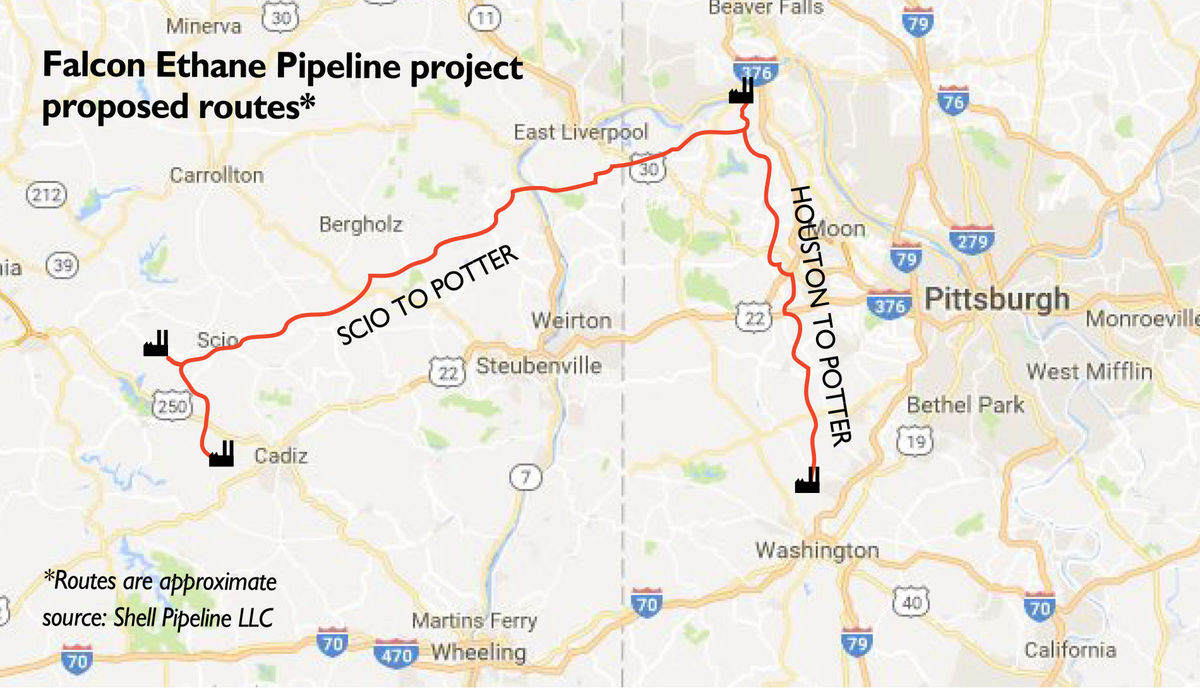
Shell’s long-talked about ethane pipeline, called Falcon Pipeline, is finally official. That is, official in the sense that Shell filed an application with the Pennsylvania Dept. of Environmental Protection last week, looking for permission to build it. Brief history: In February 2016, MDN brought you exclusive news that Shell had begun approaching landowners in Beaver County to get them to sign easements for two ethane pipelines to feed the mighty cracker plant they plan to build in the county (see Exclusive: Shell Leasing Land for 2 Pipelines to PA Cracker Plant). At that time Shell had still not fully committed to building the cracker–something they finally did in June 2016 (see Breaking: Shell Pulls the Trigger, PA Ethane Cracker is a Go!). NGI’s Shale Daily broke a story in August 2016 that shed new light on the project–news that Shell is working on a 94-mile ethane “pipeline system” with two “legs” to feed the cracker, confirming the tip we received in February (see Shell Working on 94-Mile Ethane Pipeline to Feed PA Cracker). As NGI reported at that time, the new ethane pipeline system has a name: the Falcon Ethane Pipeline System. In October 2016 Shell launched a binding open season for the Falcon pipeline (see Shell Launches Open Season for PA-WV-OH Falcon Ethane Pipeline). You might justifiably think that with open seasons and a scad of easements signed between landowners and Shell, that the project had already filed for permission to build. Not so. Last week Shell made it official by filing that paperwork–for the portion of the pipeline running through PA…
Read More “Shell Files PA Application for Ethane Pipe to Feed Cracker Plant”
 In July 2016 MDN told you about a smallish, but important pipeline project in the Delmarva Peninsula area, which includes most of Delaware and portions of Maryland and Virginia. Eastern Shore Natural Gas’ 2017 System Expansion project will bring new sources of natgas from an interconnection Eastern Shore has with the mighty TETCo (Texas Eastern Company) pipeline near Philadelphia (see
  The debate rages, both nationally and on the state level (in Pennsylvania, anyway) about the best way to reduce fugitive methane. That is, to stop methane from leaking out of pipes and into the atmosphere where it supposedly contributes to mythical man-made global warming. Leaving aside the nonsensical global warming stuff, it’s in the best interests of any producer (or pipeline company) to ensure no methane molecules leak out of the system. It’s the stuff they extract and sell! They don’t want their inventory flying away into heaven. The debate is how best to ensure less methane leaks. On one side you have the typical Big Government types that want to regulate everything, down to the type of equipment you use to detect leaks and the methods for fixing it. We have nothing against common sense regulations, but as everyone knows, government tends to screw things up, rather than fix things. On the other side you have drillers and midstream companies who content “just give us a standard and let us figure out how best to meet that standard.” Case in point is Southwestern Energy. Southwestern launched a leak detection and fixing program five years ago–and has dramatically cut the amount of methane leaking from its operations. Southwestern, and others, show us the way it should be done, WITHOUT needing onerous regulations from the federal government or from the regulation-happy PA Gov. Tom Wolf…
 In March MDN brought you the news that APV Renaissance Partners (a subsidiary of American Power Ventures) wants to build a 1000 megawatt, combined-cycle power plant at the old Hatfield’s Ferry site in Greene County, PA–to be powered with Marcellus Shale gas (see
  In reporting on APV Renaissance Partners’ plan to build a 1000 megawatt electric power plant in Monongahela Township (Greene County), PA, today, we noticed an interesting closing paragraph in the story we quoted, which says: “Another energy company, Hill Top Energy Center, also has proposed constructing a natural gas power plant in Greene County. Hill Top has proposed building a 536-megawatt plant on 41 acres of land off Thomas Road in Cumberland Township. A public hearing on Hill Top’s proposed air quality plan will be held by DEP at 6 p.m. Nov. 2 in the Carmichaels Area High School auditorium.” A second Marcellus-fired power plant planned for Greene! Who knew? We went searching for details we could find to share with you about this second project, which will get a DEP hearing in a month…
 Next month when New Yorkers go to the polls to cast their votes (an illusory scam in Communist NY), there will be three Propositions on the ballot. One of the three is called, “Authorizing the Use of Forest Preserve Land for Specified Purposes.” The one-paragraph description implies municipalities will have more flexibility in using “preserved” land–so long as they designate the same amount of land to be added back to the pool of preserved land. It also allows bicycle trails and public utility lines to cross preserved land. However, what the description does not say (which can be found in a full reading of the proposition) is this: the proposition “prohibits the construction of a new intrastate gas or oil pipeline that did not receive necessary state and local permits and approvals by June 1, 2016.” So no new intrastate (within the state) pipelines through preserved land, period. Ever. Even though electric lines crossing preserved land are just fine. Why is Gov. Cuomo trying to hide this from residents? Will NY residents even wake up and notice they don’t know what they’re actually voting for (or against)? That’s how sleazy politics is played in the Empire State…
 In an issue that’s growing old, fast, the Pennsylvania legislature has still not dragged the dead horse known as the 2017 state budget across the finish line. It all started months ago when the Republican-led legislature passed a $32 billion budget–with only $30 billion available to pay for it. Big mistake. The pressure was intense to pass a severance tax to help fill the gap. Traitorous Republicans in the Senate caved to that pressure and in July passed a budget bill that hikes taxes on lots of things, including a severance tax (see
  In August the D.C. Court of Appeals ruled in a case that (we previously thought) may have long-term, very negative consequences for the oil and gas industry related to pipeline development (see
  Back in May MDN told you about the antis running the City of Green, Ohio (see
  Landowners in Wayne (and Pike) counties in northeastern Pennsylvania are not going to stand by and allow their property rights to be stripped away from them. Two weeks ago the Delaware River Basin Commission (DRBC), which has had an ongoing, “temporary” ban on fracking within the Delaware River Basin since 2010, voted to begin the process of implementing a permanent ban (see
  Lone Pine Resources, a U.S.-based driller, has a huge amount of Canadian Utica Shale acreage in the province of Quebec. As we reported in 2012, they own 398,850 gross (240,320 net) acres of leases (see
  MDN is once again attending the Shale Insight event–in Pittsburgh. Yesterday was the first day of the event. The crowd was definitely smaller than last year when then-candidate Trump spoke to attendees. However, Day One saw a number of heavy-hitting speakers, including Secretary of Labor Alexander Acosta, Deputy Secretary of Energy Dan Brouillette, XTO Energy President Sara Ortwein, Chevron Appalachia President Stacey Olson, and People’s Natural Gas CEO Morgan O’Brien. Marcellus Shale Coalition President Dave Spigelmyer served as master of ceremonies and seemed to be everywhere-present during the event (how does he DO that?). From the opening session to the exhibit floor to attending the breakout sessions, MDN editor Jim Willis made the rounds–and took lots of notes. In the coming days he will write up those notes and share them. For now, we have links and extracts of articles from other publications attending and reporting on this year’s Shale Insight…
 Last week MDN brought you the news that Ohio EPA’s director, Craig Butler, has kind of tipped over into the deep end with his rantings and ravings about Rover Pipeline (see
  In early September, a Broome County, NY judge ruled that the Town of Fenton (Binghamton area) Planning Board did not take a hard enough look at environmental and traffic issues related to their approval of NG Advantage’s plan to construct a facility in the town to compress and load natural gas onto tractor trailers for delivery to regional customers who desperately need the gas–what is called a “virtual pipeline” (see