
Investment Firm Threatens 2nd Lordstown Electric Plant, $30B @ Risk
 Update: 7/19/17: An MDN subscriber with inside knowledge of what’s happening wrote to MDN to clarify our post. Magna Seating is the car seat manufacturer. They LOVE Clean Energy Future and both plants. In fact, Magna’s union shop chairman has said he will testify in favor of CEF’s second plant at the public hearing being held next Tuesday, July 25th. However, the landlord that owns the building Magna works in–Vienna Investments–is the one attempting to make trouble for CEF in building a second plant. Here’s the kicker: Vienna knew about CEF’s plans for the second plant BEFORE they bought the building Magna works in. Stands to reason if Vienna had an objection, they might have expressed it when they bought the building–or would not have purchased it in the first place. Which makes us wonder, what game is Vienna playing? Why are they objecting now?
Last June, Clean Energy Future broke ground on the Lordstown (Trumbull County, OH) Energy Center, a Utica Shale-powered electric generating plant that is projected to contribute nearly $1 billion to the local economy (see Lordstown Energy Center Breaks Ground on $890M Electric Plant). Clean Energy Future has also committed to building a second billion-dollar plant at the same location (see Lordstown, OH May Get Second Utica Gas-Powered Electric Plant). According to local economic officials, the two plants, over the next 30 years, will contribute a staggering (incomprehensible!) $60 BILLION to the local economy. We simply don’t have words for this kind of econ benefit for a community like Lordstown and Trumbull County. So it’s understandable that the action of a neighbor in the same industrial park where the plants will get built–a neighbor that manufactures car seats for Chevrolets–is threatening to undo half of that economic benefit by filing to “intervene” in the project with the Ohio Siting Board, regarding the second proposed Utica Shale-powered electric plant. It seems Vienna Investments, which owns the car seat manufacturing plant, is concerned about unspecified “safety” issues with construction of the second plant. Local officials, and the editorial board of Youngstown Vindicator, are somewhat alarmed and “encouraging” (pressuring) Vienna to come clean now about what they’re really concerned about, so it can be addressed and not derail the second plant (and $30 billion worth of income for the region)…
Read More “Investment Firm Threatens 2nd Lordstown Electric Plant, $30B @ Risk”
 In June 2016, MDN shared with you the news that Munroe Falls (Summit County), OH had filed yet another frivolous lawsuit against Beck Energy to prevent drilling–after already losing a similar case before the Ohio Supreme Court (see
  As recently as July 7th, Energy Transfer Partners, builders of the mighty 711-mile Rover Pipeline project that will run from PA, WV and eastern OH through OH into Michigan and eventually into Canada, said that a portion of Phase 1–from Cadiz, OH to Defiance, OH–will be completed and go online this month, in July (see
  In May 2015, Rover purchased a house in Carroll County, OH, located near where the pipeline, and a compressor station for that pipeline, is due to run. Rover bought the house to use for offices for several Rover affiliate companies. After buying it, Rover determined the house was “ill-suited for its intended purpose” and decided to demolish it. Problem was/is, that house was under consideration to be added to the National Register of Historic Places. The house was not yet on the list of Historic Places, but was on a list of properties under consideration. Their action in demolishing the house landed Rover in hot water with the Federal Energy Regulatory Commission (see
  Yesterday the Federal Energy Regulatory Commission (FERC) sent a letter to Energy Transfer regarding the Rover Pipeline project. You may recall that Rover hit some bumps along the way in its aggressive schedule to get part of the pipeline up and running by the end of this month, and the rest operational by the end of November. In Ohio, Rover experienced a series of mishaps, the most serious of which spilled 2 million gallons of non-toxic drilling mud in a swamp near the Tuscarawas River back in April (see
  The Ohio Controlling Board, part of the Office of Budget and Management, has raided (i.e. stolen) $15 million from Ohio’s severance tax fund to use in settling a lawsuit from the late 1990s–a lawsuit that has nothing whatsoever to do with oil and gas. According to the American Petroleum Institute Ohio, the misappropriation of the money is likely illegal. The Controlling Board was set up by the Ohio legislature to handle “necessary adjustments to the state budget.” In other words, it was set up to pick one pocket and put the money in a different pocket. In 1997 Ohio widened a dam spillway in the western part of the state, and the result flooded the property of some unfortunate landowners, who sued. The lawsuit has languished for years, and it’s now time to pay up. The Controlling Board decided to raid/steal the money from the severance tax fund–a fund that’s supposed to be used for things like plugging abandoned orphan o&g wells. Most drilling in Ohio happens on the eastern side of the state. The flooded property in 1997 happened on the western side of the state. Anyone else see a disconnect and sleazy politics going on here? The severance tax fund has become the personal piggy bank for certain Columbus politicians…
 Sounding eerily like a Borg drone from Star Trek (“YOU WILL COMPLY, RESISTANCE IS FUTILE”), the Ohio EPA (OEPA) has asked Ohio’s Attorney General, Mike DeWine, to force Rover to pay the Ohio EPA $914,000 in so-called fines it has unilaterally levied (with no apparent authority to do so) to punish Rover for a series of accidents while constructing the pipeline. Rover has not agreed to the fines and is challenging the OEPA’s authority to levy them. So the OEPA is asking DeWine to use the full weight and force of his office to force Rover to comply. Rover has had the pedal to the metal since receiving a go-ahead from the Federal Energy Regulatory Commission (FERC) in March to begin construction to build a 711-mile natural gas pipeline from PA, WV and eastern OH through OH into Michigan and eventually into Canada (see
  Thumbing their collective noses at Ohio RINO Gov. John Kasich, in May Republican legislators in the House added a “little-noticed provision” in the state budget deal that will give the legislature, and not the governor, the power to select members of the Ohio Oil and Gas Commission (see
  Once again, the radicals behind the Pennsylvania-based Community Environmental Legal Defense Fund (CELDF), operating in Ohio, have suffered a humiliating defeat. This time in liberal Athens, Ohio. For three years running, the CELDF and their local useful idiots have been pedaling a so-called Community Bill of Rights ballot measure–which is nothing more than an anti-fracking law. No, there is no drilling in or under Athens, but such a law would send a loud and clear signal that Athens is closed for business when it comes to the oil and gas industry–an industry that pumps millions into the local economy (even without drilling in the area). For the third year running the CELDF drones filed a petition to include the “Bill of Rights” measure on the November ballot–and for the third year in a row, the County Board of Elections voted NOT to allow it–unanimously…
 The Gas Technology Institute (GTI), based in Illinois, is doing the Marcellus/Utica region a huge favor. GTI has launched a pre-employment training program to introduce folks to natural gas pipeline operations. The four-week program provides a basic understanding of natural gas, the utility and pipeline industry, and different equipment, procedures and operations used. The program is aimed at students, veterans, displaced coal workers and others with an interest in getting a job with utilities, midstream (i.e. pipeline) companies and their contractors. Here’s the best part: The program is fully funded, so there is no tuition cost for those who qualify. The program is delivered via classroom at three participating colleges: Westmoreland County Community College and Butler County Community College (both in PA), and Washington State Community College (in OH). Here’s the lowdown..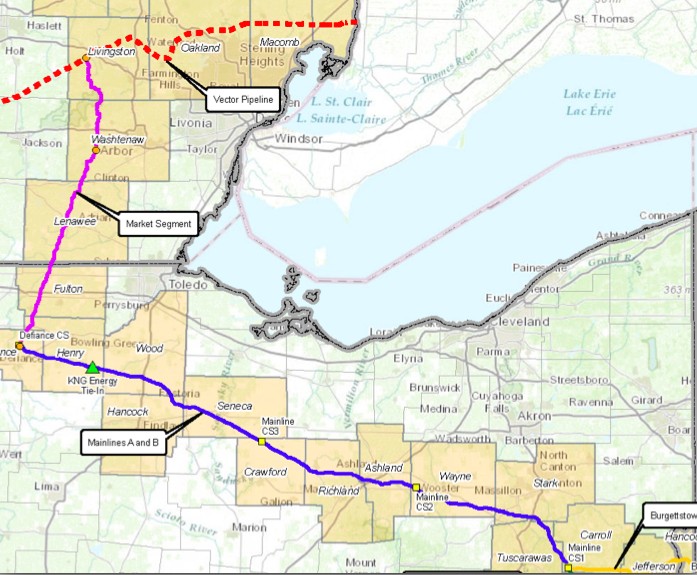
 Phase I of the 711-mile Rover Pipeline project that will run from PA, WV and eastern OH through OH into Michigan and eventually into Canada is supposed to be completed by July 2017, while Phase II is supposed to be done by November 2017. Will Phase I be done by the end of this month? We sure wouldn’t want to take that bet, but we suppose there’s still a slim chance. While building the $3.7 billion pipeline project, Energy Transfer (or more correctly its contractors) hit some snags, including spilling 2 million gallons of non-toxic drilling mud near the Tuscarawas River (see
  In February MDN reported that Marathon Petroleum had begun to build a 49-mile condensate pipeline, called HALI–the Harpster to Lima Pipeline (see
  Being a marketing guy, MDN editor Jim Willis knows that crystallizing a concept into a few key words is critical. You have to be able to convey your meaning in as few words as possible–and those words must be pregnant with meaning. Jim was lucky enough to name this blog/news site Marcellus Drilling News, which (mostly) conveys its purpose–to report on happenings in the Marcellus (later adding the Utica) region. A very smart person who’s given a lot of thought about our industry is Kathryn “Katie” Klaber. Katie owns her own consulting firm–The Klaber Group. But before that, she was founder and president of the Marcellus Shale Coalition (a well-named organization). Katie lives and works in Pittsburgh. In a recent article for the Pittsburgh Business Times, Katie ponders over Pittsburgh (and our industry’s) “identity crisis”–by which she means our lack of good branding. Sometimes our industry and region is referred to as “Appalachia.” But that term often connotes the mountains of West Virginia, spreading out into Kentucky. Sometimes we are referred to as the “Marcellus/Utica basin,” which gets a lot closer to meaningful, but connotes drilling and leaves out the downstream. And sometimes we’re called “the Northeast.” But folks in Ohio consider themselves Midwesterners, not northeasterners. Why is it important to lock down an accurate, pregnant-with-meaning description for our entire industry (upstream, midstream and downstream), and our geographic region? According to Katie, it comes down to two words: capital investment. We need to brand ourselves and do it sooner rather than later, if we want to grow business in our neck of the woods…
 Last year MDN brought you the story of researchers who found microbes (bacteria) living nearly two miles down in Utica Shale wells. They dubbed one of the never-before-seen bacterial “lifeforms” in the well Frackibacter. We immediately labeled it a different name: Frackenstein (see
  Although a final investment decision (FID) is still months away, Thailand-based PTT Global Chemical decided spending $13.8 million to buy 168 acres at the proposed site for a second Appalachia ethane cracker, in Belmont County, OH, would be a good investment. Which they have now done. The deal, which closed in June, is just now coming to light. PTT bought the land for the site from FirstEnergy Corporation. The deal was recorded at the Belmont County Courthouse on June 14. This is yet another sign that PTT will make a positive FID later this year. Even though PTT just bought the land, work was previously done on the site to clear it and get it ready for construction, as we reported in December (see