
Rover Pipeline Converts Some Horizontal Drilling to Trenches Instead
 Phase I of the 711-mile Rover Pipeline project that will run from PA, WV and eastern OH through OH into Michigan and eventually into Canada is supposed to be completed by July 2017, while Phase II is supposed to be done by November 2017. Will Phase I be done by the end of this month? We sure wouldn’t want to take that bet, but we suppose there’s still a slim chance. While building the $3.7 billion pipeline project, Energy Transfer (or more correctly its contractors) hit some snags, including spilling 2 million gallons of non-toxic drilling mud near the Tuscarawas River (see Rover Pipeline Accident Spills ~2M Gal. Drilling Mud in OH Swamp). The Federal Energy Regulatory Commission (FERC) slapped a stop work order on any horizontal directional drilling (HDD, or underground drilling) projects for Rover not already underway. A tipster later claimed diesel fuel was being added to the drilling mud and after testing a sample from the spill near the Tuscarawas, the Ohio EPA claimed to have found diesel in the mud (see OH EPA Says Diesel Fuel Found in Rover 2M Gal Drilling Mud Spill). That made FERC really upset and touched off a full investigation. Meanwhile, Rover hired a new firm to oversee HDD activity and pledged with a cross-your-heart-pinky-swear to FERC that those kinds of accidents would not happen again. FERC recently allowed Rover to restart some of the work halted, which has radicals at the Sierra Club fit to be tied. However, in the “you can start again” order, we noticed that Rover has changed some (much?) of the remaining HDD projects into digging trenches instead. Obviously you can’t dig a trench across the Tuscarawas River–or a highway–or other such structures. But you can dig a trench right up to the edge of those structures. It’s our observation that a change from HDD to trenching has allowed Rover to restart stopped work in a number of locations…
Read More “Rover Pipeline Converts Some Horizontal Drilling to Trenches Instead”
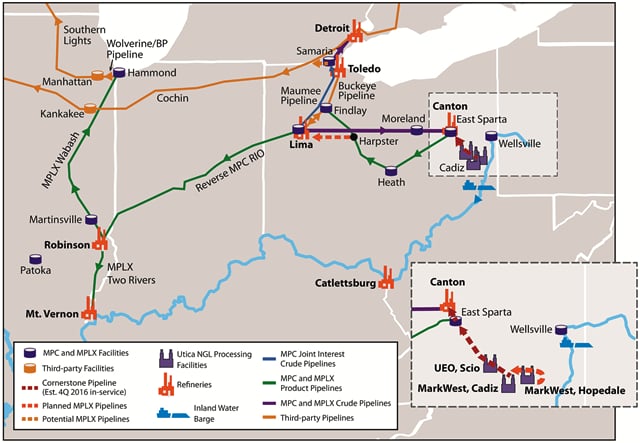
 In February MDN reported that Marathon Petroleum had begun to build a 49-mile condensate pipeline, called HALI–the Harpster to Lima Pipeline (see
 Being a marketing guy, MDN editor Jim Willis knows that crystallizing a concept into a few key words is critical. You have to be able to convey your meaning in as few words as possible–and those words must be pregnant with meaning. Jim was lucky enough to name this blog/news site Marcellus Drilling News, which (mostly) conveys its purpose–to report on happenings in the Marcellus (later adding the Utica) region. A very smart person who’s given a lot of thought about our industry is Kathryn “Katie” Klaber. Katie owns her own consulting firm–The Klaber Group. But before that, she was founder and president of the Marcellus Shale Coalition (a well-named organization). Katie lives and works in Pittsburgh. In a recent article for the Pittsburgh Business Times, Katie ponders over Pittsburgh (and our industry’s) “identity crisis”–by which she means our lack of good branding. Sometimes our industry and region is referred to as “Appalachia.” But that term often connotes the mountains of West Virginia, spreading out into Kentucky. Sometimes we are referred to as the “Marcellus/Utica basin,” which gets a lot closer to meaningful, but connotes drilling and leaves out the downstream. And sometimes we’re called “the Northeast.” But folks in Ohio consider themselves Midwesterners, not northeasterners. Why is it important to lock down an accurate, pregnant-with-meaning description for our entire industry (upstream, midstream and downstream), and our geographic region? According to Katie, it comes down to two words: capital investment. We need to brand ourselves and do it sooner rather than later, if we want to grow business in our neck of the woods…
 Last year MDN brought you the story of researchers who found microbes (bacteria) living nearly two miles down in Utica Shale wells. They dubbed one of the never-before-seen bacterial “lifeforms” in the well Frackibacter. We immediately labeled it a different name: Frackenstein (see
 Although a final investment decision (FID) is still months away, Thailand-based PTT Global Chemical decided spending $13.8 million to buy 168 acres at the proposed site for a second Appalachia ethane cracker, in Belmont County, OH, would be a good investment. Which they have now done. The deal, which closed in June, is just now coming to light. PTT bought the land for the site from FirstEnergy Corporation. The deal was recorded at the Belmont County Courthouse on June 14. This is yet another sign that PTT will make a positive FID later this year. Even though PTT just bought the land, work was previously done on the site to clear it and get it ready for construction, as we reported in December (see
 Ohio is about to pass and adopt it’s latest biennial budget. Part of the budget bill includes language to exempt Ohio’s city and town parks from the state’s unitization (i.e. forced pooling) laws. In Ohio, if 65% of the landowners in a proposed unit have agreed to lease their land for oil or gas drilling, the other landowners in the unit can be forced to join the unit to allow drilling under (not on) their land. There are all sorts of requirements before forced pooling occurs, including a $10,000 fee paid by the driller, and a hearing to review efforts made to enroll said recalcitrant landowners. But in the end, it is possible to force landowners who don’t want drilling, to have it. The justification is that those who don’t want it are harming those who do want it by not agreeing to join the unit. Should the action of someone with a few acres deny benefits to all of his neighbors? We’re not saying we support the concept of forced pooling–just giving you our best interpretation of the arguments used to support it. We understand those arguments. We also understand the sanctity of private property. Until now, local towns and municipalities in Ohio were treated like any other landowner. But now, with the new budget, they will get a special exemption. Local municipalities cannot be forced to participate–unless they want to participate–in a drilling unit…
 In early June, MDN brought you the news that officials with Ascent Resources (formerly American Energy Partners) and Chesapeake Energy said their respective companies are putting a renewed focus on Jefferson County, OH in the coming months (see
 Some good news for Utica (and Marcellus) drillers: The Ohio Dept. of Natural Resources (ODNR) has just approved permits for two new frack wastewater injection wells in Trumbull County, OH. Which doesn’t make the local anti-fracking nutters with FrackFree America happy. One of them calls the approvals “immoral.” She’s calling on the company building the wells, Highland Field Resources, to “abandon its plans.” (chuckle) The wells will be built in the town of Brookfield. ODNR has attached a myriad of conditions and required testing before the wells can go live. Here’s the immoral details…
 The Fresh Water Accountability Project, an anti-fracking group based in Michigan, has filed a frivolous lawsuit against the Patriot Water Treatment facility and the City of Warren, OH, claiming they are processing frack chemicals at their plants that don’t get processed enough–and consequently get released into the Mahoning River. This is not Patriot Water’s first time in court. Patriot has had a long-running feud with the Ohio EPA and Ohio Dept. of Natural Resources (ODNR)–a feud that goes all the way back to 2011 (
 Yesterday Energy Transfer Partners, the builder of the Rover Pipeline, once again asked the Federal Energy Regulatory Commission (FERC) if they could pretty-please-with-a-cherry-on-top resume horizontal directional drilling (HDD) in a couple of key locations in Ohio, so they can finish phase one of the pipeline somewhere close to on-time. Rover is a $3.7 billion, 711-mile Marcellus/Utica natural gas pipeline that will run from PA, WV and eastern OH through OH into Michigan and eventually into Canada. It is a critical piece of sorely needed infrastructure for the Marcellus/Utica industry. As soon as ET received approval for the project in February, they began building it. But they hit a few snags along the way, including an “inadvertent return” (i.e. leak) of 2 million gallons of drilling mud in a swamp next to the Tuscarawas River (Stark County, OH). Following that leak and other leaks, FERC told Rover to stop any new underground drilling not already under way (see
 Here is a short list of radical environmental groups that are despicable and loathsome in every sense of the word: Sierra Club, Center for Biological Diversity, Earthworks, Freshwater Accountability Project, Friends for Environmental Justice, Indigenous Environmental Network, Indigenous Iowa, Keep Wayne WILD, Louisiana Bucket Brigade, Ohio River Citizens’ Alliance, and Oil Change International. They have dedicated themselves to stopping work on, and ultimately blocking, Energy Transfer’s (ET) $3.7 billion, 711-mile Marcellus/Utica Rover natural gas pipeline that will run from PA, WV and eastern OH through OH into Michigan and eventually into Canada. The problem, however, is that ET has given these groups an open door to pedal their anti-fossil fuel nonsense. Indeed, ET has given them an open door to block further progress on building Rover. How? By rushing construction that has led to a string of accidents and incidents, alienating the thin-skinned Ohio Environmental Protection Agency (OEPA) and a number of landowners. One of the accidents, perhaps the most prominent accident that’s been the focus for much of the radical’s efforts, was a 2 million gallon spill of drilling mud into a wetland near the Tuscarawas River back in April (see
 In March of this year, the Team Pennsylvania Foundation released a report called “Prospects to Enhance Pennsylvania’s Opportunities in Petrochemical Manufacturing” (see
 Here’s a case in Ohio that has the potential to impact Utica Shale, as well as conventional, leases. According to OOGA (the Ohio Oil and Gas Association) it has the potential to affect “the validity and viability of thousands of oil and gas leases across the state.” In brief, a conventional gas well was drilled on property in Washington County, OH in 1951. The landowner later agreed to exchange royalty payments for free, unlimited gas to her home. Leases can be terminated if they stop producing profitable amounts of oil and gas. Between 1977 and 1981 there was no commercial sale of gas from the well–but the landowner kept getting her free gas. Using that five-year period of time of no commercial output, the landowner filed paperwork to declare the lease has been terminated and reverts back to her, the landowner. The driller says she continued receiving her “royalty payments” (i.e. free gas) even though nothing was sold from the well–and that’s enough to keep the lease in effect. There appear to be strong arguments on both parts, and apparently this arrangement of receiving free gas in lieu of royalty payments is not uncommon in Ohio. So the Ohio Supreme Court will decide, having recently heard oral arguments…
 The legal beagles of top energy law firm Babst Calland recently released their seventh annual energy industry report called, “The 2017 Babst Calland Report – Upstream, Midstream and Downstream: Resurgence of the Appalachian Shale Industry; Legal and Regulatory Perspective for Producers and Midstream Operators.” This latest annual review chronicles the comeback of the Marcellus/Utica and what challenges lie ahead. In an MDN exclusive, we have the first seven pages of the 74-page report (see below), along with details on how you can request a full copy. Worth the read! Here’s an overview…
 The TriState Infrastructure Council (TSIC) was founded in Pittsburgh in late 2016 to “serve a broad-based business community during the critical next few years by attracting and deploying investments in infrastructure projects in Ohio, Pennsylvania and West Virginia.” With infrastructure upgrades, the region will be able to realize economic growth resulting from petrochemical manufacturing and related industries in the Appalachian basin. One of the driving forces behind TSIC is a name you are likely familiar with: Kathryn Klaber. Katie Klaber founded and until a few years ago led the Marcellus Shale Coalition. She opted to focus on her consulting practice following the MSC and is now managing the TSIC. The TSIC organization was founded with a group of A-list companies located in the region. At this week’s Northeast U.S. Petrochemical Construction conference in Pittsburgh, Katie unveiled an exciting new project to map infrastructure in an 82-county region throughout the Ohio River Valley. The aim is to identify missing/key/critical infrastructure components and then work to set up public-private partnerships to get those components built. The TSIC is looking at “electric transmission and distribution, pipelines, natural gas and natural gas liquid storage capacity, reliable locks and dams, rail networks, roads and bridges, water and sewer, building sites, barge loading/unloading facilities, broadband, fiber optics, and air service, among others.” And yes, the Marcellus/Utica shale is the linchpin that holds it all together–makes it all possible–and the raison d’être for the TSIC. Here’s more on the new infrastructure database, the TSIC, and how they are giving the shale industry a big assist…