
Duke Energy’s 13-Mile Cincinnati NatGas Pipeline Put on Hold
 Duke Energy needs to replace an aging pipeline, built in the 1950s, near Cincinnati, OH–or some people in Cincy will have to go without natural gas. Duke has proposed a 13-mile, 20-inch pipeline along two potential routes. Both routes are opposed by antis, including a group calling themselves NOPE–Neighbors Opposing Pipeline Extension. We call them DOPEs–Dummies Opposing Pipeline Extensions. Will the DOPEs volunteer to shut off the natural gas to their homes and businesses if the pipeline doesn’t get built? Not on your life! The Ohio Power Siting Board (OPSB) held two public hearings in April, to grant anti-pipeliners the opportunity to vent (see Hearings Scheduled for Proposed Duke Pipeline in Cincinnati). They didn’t disappoint. The DOPEs turned up in force. We are just weeks away from a final approval by the OPSB–but then Duke asked the state to push the pause button. Duke says they have “potential concerns” about building the pipeline on a property close to a Superfund site in Reading. So now the project is on hold, which makes the DOPEs happy…
Read More “Duke Energy’s 13-Mile Cincinnati NatGas Pipeline Put on Hold”
 Exactly one week ago MDN brought you the exclusive news of WHO is selling a bunch of conventional wells and leases (and pipelines) located in West Virginia, Ohio and Virginia to Carbon Natural Resources (see
  Work is now underway on Shell’s $6 billion ethane cracker in Beaver County, PA. What’s the status of the region’s second likely cracker plant, in Ohio? PTT Global Chemical previously announced they are interested in building a $5 billion petrochemical complex, including an ethane cracker, in Belmont County, OH at the site of the old R.E. Burger power plant. However, they have repeatedly said a “final investment decision” (FID) will not happen until the end of 2017. This is the same routine Shell used. In fact, Shell dragged out their FID a lot longer than PTT has. As with Shell, we look for signals that the FID will be a positive decision to move forward with construction. And as with Shell, we see those positive signs. Shell purchased the land for the site before announcing their FID. As we told you last month, PTT has now done the same–buying the former R.E. Burger site from FirstEnergy for $13.8 million (see
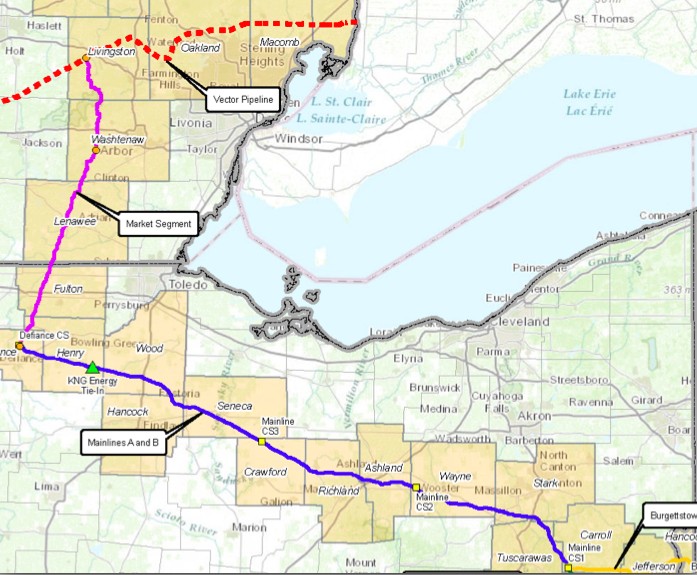
  Rover is a $3.7 billion, 711-mile natural gas pipeline that will run from PA, WV and eastern OH through OH into Michigan and eventually into Canada. While Phase 1A of the pipeline is essentially done and ready to begin service by the end of this month (see
 We always find it sad when a company builds a manufacturing plant in another country, closing one here at home (and firing the people who worked there). Such is the case in Carroll County, OH. Automotive supplier dlhBowles recently opened a 280,000-square-foot assembly plant in Reynosa, Mexico–and closed a plant in Carroll County. The company manufactures things like hoses and nozzles for windshield washer systems. Reynosa says closing the Carroll plant and laying off the 94 people who worked there is not “directly related” to opening the Mexico plant. Right. But officials in Carroll aren’t bitter. They believe the Utica Shale and various pipelines running through the area will result in new plastics companies (and other types of companies in the downstream) locating in Carroll. Buh bye Reynosa. Hello new manufacturers with the foresight and intelligence to set up shop in red-hot eastern Ohio…
 The Utica Shale’s economic impact on Ohio has been nothing short of “staggering.” In fact the shale revolution has fundamentally changed the United States over the past 10 years. But nowhere is it more obvious than in the Buckeye State. Our friends at Energy in Depth have assembled the results of several research studies of just how much shale has impacted Ohio, and summarized it in a handy infographic download (below). The short version is this: through the first quarter of 2016, if you add the number all up thus far, the “upstream” (drilling) industry in Ohio has invested a whopping $39.2 billion. Amazing! But that’s not all. The “midstream” (pipeline) industry has invested $13.7 billion. But wait! There’s more! The downstream (petrochemicals) industry has invested, so far, $15.3 billion. And there’s far more downstream investment coming, especially if/when PTT Global Chemical decides to move forward with building a $5 billion ethane cracker facility in Belmont County. When you add it all up, the Utica industry has invested $68.2 billion SO FAR. And that’s all private money–not taxpayer money. In fact, millions of dollars have flowed into communities from taxes on the industry. It’s truly hard to put into words just how big a deal this is…
 The CORNballs of Ohio are not happy campers in their quest to try and shut down the $2 billion, 255-mile NEXUS interstate natural gas pipeline that will run from Ohio through Michigan and eventually to the Dawn Hub in Ontario, Canada. CORN stands for Coalition to Reroute NEXUS. CORNballs is what we affectionately call the group–as a way of pointing out their nutty real purpose, which is to try and shut the NEXUS project down. Their aim has nothing to do with “rerouting” and everything to do with shutting it down. In May 2017, the CORNballs revealed their true colors when they filed a lawsuit in federal court in Akron, OH (see
  It looks like the trouble Vienna Investments tried to make for Clean Energy Future in wanting to build a second natural gas-fired electric generating plant in the same office park where the first is being built (near a building owned by Vienna) has amounted to nothing. Bupkis. The Ohio Power Siting Board (OPSB) held a public hearing at the local high school in July, to accept public comments on the second power plant (see
  Those opposing two major Energy Transfer projects–Rover Pipeline and Mariner East 2–will not be happy with the good news coming from ET this week. The company issued its second quarter update and held a conference call yesterday. During the call we learned that Phase 1 of Rover, a $3.7 billion, 711-mile Rover Pipeline project that will run from PA, WV and eastern OH through OH into Michigan and eventually into Canada, is “substantially complete” with Phase 1A expected to be done next week and online asap. Phase 1A stretches from Cadiz to Defiance, which is most of Ohio. Phase 1B is a short segment from Seneca to Cadiz, and once ET gets clearance from FERC to drill horizontally under Captina Creek, it will only take them about 40 days to complete Phase 1B. If ET can convince FERC to allow them to restart more horizontal directional drilling (HDD) work, Phase 2 will be done soon as well–and the entire project will be up and running by the end of the year. More good news for Rover: The temporary ban on HDD work for Rover in two West Virginia counties that began two weeks ago has now been lifted by the WV Dept. of Environmental Protection. As for ET’s Mariner East 2 (ME2) pipeline project that stretches across Pennsylvania, 80% of the pipeline has been strung, more than 70% is welded and over half has been lowered in and covered up. As we reported yesterday and again today, ET subsidiary Sunoco Logistics Partners (building ME2) has brokered a deal with several radical environmental groups that will slow the project down some, but slow and done is better than no progress at all. Here’s an update on the good news about Rover and ME2…
 Gulfport Energy, which is the second most active driller in the Ohio Utica, behind Chesapeake Energy, has (so far) drilled 303 Utica wells and owns 211,000 acres of leases in the Buckeye State. Gulfport, which drills mainly in the Utica (but also the SCOOP, in Oklahoma) reported their second quarter 2017 production numbers on July 31 (see
  Earlier this week Rex Energy issued its second quarter 2017 update. During 2Q17 Rex drilled 2, completed 6 and put online into sales 4 wells in their Butler County, PA acreage. They also began drilling a new 4-well pad in Butler. In the company’s Carroll County, OH acreage, Rex drilled a 3 wells on a single pad. The big news from the update was a deal with BP to market Rex’s natural gas liquids (or C3+) production, and the sale of a water pipeline owned by Rex in Salineville, OH for $8 million. Rex’s finances didn’t do so well. In 2Q17 the company lost $10 million versus making a $16 million profit in 2Q16. Production picked up a bit, from 173.4 million cubic feet equivalent per day (MMcfe/d) in 1Q17 to 177.1 MMcfe/d in 2Q17. The official statement said 2Q17 production was “constrained” during the quarter “due to unplanned maintenance downtime in the company’s midstream services.” Which means they had hoped it would have been higher than 177.1 MMcfe/d. Looking forward to 3Q17 Rex says they plan to bring 12 new wells in Butler County online…
 In May, MDN told you that virulent anti-drillers in Youngstown, OH, puppets of the Community Environmental Legal Defense Fund (CELDF), have once again circulated a petition to put a so-called Community Bill of Rights ballot measure on the ballot this November (see
  In late January, Federal Energy Regulatory Commission member Norman Bay announced he was quitting, in a huff, because President Trump has elevating another commission member to be chairperson (see
  Below is a story of an Ohio landowner who “worked to get good easements and good language” in the contract he signed with Rover Pipeline. But, according to the landowner, once construction began, “everyone seemed to forget” what they promised in the contract. And so landowner Roger Meggyesy has been vigilant to point out violations to third-party pipeline inspectors who report on Rover’s activities to the Federal Energy Regulatory Commission (FERC). As Meggyesy rhetorically asks, “Why do we have to come and fight after the fact?” It is disheartening to read these kinds of accounts. This guy did everything right, got it all in writing–and yet it’s still an uphill fight. We bring you this story because it’s important to air the problems along with highlighting the good stuff when it comes to these big pipeline projects…