
Ridgetop Capital Raises $200M to Invest in Marcellus/Utica Leases
 Ridgetop Capital Partners, founded in 2007 and headquartered in the Pittsburgh area, is a private institutional investment firm focused mainly on the oil and gas space. That is, they raise money from rich people (and businesses) and invest that money in projects which they closely watch and influence, hoping to make their money back with a generous interest rate. A LOT of private money funds oil and gas development–there is nothing new or novel about Ridgetop. However, what is new and novel is that the company has just closed on another round of fundraising–chasing $200 million through the door–which they will now use to buy natural gas mineral rights (i.e. leases) in the Marcellus/Utica. The company previously invested ~$130 million in our region’s shale, snapping up ownership in over 30,000 acres (most, perhaps all of it, in joint ventures with major M-U drillers). Where will Ridgetop likely invest to buy new acreage? They’ve given us a big clue…
Read More “Ridgetop Capital Raises $200M to Invest in Marcellus/Utica Leases”
 In July MDN told you that puppets of the PA-based Community Environmental Legal Defense Fund (CELDF) have once again gotten enough signatures to put a so-called Community Bill of Rights (i.e. frack ban) ballot measure on the ballot this November in Youngstown, Ohio–for the 7th time (see
  Phase 1A of the Rover Pipeline has been online for less than a week (see
  Here’s a story you won’t read in mainstream news outlets–because it doesn’t fit the media’s anti-fossil fuel narrative that all pipelines are evil, and the people installing them are either misguided, or perhaps evil too. TransCanada’s Leach XPress pipeline project involves construction of approximately 160 miles of new “greenfield” natural gas pipeline and compression facilities in southeastern Ohio and West Virginia’s northern panhandle, flowing 1.5 billion cubic feet (Bcf) of gas all the way to Leach, Kentucky (hence the name). The Federal Energy Regulatory Commission (FERC) approved Leach XPress and a companion project, Rayne XPress, in January of this year (see
 This morning Carrizo Oil & Gas announced it has sold “substantially all” of its Utica Shale assets, located primarily in Guernsey County, OH, for a grand total of $62 million. The Carrizo website says the company owns 25,900 acres in the Utica. Do the math, and if they sold all 25,900 acres for $62 million it works out to a relatively low $2,394 per acre–essentially a fire sale compared with lease prices in that area which are double that amount. Once upon a time Carrizo had big plans for the Utica. They (wisely) sold off their northern Utica acreage and retained their southern acreage in 2012 (see
  The Ohio Dept. of Natural Resources (ODNR) has just issued production numbers for the second quarter of 2017. In a pattern that keeps repeating, oil production was down in 2Q17, down 17% from the same quarter in 2016. However, that’s an improvement from 1Q17 when oil production was down 29% from the year before, and 4Q16 when oil production was down 44% from the year before. So oil is down, percentage-wise, but down less than last quarter. The good news continues to be natural gas production, which was up 16% over the same period in 2016. In 1Q17 natgas production was up 13% over the same period in 2016. Eclipse Resources once again dominated with four of the top 5 spots on the natural gas production list, all of those wells drilled in Monroe County. Ascent Resources continued to dominate oil production with 17 of the top 25 most productive wells. Eclipse had the #2 most productive oil well, the first time the record-breaking Purple Hayes (at one time the longest on-shore lateral well in the world) has slipped from it’s #1 spot since it went online in 2016. Below we have the ODNR’s high level overview of the numbers, along with MDN’s own exclusive analysis showing: the top 25 producing gas wells, the top 25 producing oil wells, and then the top 25 gas and oil wells as ranked by average production per day. There is a difference…
 The president of the company looking to build the Mountaineer NGL Storage facility in Monroe County, Ohio, near Clarington, along the Ohio River says operating the facility close to the Ohio River is safe and “is not rocket science.” Last week West Virginia University researchers released a report that the Marcellus/Utica region needs an ethane storage hub (see today’s companion story, WVU Appalachia Ethane Storage Hub Final Report – We Need it Bad). Most of the talk has been about a massive, $10 billion ethane storage facility to help feed cracker plants and other petrochemical facilities that will locate in our region. At the meeting last week, David Hooker, president of Energy Storage Ventures which wants to build the Mountaineer NGL Storage facility, made the point that his company is already working on what will likely be multiple NGL storage facilities. MDN has been following the Mountaineer NGL project. At least check in June, Mountaineer still needs customers to sign up, and they need more regulatory approvals from Ohio (see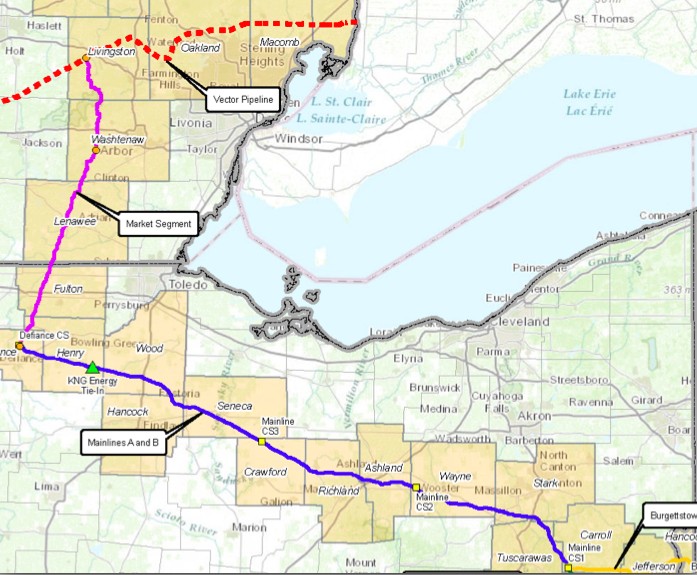
 We’re always on the lookout for news about a final investment decision by PTT Global Chemical to build a $5 billion ethane cracker in Belmont County, OH. Recently PTT spent $13.8 million to buy 168 acres at the proposed cracker plant site (see
  E2 Energy Services, which operates numerous natural gas processing facilities in the Marcellus/Utica, has just recapitalized “through an equity commitment from Tailwater Capital.” MDN first heard of E2 back in October 2014 when EnLink Midstream transferred ownership (“dropped down”) its investment in E2 Appalachian Compression, LLC and E2 Energy Services, LLC from one EnLink corporate entity to another (see
  Anti fossil fuelers committed to stopping (NOT rerouting) the newly approved NEXUS Pipeline in Ohio continue to pin their hopes on a meritless lawsuit against the Federal Energy Regulatory Commission (see
  The University of Cincinnati (UC) has now used $470,000 of taxpayer money for three research studies (over the past four years) to study the health effects of Utica Shale fracking. One of the studies dealing with ambient air pollution (published in March 2015) had such major errors the authors retracted it in June 2016 (see
  Ohio Gov. John Kasich (RINO) promised, five years ago, to allow shale drilling on state-owned forests and parks. He promptly then reneged on his promise. The way Kasich blocked drilling was to refuse adding new members to the Oil and Gas Commission, charged with approving potential drillers on state land. Kasich created a de facto moratorium that prevents fracking on state-owned land. In May of this year, Republican legislators, tired of Kasich’s recalcitrance, added a “little-noticed provision” in the state budget deal that will give the legislature, and not the governor, the power to select members of the Ohio Oil and Gas Commission (see
  Two new members added to the Federal Energy Regulatory Commission by President Trump (Neil Chatterjee and Rob Powelson), added to the Obama-appointed member (Cheryl LaFleur) have not wasted any time in authorizing their first major pipeline project as a group. Last week the trio voted to approve the first major pipeline project since a quorum has been reestablished–NEXUS, a $2 billion, 255-mile interstate pipeline that will run from Ohio through Michigan and eventually to the Dawn Hub in Ontario, Canada. On August 4th, NEXUS, which is a jointly owned project between DTE Energy and Spectra Energy (now part of Enbridge), sent a letter to the new FERC quorum urging fast action (see