 Rover Pipeline–$3.7 billion, 711-mile natural gas pipeline that (will eventually) run from PA, WV and eastern OH through OH into Michigan and on to Canada–began flowing natural gas through a large portion of the pipeline on Sept. 1st (see Big Portion of Rover Pipeline Now Up & Running – Thru Most of Ohio). In the past three weeks, Phase 1A of the pipeline has steadily increased its throughput and now flows over 700 million cubic feet per day (MMcf/d) of yummy Utica/Marcellus Shale gas to Defiance, OH. However, it could flow more, if the Federal Energy Regulatory Commission (FERC) would lift its considerable boot off Rover’s neck and let them finish Phase 1B pipeline work in eastern Ohio to feed more gas to the main part of the pipeline. The problem is that Rover had early missteps, the most serious of which spilled 2 million gallons of non-toxic drilling mud in a swamp near the Tuscarawas River back in April (see Rover Pipeline Accident Spills ~2M Gal. Drilling Mud in OH Swamp). An investigation by the Ohio Environmental Protection Agency (OEPA) found the presence of diesel fuel in the drilling mud, which means the mud wasn’t so non-toxic after all (see OH EPA Says Diesel Fuel Found in Rover 2M Gal Drilling Mud Spill). Rover believes sabotage may have been the cause. Since April, FERC has blocked all new underground HDD work for the Rover project. Rover has asked (begged, pleaded) FERC, several times, for permission to restart the HDD work–at least in a few select locations. In August, FERC issued eight conditions before they would agree to lifting the HDD ban (see FERC Issues Rover 8 Commandments to Restart Horizontal Drilling). Rover says they have met all of those conditions. However, the OEPA says they have not. Last week OEPA asked FERC to continue blocking HDD activity until they (OEPA) are satisfied (see Rover Pipeline Still Battling Ohio EPA, Asks FERC to Lift HDD Ban). Rover fired off a letter to FERC that says OEPA’s public statements are opposite of their private statements with Rover. In other words, OEPA is lying. Who will FERC listen to? Now we know. They’re listening to Rover. Yesterday FERC lifted the ban on HDD for nine key locations–NOT including the Tuscarawas River site. FERC says they are still investigating that spill. FERC said, in lifting the HDD ban, that “Rover has demonstrated sufficient progress on the required rehabilitation and restoration of the areas affected by the inadvertent release and drilling mud contamination” and that the company is following FERC’s 8 Commandments. We’re pretty sure yesterday’s FERC decision won’t make the OEPA happy…
Read More “FERC Lifts Rover Horizontal Drilling Ban, Pipeline Work Resumes”

 On Monday, Mr. Supattanapong Punmeechaow, president and CEO of PTT Global Chemical (Thailand’s largest petrochemical company) signed a Memorandum of Understanding (MOU) with JobsOhio regarding PTT’s proposed ethane cracker plant. The MOU pledges to “enhance the well-being and quality of life” for those living in the area near the proposed cracker plant. PTT announced in April 2015 they are interested in building a $5 billion ethane cracker plant complex in Belmont County, OH (see It’s Official: Belmont County Chosen as POSSIBLE Cracker Plant Site). Since that time, all of the signs have been positive. PTT has said a final investment decision will be forthcoming by the end of this year. The MOU signing ceremony on Monday is yet more evidence that this project will happen. The ceremony itself is kind of interesting. It was not held in Ohio–but in Washington, D.C. where a trade delegation from Thailand was visiting (Punmeechaow was part of the delegation). So John Minor, president of JobsOhio, traveled to D.C. for the signing ceremony, which was held in what we can only describe as a garage…
 Back in May MDN told you about the antis running the City of Green, Ohio (see
  MDN is once again attending the Shale Insight event–in Pittsburgh. Yesterday was the first day of the event. The crowd was definitely smaller than last year when then-candidate Trump spoke to attendees. However, Day One saw a number of heavy-hitting speakers, including Secretary of Labor Alexander Acosta, Deputy Secretary of Energy Dan Brouillette, XTO Energy President Sara Ortwein, Chevron Appalachia President Stacey Olson, and People’s Natural Gas CEO Morgan O’Brien. Marcellus Shale Coalition President Dave Spigelmyer served as master of ceremonies and seemed to be everywhere-present during the event (how does he DO that?). From the opening session to the exhibit floor to attending the breakout sessions, MDN editor Jim Willis made the rounds–and took lots of notes. In the coming days he will write up those notes and share them. For now, we have links and extracts of articles from other publications attending and reporting on this year’s Shale Insight…
 Last week MDN brought you the news that Ohio EPA’s director, Craig Butler, has kind of tipped over into the deep end with his rantings and ravings about Rover Pipeline (see
  Back in March MDN told you about an Ohio landowner with an old oil and gas lease where a conventional (vertical only) well was drilled–and still producing–suing the energy company, telling the company to either explore the shale layer, or severe the lease rights to shale so the landowner can lease it to someone who will go after the shale (see
  NEXUS Pipeline, a $2 billion, 255-mile interstate pipeline that will run from Ohio through Michigan and eventually to the Dawn Hub in Ontario, Canada, is about ready to begin construction–any time. NEXUS got final approval for the project from the Federal Energy Regulatory Commission (FERC) in August, the first major pipeline to get approved following a newly restored quorum at FERC (see
  District 5 Investments, an energy-focused private equity firm based in Texas, has formed a new subsidiary called Pathfinder Resources in order to invest in the Marcellus/Utica region. According to an announcement yesterday, Pathfinder will focus on acquiring “producing and non-producing oil and gas mineral interests, royalty interests and non-operated working interested” across the U.S., but starting first in the Marcellus/Utica. Investment sizes range from $5 million to $35 million. Here’s the latest investor to grab a piece of the Marcellus/Utica pie…
 From the day the first backhoe began digging in Ohio, it has appeared that Ohio EPA director Craig Butler has had a grudge against Rover Pipeline. We’re not saying Rover hasn’t had its fair share of environmental transgressions that need to be monitored and rectified. But Butler has been on a one-man mission to punish Energy Transfer, the builder, demanding (without legal authority) insanely high “fines” from ET Rover. At first it was $400,000. Then $900,000. Now Butler says ET owes the state $2.3 million! Butler is trying to draw in Ohio’s Attorney General into the confusion in order to shake down Energy Transfer and make them pay. Yesterday Butler held a conference call with the media (MDN wasn’t notified/invited) where he made wild allegations. What seems to have precipitated Butler’s media bender is a decision by the Federal Energy Regulatory Commission (FERC) on Monday to allow ET to resume horizontal directional drilling (HDD) in most Ohio locations, after banning it for several months (see
  At a staged media event yesterday, Ohio EPA director Craig Butler had no end of insults for Energy Transfer and their Rover Pipeline project, making wild claims that the company now owes the state $2.3 million in fines (see today’s companion story). However, at the same media event, Butler had faint praise for another project–NEXUS Pipeline. The OEPA issued a federal water permit for the project on Tuesday. NEXUS is a $2 billion, 255-mile interstate pipeline that will run from Ohio through Michigan and eventually to the Dawn Hub in Ontario, Canada. The project is co-owned by DTE Energy of Detroit and Spectra Energy (now part of Canadian company Enbridge). NEXUS got final approval from the Federal Energy Regulatory Commission in August, the first major pipeline to get approved following a newly restored quorum at FERC (see
  Rover Pipeline–$3.7 billion, 711-mile natural gas pipeline that (will eventually) run from PA, WV and eastern OH through OH into Michigan and on to Canada–began flowing natural gas through a large portion of the pipeline on Sept. 1st (see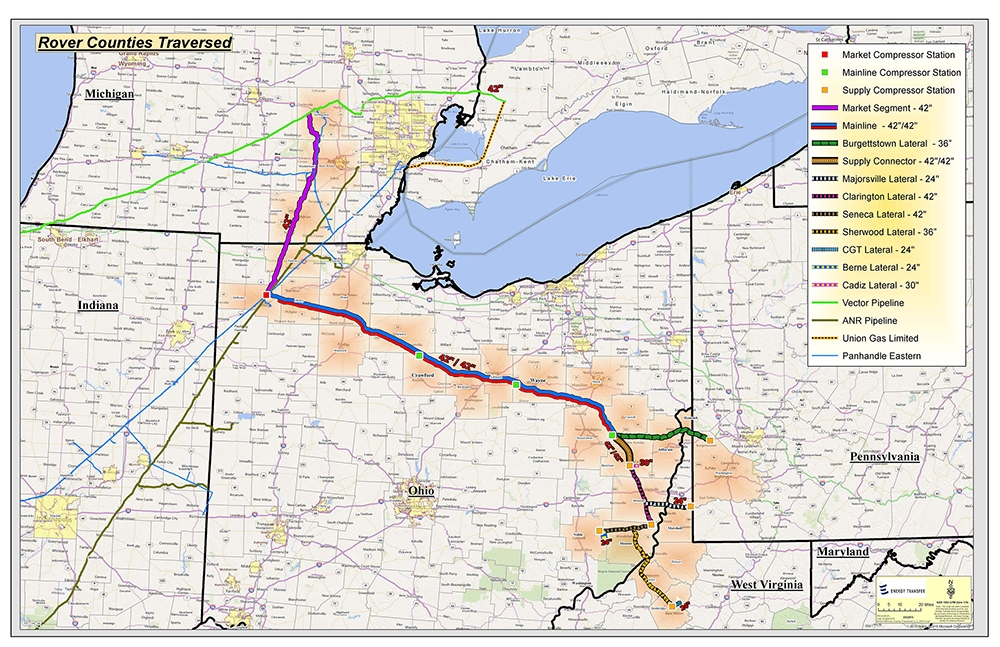
 Mountaineer NGL Storage wants to build a new underground NGL storage facility in Monroe County, Ohio, near Clarington, along the Ohio River (see
  Lawsuits filed against Antero Resources in both Ohio and West Virginia seek class action status. Both lawsuits make similar claims: Namely that Antero has improperly deducted post-production expenses from royalty checks (not allowed under lease terms), and that Antero has avoided, with creative accounting, paying royalties on natural gas liquids (NGLs) produced. The OH lawsuit was first filed in January of this year, followed by a lawsuit filed in WV in May. We have copies of both complaints below, so you can read the language for yourself. In the case of the OH lawsuit, Antero filed a motion to dismiss. The landowners amended the complaint and Antero dropped their motion to dismiss. The OH lawsuit, and as near as we can tell, the WV lawsuit, are both moving forward. Here’s our summary of both lawsuits–the MDN Cliffs Notes version…
 In June 2016, MDN told you about an economic development group of business and government leaders from Ohio and West Virginia (the Mid-Ohio Valley) called Shale Crescent (see