
1st Marietta College Oil and Gas Technical Exposition Big Success
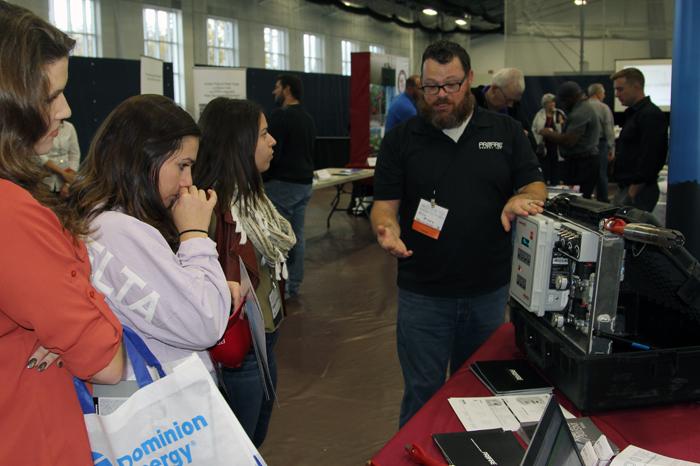
Hats off to the smart and ambitious kids at Marietta (OH) College. A group of students in the college’s oil and gas program planned and hosted the first Marietta College Oil and Gas Technical Exposition (MCOGTE) last Friday. There were 51 companies exhibiting at the event. The event drew over 400 attendees–students, members of the oil and gas industry, and members of the local community. There were five large pieces of equipment prominently on display: Halliburton’s Data Van, a Halliburton 30-foot long mud motor, a Nine Energy wireline truck, a Wagner torque and test unit, and an Aqua Source lab. These kids know how to put on a good show! The event offered opportunities to learn and network. Callum Streeter, COO of EdgeMarc Energy and president of Appalachia AADE (American Association of Drilling Engineers) was the keynote speaker. Below is a roundup of what happened at the event…
Read More “1st Marietta College Oil and Gas Technical Exposition Big Success”

 Last week Eclipse Resources, the “super-lateral” Marcellus/Utica driller, turned in its third quarter 2017 update. Eclipse is a Marcellus/Utica pure play driller headquartered in State College, PA that drills mostly in the Ohio Utica. Eclipse has drilled the top three longest onshore oil/gas wells in the world. What do we glean from the 3Q17 update? Two of their world’s longest onshore wells–the Great Scott 3H and Outlaw C11H–are now online and pumping. They are pumping record-setting amounts of condensate. Each is averaging 3,300 barrels of oil equivalent (BOE) to date on a restricted choke, consisting of almost 50% condensate and 68% in total liquids. Gushers! During 3Q17 Eclipse drilled 10 wells in all, including four super-laterals with an average lateral length of over 17,500 feet. So far the company has drilled 11 super-lateral wells with an average lateral length of ~18,000 feet–averaging just 16 days from spud to total depth. Incredible! The company had average daily production of 353 million cubic feet equivalent per day (MMcfe/d). On an analyst phone call, Eclipse’s top brass said they are working to create a “reputable” super-lateral program, meaning (our words) building a successful program of long laterals that also makes big money. Here’s the 3Q17 update, along with portions of the analyst phone call and the latest slide deck…
 Energy Transfer’s top brass delivered some bad news and some good news on yesterday’s analyst phone call to discuss third quarter 2017 performance. Two projects vital to the Marcellus/Utica are being built by ET–Mariner East 2 (ME2) and Rover Pipeline. The bad news is that ME2, a natural gas liquids (NGL) pipeline project that stretches from eastern Ohio across the state of PA to the Marcus Hook refinery near Philadelphia, will be delayed an extra nine months. ME2 has a new in-service target date of “second quarter 2018.” Progress on ME2 is not as fast as it could be primarily due to an ongoing onslaught of lawsuits by Big Green organizations, coupled with delays from the PA Dept. of Environmental Protection. The good news for ME2 is that by Dec. 31st, 99% of the pipeline will be in the ground and buried. The news for Rover is all good. Rover is a $3.7 billion, 711-mile natural gas pipeline that will run from PA, WV and eastern OH through OH into Michigan and eventually into Canada. Rover had been dogged by problems with horizontal directional drilling (HDD), but those problems are now behind it. Yes, head of the Ohio EPA, Craig Butler, continues his Captain Ahab routine to try and stop the project (see
  When we notice municipal referendums and ballot measures related to blocking shale drilling and pipelines, we always highlight them. Such a ballot measure appeared on the ballot in Bowling Green (Wood County), OH on Tuesday. We honestly were not aware of it prior to reading an article in the Toledo Blade. The ballot measure called for a ban on pipelines that flow natural gas and other fossil fuels over city-owned property. It’s aim is to prevent NEXUS Pipeline from building nearby. Antis got enough signatures for this glittering jewel to appear on the November ballot. And how did the good people of Bowling Green vote? They saw right through this one–voting it DOWN by a huge margin: 61%-39%. That’s a blowout, politically. But you know antis. Nothing, including the truth, will ever change their minds. The Bowling Green ballot measure was the work of out-of-towners–the Community Environmental Legal Defense Fund (CELDF)–about whom we’ve written plenty (
 Over the past six months we’ve run a steady string of stories about Mountaineer NGL Storage and its proposed underground NGL (mostly ethane) storage facility in Monroe County, Ohio, near Clarington, along the Ohio River (
 The International (non-U.S.) Baker Hughes rig count for October 2017 was 951, up 20 from the 931 counted in September 2017, and up 31 from the 920 counted in October 2016. The U.S. rig count for October 2017 was 922, down 18 from the 940 counted in September 2017, but up 378 from the 544 counted in October 2016. Notice that we have almost as many rigs operating in the U.S. as the entire rest of the world (minus Canada). Canada’s rig count has improved a lot since earlier this year. However, Canada’s October rig count drooped a bit–204 in October (down 4 from September) but up 48 from October 2016. What about rig counts in the Marcellus/Utica? Pennsylvania lost one rig and ran an average of 32 rigs during October, versus Ohio running 29 rigs and West Virginia running 15 rigs, the same as September…
 The director of the Ohio Environmental Protection Agency (EPA), Craig Butler, continues to go off the rails with a major grudge against Rover Pipeline (see
  In March MDN reported on a court case decided in Ohio’s Seventh District Court of Appeals that seems to say that at least some landmen in Ohio DO need to be licensed real estate agents, in order to get paid (see
  This story necessarily gets into the weeds of pipeline construction. But so you have the essential story line up front, this is it: On Monday Energy Transfer asked the Federal Energy Regulatory Commission (FERC) for permission to dump something called annular pressure monitoring (APM) when drilling underground (horizontal directional drilling, or HDD) for the Rover Pipeline–and on Tuesday FERC granted that permission. Here’s the slightly longer explanation. Rover is a $3.7 billion, 711-mile natural gas pipeline that will run from PA, WV and eastern OH through OH into Michigan and eventually into Canada. Early on, Rover had early missteps when using HDD to insert pipeline under things like rivers and roads. The most serious episode occurred when Rover drilling spilled 2 million gallons of non-toxic drilling mud in a swamp near the Tuscarawas River (in Ohio) back in April (see
  NEXUS Pipeline has had to use the unpreferred last option and has taken landowners of 42 properties to court using eminent domain in order to secure easements so they can lay pipeline through those properties. NEXUS is a $2 billion, 255-mile interstate pipeline that will run from Ohio through Michigan and eventually to the Dawn Hub in Ontario, Canada. NEXUS received final approval for the project from the Federal Energy Regulatory Commission (FERC) in August, the first major pipeline to get approved following a newly restored quorum at FERC (see
  The U.S. District Court in Akron, OH has just made a major ruling that affects all Utica landowners and drillers. In 2015, the Ohio Supreme Court accepted a case that will sound familiar to readers of MDN. The case, known as Lutz v. Chesapeake Appalachia, is about whether or not drillers (Chesapeake in this case) are allowed to deduct certain post-production costs from landowner royalty checks. The Ohio Supremes were asked to decide whether Ohio follows the “at the well” rule, which permits the deduction of post-production costs, or if the state follows the “marketable product” rule, which limits the deduction of post-production costs under certain circumstances. The Supremes came down off Mount Olympus in November 2016 to render their verdict (see
  Last week NEXUS Pipeline notified the Federal Energy Regulatory Commission (FERC) they had begun construction on the $2 billion, 255-mile interstate pipeline that will run from Ohio through Michigan and eventually to the Dawn Hub in Ontario, Canada. We purposely held off on sharing this exciting news until we could tell you where construction has begun. Each week NEXUS, like other interstate pipelines answering to FERC, provides a weekly update on construction and other project activities. We have a copy of that report (below). What does it show? Preliminary activities are taking place to move equipment, put up signage, and begin to work in “Spread 1”–meaning somewhere within Columbia, Stark, Summit, and Wayne counties in Ohio. Similar work is happening in “Spread 4”–meaning counties in Michigan. Initial site preparation is already happening at three of the four planned compressor stations. Here’s what we have been able to piece together about the initial construction work done on NEXUS…
 Ohio Utica Shale drilling is showing signs of a new boom in drilling–much to the delight of everyone, except anti’s. A new shale boom in the Buckeye State is good for landowners, it’s good for the economy, and it’s good for jobs. Frankly, it’s good for everyone. What are the signs of a burgeoning new shale boom? Here’s one sign: Business at a barge facility on the Ohio River where drillers offload equipment and supplies had all but dried up–at least traffic coming from shale-related customers. The facility operator kept afloat by handling soybeans and corn. But now? The bookings from the oil and gas industry are rolling in again. Drilling supplies like barite are once again coming to the facility. Add to that rig counts in Ohio are inching up–almost at parity with Pennsylvania (see