
New Shale Permits Down in PA & OH as Winter Begins
 An analysis by Argus Media shows the number of new permits issued to drill in the Pennsylvania Marcellus Shale was down 42% in November 2018 over the same time a year ago. Drilling in Ohio’s Utica Shale was down 26% in November vs. a year ago. Yet one overpowering fact remains: Production in both states is UP over a year ago! How do you explain it? Each year drillers get better at what they do–they get more gas from drilling fewer wells. Longer laterals, more sand, improved fracking techniques–it all adds up to more production with less drilling. Our region is also still working down our DUC (drilled but uncompleted) wells inventory, which means less drilling. And winter cold has set in, early. Yeah, less drilling means fewer jobs and fewer opportunities to sell goods and services to drilling companies. But watch for the permit numbers to start going up again (our prediction). Why? Because with pipelines which recently went online and new pipes due to go online, the price our gas is fetching has dramatically increased–and that means the willingness of M-U drillers to drill new wells will increase too.
Read More “New Shale Permits Down in PA & OH as Winter Begins”
 The Pennsylvania Dept. of Environmental Protection (DEP) issued 269 permits for Marcellus (and possibly a few Utica) shale wells in October and November. The Ohio Dept. of Natural Resources (ODNR) issued 22 permits in the Utica/Point Pleasant shale play in October, and 11 permits in November (as of Nov. 17). That’s over 300 new shale wells between the Marcellus and Utica in the most recent two months–a strong showing. Farm and Dairy, a 100+ year-old publication serving the rural communities of Ohio, Pennsylvania and West Virginia, recently tabulated the permit numbers for western PA and eastern OH, down to the county level. Here’s what the numbers show.
 This is the kind of news we love to share! Keystone Clearwater Solutions, which was once majority owned by Rex Energy until they sold it to American Water Works in 2015 (see
  How much “diligence” is required when trying to locate the heirs of mineral rights owners in Ohio, as stipulated by the Ohio Dormant Minerals Rights Act (DMA)? That issue was addressed, once again, last week–this time by Ohio’s 7th District Court of Appeals. The DMA requires a surface owner to exercise “reasonable due diligence” to ascertain the names and addresses of mineral holders and their heirs prior to serving notice of abandonment by publication. The question is, what is “reasonable due diligence”? Is there a common standard? The 7th District decided there is no common standard, and what’s reasonable in one case may not be reasonable in another. In other words, it all depends–and is unique in each case.
 Each year (for the 12th year running) the Canadian-based Fraser Institute surveys petroleum industry executives and managers (256 of them for 2018) asking them their opinions on the barriers to investing in exploration and production in various geographies across the globe. That is, what makes them more likely or less likely to spend money drilling in a particular location? The Global Petroleum Survey (full copy below), tallies the survey responses and ranks each geography from most desirable place to invest, to least desirable. Last year West Virginia was ranked as the fifth most desirable place to invest (see
  Reuters has published a “hit piece” against Energy Transfer (ET) and two of its recent big pipeline projects–Rover Pipeline (in Ohio & Michigan), and Mariner East 2 Pipeline (in Ohio and Pennsylvania). Reuters is usually more balanced than, say, Bloomberg with these types of articles. Reuters usually doesn’t go out of its way to denigrate the industry. The article evaluates the number of permit violations issued for both projects. Together that number exceeds 800. Is that a lot? Reuters says they’ve analyzed “four comparable pipeline projects” and found an average of 19 violations per project (or 38 for two projects). So yeah, 800 vs. 38 sure sounds like a lot to us.
 Earlier this month Encino Acquisition Partners (i.e. Encino Energy) completed its purchase of all of Chesapeake Energy’s Ohio Utica Shale assets for $2 billion, originally announced in July (see
  NEXUS Pipeline, a $2.6 billion, 255-mile interstate pipeline that runs from Ohio into Michigan, began a partial startup in October, and is now fully online. Although there was early opposition to the project, and some complaints from landowners along the route of construction, the project is noteworthy for the just how little complaining there actually was. Not all of the restoration work–things like reseeding and landscaping–is done. Most of it is done, but not all. A few landowners still have some scattered complaints related to unfinished work. Massive amounts of rain in the region have prevented final restoration work, which NEXUS now says will have to wait until spring 2019. In the meantime, local school districts and municipalities are rubbing their hands, anticipating tax payments that will begin to flow into their coffers.
 The deal is done. On Monday, Encino Acquisition Partners completed its purchase of all of Chesapeake Energy’s Ohio Utica Shale assets for $2 billion, originally announced in July (see
 Gulfport Energy, an independent oil and gas driller with significant acreage positions in the Utica Shale of eastern Ohio and the SCOOP Woodford and SCOOP Springer plays in Oklahoma, issued its third quarter operational (not financial) update yesterday. Gulfport is one of those companies that delivers its operational news first, and a few weeks later issues its financial news. Gulfport reports production continued to climb to new highs, averaging 1,427.5 million cubic feet equivalent (MMcfe) per day, a 7% increase over 2Q18 and 19% increase over 3Q17. Said another way, 1.43 Bcf/d.
 The Ohio Oil and Gas Association (OOGA) and St. Clairsville Area Chamber of Commerce sponsored an update on the Utica Shale and its impacts in southeastern Ohio at a one-day event held yesterday at Belmont College. The upshot of the day seemed to be this: The Utica is still creating thousands of jobs, and still attracting millions of dollars in investment. Among the speakers were reps from both EQT and Ascent, who had some interesting comments about their respective operations. Question: Who do you think is the largest natural gas producer in Ohio today? One of the speakers made the surprise claim that her company is now the top producer in Ohio.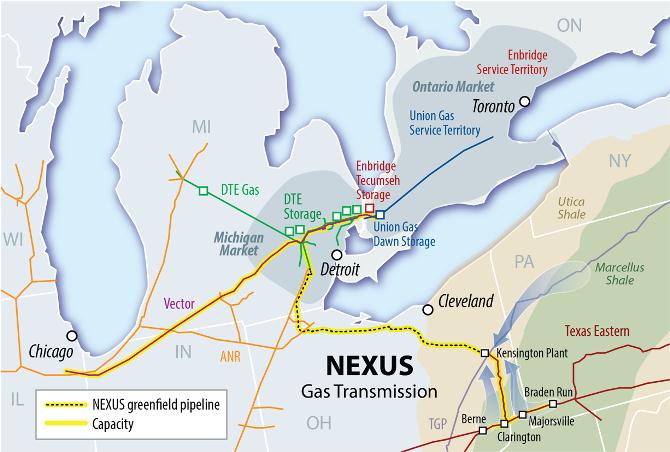
 On Tuesday, Enbridge, owner of the Texas Eastern Transmission Company (Tetco) Pipeline, announced it has put part of its Texas Eastern Appalachian Lease (TEAL) natural gas pipeline project in Ohio into service. TEAL boosts capacity along Tetco by 950 million cubic feet per day (MMcf/d), to flow Marcellus/Utica gas to the recently-completed-but-not-yet-online NEXUS pipeline (see