
Shell’s PA Ethane Cracker Plant Gets a Name: Shell Polymers
 If you’ve read MDN for any length of time, you know about a $6 billion ethane cracker plant being built by Shell in Monaca (Beaver County), PA–near Pittsburgh. The plant will chemically “crack” ethane, an abundant natural gas liquid (NGL) that comes out of the ground along with methane, creating polyethylene from the ethane. Polyethylene is, in essence, raw plastic. Manufacturers in the region and beyond will use the plastic pellets Shell will produce at the plant to create an unlimited variety products. Shell is a smart company. They’re as much a marketing company as they are an oil and gas producer and petrochemical manufacturer. They know the value of positioning and mind share. We hadn’t thought about it previously, but we always just thought of and called the project the “Shell cracker plant.” The plant now has a name: Shell Polymers. The name Shell Polymers has been around for a long time but had fallen out of use when Shell largely exited the plastics business. With the new cracker coming online in the next few years, it’s time to revive the Shell Polymers name/brand and apply it to the cracker plant, which is how the project was being pitched at the last week’s NPE2018 (formerly called the National Plastics Exposition) in Orlando, Florida…
Read More “Shell’s PA Ethane Cracker Plant Gets a Name: Shell Polymers”
 Last Thursday Pittsburgh’s KDKA-TV hosted an event called “Eye on Beaver County” in Beaver, PA–a celebration of Beaver and a discussion about the county’s future. An 11-member panel discussed the past, present and future of the county. The discussion, as you might imagine, quickly turned to Shell’s $6 billion ethane cracker, going up in Monaca even as you read this. A Shell rep and several reps from labor unions were on hand to discuss the manpower issue. The short version is this: Unions for carpenters, ironworkers, steamfitters, and heavy equipment operators need more members, more people to help build the facility. Like, now. The unions offer free training. No, the jobs are not permanent, but such jobs never are. They’re good, high-paying jobs and the jobs will last at least a few years. Plus you get bragging rights–“I helped build the Shell cracker plant.” Here’s how the discussion about the need for more cracker plant workers went at last week’s event…
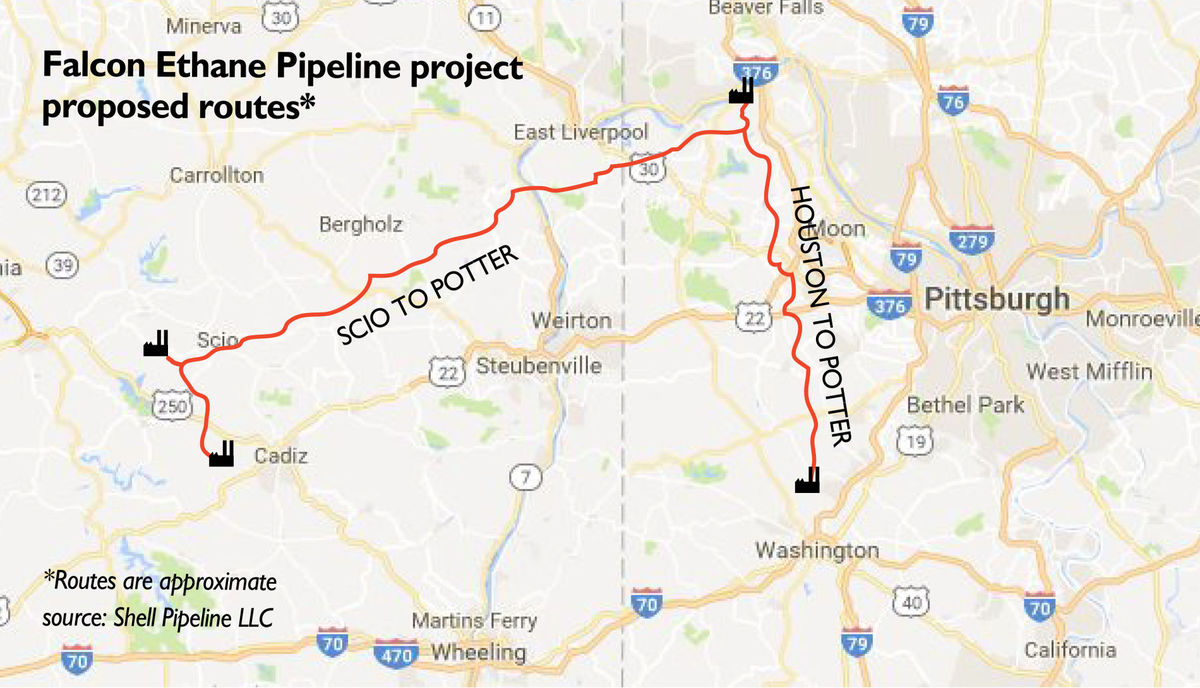

 Shell wants to build a 97-mile ethane pipeline to feed the mighty $6 billion cracker plant its building in Beaver County, PA. Shell chose not use eminent domain but instead negotiated with (paid big bucks for) rights of way along the pipeline’s path. Earlier this month additional details came out about the proposed project when the Pennsylvania Dept. of Environmental Protection (DEP) published an application from Shell for stream crossing permits. When the details became known, the Ambridge Water Authority (in Beaver County), an organization that oversees a reservoir that provides drinking water for ~30,000 people, expressed “strong opposition” to the route of the pipeline (see
 Shell Chemicals this week announced the donation of a $1 million gift to the Community College of Beaver County (CCBC). The gift will benefit the school’s process technology program and will be used to construct a new Shell Center for Process Technology Education building. CCBC President Chris Reber called it a “transformational gift” and an “extraordinary investment.” The gift will ultimately help train students to work for Shell and other companies that will benefit from Shell’s ethane cracker plant (being built in Beaver County). This isn’t the first huge gift for the process technology program at CCBC. In December, the Allegheny Foundation donated $1 million toward the first phase of the program’s expansion. Shell’s donation will fund the second phase. Aside from the big $1M announcement, Shell also awarded $2,500 (each) scholarships to 13 students in the CCBC process technology program. Shell has really stepped up to the plate in SWPA. They are investing in local talent and local institutions…

 Shell has had pretty smooth sailing with their proposed 97-mile Falcon ethane pipeline project–a pipeline that will feed the mighty $6 billion cracker plant Shell is building in Beaver County, PA. Shell did not use eminent domain but instead negotiated with (paid big bucks for) rights of way along the pipeline’s path. That process continues. There have been some grumblings here and there, particularly from Big Green groups. But all in all, there has been remarkably little opposition–that is, until now. Shell filed an application to build the Falcon project back in October (see

 Although Shell’s mighty $6 billion ethane cracker chemical complex won’t be completed until around 2020, Shell is not waiting with respect to recruiting talent to operate the plant. Shell recently launched a page on their main website dedicated to recruiting people for cracker plant jobs (
 A major milestone has been reached in the mighty Shell $6 billion ethane cracker facility project. Over the past year or so site preparation has been vigorous. Work at the site in Monaca (Beaver County), PA has included building bridges, relocating a state highway, improving existing interchanges, repositioning a rail line, and preparing foundations for the new complex. The prep work is now largely done–and this week begins construction of the buildings that will house four processing units–the ethane cracker itself and three polyethylene units. Also part of this next (final) phase of construction: a 900-foot long cooling tower, rail and truck loading facilities, a water treatment plant, an office building and a laboratory. Oh! And let’s not forget that Shell will also build a 250 megawatt electric generating plant that will provide all of the electricity needed at the facility–powered by Marcellus Shale gas, of course! Here’s an update from Shell, with a picture of the site as it is now…
 Shell’s $6 billion ethane cracker plant facility in Monaca (Beaver County), PA is about to ramp up construction of the numerous buildings that will house the equipment. Since 2014, Ate Visser, vice president of Appalachia petrochemicals at Shell Chemical, has been the guy in charge of the project (see
 An extensive article in the Pittsburgh Business Times calls attention to the developing shortage of qualified construction workers in southwest Pennsylvania. So far the need for workers has been met, but it’s not hard to predict that as Shell ramps up its “vertical construction” (building the buildings to house the cracker) this fall, that shortages will happen–not only for Shell’s project, but for other expansion projects in the area as well. Shell is the anchor. There are dozens (perhaps hundreds) of other businesses that will launch, relocate or expand to take advantage of Shell’s forthcoming supply of cheap plastics. All of those projects will create thousands of jobs in the construction industry. Various colleges and unions have launched training programs to meet the need for electricians, carpenters, iron workers, steamfitters, insulators and sheet metal workers. Question is, will it be enough?…
 A decade ago the petrochemical industry in the U.S. was in the toilet–in the midst of a downturn. Plants were leaving our shores, heading to other countries. And then the shale revolution hit full force–and changed everything. Petrochemical plants and investment is now skyrocketing here at home, because of shale. Petrochemicals are chemical products derived from petroleum (i.e. oil) and natural gas. The entire plastics industry comes from oil and gas–you knew that, right? Ethylene (which comes from ethane) and propylene (which comes from propane) are used to make polyethylene and polypropylene respectively–that is, plastics. And plastics are used in just about everything you touch, live in, ride in, etc. Plastics make modern life possible. Without plastics, we’d be back in the Stone Ages–living short, brutish lives. Ten years ago our petrochemical industry was flailing, but today it’s thriving. According to an expert speaking last week at Pittsburgh Chemical Day (an annual event), the Shell ethane cracker now under construction is in the “the second wave” of ethane crackers. According to the same expert, we are witnessing the “biggest buildup in the U.S. petrochemical industry we have ever seen.” And it’s all because of shale…