
New Easement for Shell Ethane Cracker Pipeline Reveals Price Paid
 Bit by bit, piece by piece, Shell is getting landowners in Beaver County, PA to sign easements for its 94-mile Falcon Ethane Pipeline–a pipeline with two “legs” that will feed Shell’s mighty ethane cracker plant. MDN exclusively broke the news in February 2016 that Shell had begun to sign leases with landowners for the pipeline (see Exclusive: Shell Leasing Land for 2 Pipelines to PA Cracker Plant). As we later learned, it’s “one” pipeline with “two” legs or branches. There were more easements signed in January (see Shell Leases More PA Properties to Build Ethane Pipeline), and again in May (see Another 7 Easements Signed for Shell’s Falcon Ethane Pipeline). The latest news is that Shell has acquired another 3,183 feet. What’s different this time, however, is that we know how much Shell paid to lease those 3,138 feet. We’ve not seen any mentions of payments in the past (Shell preferring to keep it private). We won’t keep you in suspense, the price paid works out to be $75 per foot…
Read More “New Easement for Shell Ethane Cracker Pipeline Reveals Price Paid”
 Believe it or not, Shell previously hired a third-party consultant to perform a traffic study in the area where Shell plans to build a $6 billion ethane cracker in Beaver County, PA. Based on the findings and recommendations of that study, Shell has begun to secure parking spots for construction workers that will descend on that location to build the plant–beginning later this year. One of the recommendations is to limit the number of parking spots to no more than 1,500 at any one location. Shell currently has three locations lined up and (mostly) ready to go, enough for 3,100 parking spots. At its peak, the project will employ something like 6,000 workers. So either Shell will line up more spots, or maybe workers will carpool…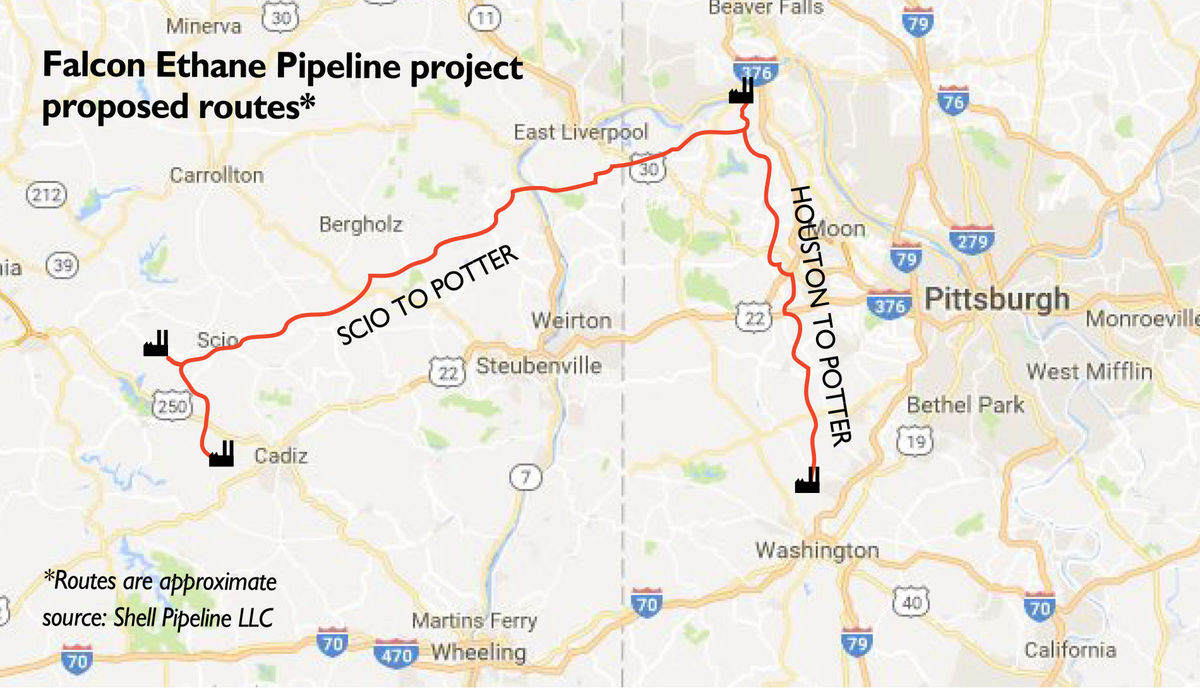
 Whenever a big, important project like the Shell ethane cracker, reported to be a $6 billion investment, goes forward, a whole lotta people were involved before the decision was made. However, if there is one universal truth in business it is this: There is always a champion at the center of any important project. The one person who’s responsibility it is to propel that project forward. The person who, we like to say, has their “butt in a sling.” It is on their shoulders to ensure the projects success. When you dig down into the story of the multi-billion dollar Shell cracker plant now being built in Beaver County, PA, you will find that one person. His name is Brent Vernon. He worked for more than five years to lure Shell to the Keystone State. Vernon was senior project manager for energy for the state when he began working, full time, on the Shell project in 2011. Since then he was promoted, first to deputy director and eventually director of the Governor’s Action Team, a role he continues. Vernon is key–one of the linchpins without whom the Shell deal would not have happened…
 The Pittsburgh, PA region has been truly blessed by the Marcellus Shale industry. Largely because of the Marcellus, last year (2016) saw the biggest year ever for capital investment in the 10-county Pittsburgh region–a mind-blowing $10.2 billion of investment! It is the highest capital investment in a single year ever. Now mind you, not all of that money actually got invested last year. Some of it will come in dribs and drabs over the next several years. But all of that $10.2 billion was committed to in 2016. Last week the Pittsburgh Regional Alliance (PRA) issued its annual Business Investment Scorecard. The report (read it below) finds that more than half of last year’s capital investments pledged to Pittsburgh region came from a single project–the $6 billion Shell ethane cracker. The report also found another $3.11 billion worth of investment related to shale gas (processing plants, gas-fired power plants, etc.). Add it all together, and over $9 billion of the $10.2 billion committed last year is due to the Marcellus industry. To which we say, Pittsburgh should bow down and kiss some shale rock…
 It’s hard to keep track of all the Marcellus and Utica Shale-fired electric plants being planned, built and going online. We recently highlighted a list of 11 such projects getting built in Ohio (see
  Positive economic signs continue to pop up with respect to Shell’s multi-billion dollar ethane cracker project in Beaver County, PA. Here’s the latest major economic impact from the project. A local developer has filed for a state grant to build a massive new housing project 2.5 miles from the cracker site. The new project calls for 450 housing units, retail space, a golf course, swimming pool and parking garage. What’s that? What happens after the cracker is built and the “temporary” workers, who would be living in this new complex for the next 5-10 years, leave? Great question! Answer: Turn it into a retirement community…
 Some 400 business, education and government officials attended a sold-out forum last week in Titusville, PA to hear about doing business with the $6 billion Shell ethane cracker project in Beaver County, PA. The stakes are high. One PA official said, “This is the greatest generational economic development we’ve seen in Pennsylvania, maybe ever.” According to a Louisiana resident involved with crackers in his state, for ever job the Shell cracker creates there will be 8.3 jobs somewhere else–at other companies in the region–to support the plant. It is an incredible opportunity. The question, for businesses in the region, is: How do we get a piece of the cracker pie? We now have an answer–at least in part. If you want to supply goods and services for the construction of the plant, the key is in working with the main contractor building the plant–Bechtel. Below we have details on how to plug in to the Bechtel supply chain system, along with advice for job seekers who want to work at the cracker plant once it’s built…
 Jim Sewell, the Environmental Manager for the Shell ethane cracker project being built in Beaver County, PA, recently gave an update on the project to members of the Ohio Valley Oil and Gas Association. Sewell spoke about the reason Shell chose the Monaca site. He also gave an update on progress at the site. The biggest problem they’re trying to solve right now? Parking for workers…
 One of our fun pastimes is speculating about when, exactly, the mighty Shell ethane cracker in Beaver County, PA will actually go online. In February, Shell CEO Ben van Beurden said this: “We haven’t announced exactly when it will start up, but expect that to be not anymore this decade” (see
  The sharp folks over at the Pittsburgh Business Times have been looking through data from the Pennsylvania Department of Environmental Protection (DEP) and have compiled a list of 20 drillers who have at least a dozen shale wells in the southwest PA region. And they ranked them from lowest to highest. We’ve grabbed the list below. The interesting thing for MDN is that there is one name in the list not familiar to us, and we’ve been watching this space since 2009. Always fun to learn something new. Here’s the list of southwest PA’s “Top 20” Marcellus drillers…
 We want to alert you to an upcoming webinar that will be worth your time. On Feb. 27 at 2 pm, NGI (Natural Gas Intelligence) will host a webinar titled, “Cracking the Ethane Code in Appalachia,” all about the Shell ethane cracker. NGI’s ace reporter Jamison Cocklin (MDN editor Jim Willis knows Jamison and has the highest regard for his reporting and writing) will moderate. On the call will be an all-star cast: Don Rush, VP of CONSOL Energy; Jim Cooper, American Fuel & Petrochemical Manufacturers; Denise Brinley, PA Department of Community and Economic Development; and Danielle Sandusky, Level 2 Energy. The webinar will help answer questions about the size and scope of the cracker, whether (and how) the cracker will impact drilling decisions, what about competition from other crackers along the Gulf Coast, and more. Below is more information, and a
 In December the Potter Township Board of Supervisors convened a public hearing on the proposed Shell ethane cracker plant–to be built in Potter Twp–that ended up going on for 10 hours (see
  In December the Potter Township Board of Supervisors convened a public hearing on the proposed Shell ethane cracker plant–to be built in Potter Twp–that ended up going on for 10 hours (see