
WV Bill Lowers Shale Well Severance Tax from 5% to 3% for 2 Years
 West Virginia Senate Bill (SB) 706 proposes reducing the state’s severance tax from 5% to 3% for new natural gas and oil wells drilled after June 30, 2026, that meet specific production thresholds. This reduction applies only to future projects, leaving existing wells at current rates. While severance taxes provide vital but volatile revenue—ranging from $98 million to $588 million in recent years—this legislation seeks to adjust the fiscal landscape for one of the state’s most profitable resources. The bill is currently under review by the Senate Committee on Energy, Industry, and Mining and awaits further legislative approval. Read More “WV Bill Lowers Shale Well Severance Tax from 5% to 3% for 2 Years”
 Sorry, Field of Dreams, but if you build it, they don’t necessarily come. That’s the hard lesson for one of the biggest boondoggles of the Biden years—seven hydrogen hub projects (from 33 finalists) promised a collective $7 billion in federal funding (see
  Vickery Energy Partners, LLC, a portfolio company of the private equity firm Quantum Capital Group, announced yesterday that it has closed on the acquisition of Tribune Resources. The transaction includes assets located primarily in Wetzel, Tyler, Harrison, and Doddridge counties, West Virginia, totaling approximately 38,000 net acres and more than 200 million cubic feet equivalent per day (MMcfe/d) of net production.
  Two weeks ago, MDN brought you the news that Antero Resources, the country’s fifth-largest natural gas producer and largest producer in West Virginia, had cut a deal to buy WV driller and midstreamer HG Energy II for a combined (upstream & midstream) $3.9 billion (see
 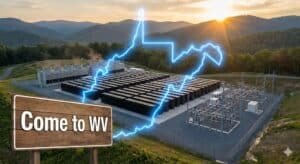 Pennsylvania and Ohio should be looking over their shoulders regarding new data centers and their decisions on where to locate them. West Virginia is making serious efforts to be THE destination for new AI data centers to locate in the Marcellus/Utica region. The West Virginia Office of Energy’s recent summit highlighted the state’s unique position to power the booming AI and data center sectors through its vast natural gas reserves. Like PA and OH, WV’s homegrown natural gas offers a reliable, cost-effective, and flexible solution for necessary baseload power. What’s beginning to set WV apart from its neighbors is legislation that explicitly targets data centers.
  Mon Power and Potomac Edison are local utilities and subsidiaries of FirstEnergy Corp. The two companies recently submitted an Integrated Resource Plan (IRP) to the West Virginia Public Service Commission, outlining how they will continue to deliver reliable, cost-effective power to West Virginia homes and businesses over the next decade (see
  Antero Resources, the largest Marcellus/Utica (M-U) driller in West Virginia, released its Q3 2025 update with two significant announcements. One is that newly appointed CEO Michael Kennedy is “excited” for the company to return to dry gas drilling after “more than a decade,” with the first new dry gas well specifically intended to service the data center market. Second, we can confirm our prior speculation to say that Antero is officially marketing its Ohio Utica assets for sale. We previously brought you that rumor in early September (see
  In October of last year, MDN told you that both EQT Corporation and Tenaska are “dipping their toes” in the carbon capture and sequestration (CCS) space (see
  The U.S. Army Corps of Engineers has proposed new permitting processes in West Virginia and Ohio that would allow certain fossil fuel projects to be built through wetlands and streams without a public comment opportunity. The proposals would allow mines, natural gas pipelines, hydropower dams, and other energy infrastructure projects in WV and OH to proceed using two simplified permits: “letters of permission” and “regional general permits.” For these projects, water pollution impacts must be limited to 2 acres or less for a letter of permission and 1 acre or less for a regional general permit. This action has the potential to speed up new natural gas pipeline projects in the Marcellus/Utica region.
  Yesterday, West Virginia and Diversified Energy unveiled a new public-private partnership to solve one of the most persistent environmental problems in oil- and gas-producing regions. WV Governor Patrick Morrisey and Diversified CEO Rusty Hutson, Jr., announced the creation of the Mountain State Plugging Fund, a unique, non-taxpayer-funded approach designed to retire an estimated 20,000 abandoned oil and gas wells permanently. By capping this old infrastructure, the state will significantly reduce the risk of groundwater contamination and stop the release of methane.

 Disappointingly, the Trump Federal Trade Commission (FTC) voted 3-0 to maintain a “consent order” that prevents private equity firm Quantum Energy Partners from owning stock in EQT and prohibits the CEO of Quantum from serving on EQT’s Board of Directors. This is all to do with EQT’s purchase of fellow driller Tug Hill in 2023. In September 2022, EQT announced a deal to buy privately owned Tug Hill Operating’s West Virginia shale assets (90,000 acres and 800 MMcf/d of production in West Virginia) for roughly $5.2 billion (see
  Mon Power and Potomac Edison are local utilities and subsidiaries of FirstEnergy Corp. The two companies recently submitted an Integrated Resource Plan (IRP) to the West Virginia Public Service Commission, outlining how they will continue to deliver reliable, cost-effective power to West Virginia homes and businesses over the next decade. The big news (for us) is that the companies are seriously exploring the possibility of building a new 1,200-megawatt natural gas combined-cycle power plant, which is expected to be operational around 2031.
  In the closing hours of the 2014 West Virginia legislative session, the legislature passed Senate Bill (SB) 373, the Aboveground Storage Tank Act (see