
EXCO Resources Heading for Bankruptcy, Turnaround Expert Resigns
 In the end, not even turnaround expert John Wilder could turn around EXCO Resources. Wilder is the guy now Secretary of Commerce Wilbur Ross brought in two years ago to turn around the ailing company. At first it seemed like it might be working (see EXCO Resources Turnaround is Working, but Comes at a High Cost). EXCO Resources was once a sizable player in the Marcellus. They still have 184,000 net acres in the Marcellus, with 124 horizontal Marcellus wells drilled and in production. However the company, as we pointed out in March 2016, has abandoned the Marcellus/Utica at this point (see EXCO: No Marcellus Drilling in 2015/2016, NYSE Threatens Delisting). The company flirted with bankruptcy for some time, but in the end they effectively turned over control of the company to its creditors this past summer (see EXCO Issues 2.7M Shares of New Stock in Lieu of Paying $23M). However, the company has continued to struggle financially. Yesterday EXCO announced Wilder has resigned from his position as a member of EXCO’s Board of Directors and from his position as Executive Chairman of the Board, effectively immediately. Translation: He’s given up on trying to save the company. In the same announcement, EXCO said Wilder’s departure “was not the result of any disagreement with the Company on any matter relating to the Company’s operations, policies or practices.” In EXCO’s third quarter 2017 update, released on Tuesday, there is a section in which management says if they can’t make the interest payments on the company’s debt, “the Company may be forced to seek protection from creditors under the U.S. Bankruptcy Code.” They go on to say debt payments and other factors, “raise substantial doubt about the Company’s ability to continue as a going concern.” Ominous language. Here’s the announcement about John Wilder and company statements about possibly seeking bankruptcy protection…
Read More “EXCO Resources Heading for Bankruptcy, Turnaround Expert Resigns”
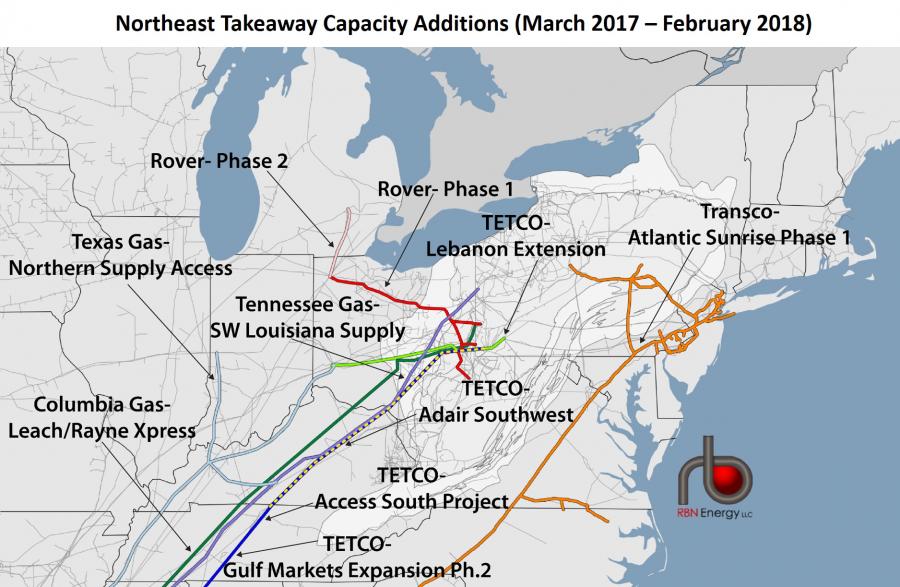
 An organic farmer in Lancaster County, PA is accusing Williams and their Atlantic Sunrise Pipeline project of violating the conditions they agreed to. What kinds of violations? “Heavy equipment was stored on the property.” Ooooookay. Uh, we don’t think they dig pipeline trenches with hand shovels any more. What about his horrific violation: “Nonorganic bags of mulch have continued to be stored on the property.” Have you ever seen a bag of “organic” mulch at Lowes or Home Depot? No, neither have we. Here’s another one: “For weeks, trucks traveled between the organic farm and a neighboring nonorganic property.” Apparently the organic farmer doesn’t like his neighbor. We suppose he’s afraid the tires will pick up some non-organic dirt (whatever that is) and track it onto his property. Does he drive a car? Does he visit “nonorganic” locations around the county? You see the hypocrisy. Here’s one we really liked: “Soil from an adjacent nonorganic property blew onto the organic farm.” What the heck is that? Now Williams is supposed to control the wind?? The last person we know of who walked Mom Earth and was able to control the wind was J.C. (Mark 4:39). And perhaps worst of all, a complete tragedy: “Signs warning construction workers of an organic farm were not posted.” You get the drift. This is all nonsense–either minor violations or outright fabrications. Williams pushed back and said so. Just one more anti, grumbling and grabbing a headline…
 TransCanada Corporation, headquartered in Calgary, Alberta, released their third quarter 2017 update yesterday. On July 1, 2016, TransCanada completed its buyout of Columbia Pipeline, a $10 billion deal (see
  Black & Veatch, a leading engineering, consulting and construction company, released their “2017 Strategic Directions: Natural Gas Industry Report” earlier this week (full copy below). In the report, B&V examines how organizations are planning for long-term, sustainable operations that can handle rising supplies and deliver those supplies to markets eager to use natural gas as a cheaper and cleaner power generation source. The report finds that LNG (liquefied natural gas) is key in shifting oversupply from countries like the U.S. to growing demand centers in Asia, Latin America, India and Sub-Saharan Africa. The report emphasizes calls from the industry to fund infrastructure investments to enable increased LNG imports and exports, including floating LNG (FLNG) and natural gas-based power generating plants. There is no doubt, according to the report, that the U.S. is now in the driver’s seat with respect to LNG. Below is a summary of the key points, followed by the full report…
 The “best of the rest” – stories that caught MDN’s eye that you may be interested in reading. In today’s lineup: Dominion dishes out $550K to veteran/military organizations; what’s a “fair tax” for PA natgas; Waste Management converting more vehicles to natgas in Scranton/WB; Alaska/China sign natgas pipeline deal; natural gas smell was dairy air in Wisconsin; another activist-funded climate change report that falls short; major changes afoot in sand use, supply, prices; Saudi Arabia’s version of “Game of Thrones” affects oil price; and more!
 The “Art of the Deal” is still alive and well for Donald Trump. Trump along with an entourage of various state officials are currently on a trade mission in Asia. This morning (our time) a flurry of announcements were issued about Trump (and others) convincing China to invest $250 billion (a staggering number!) in various projects in the U.S. A whopping $83.7 billion of that (a full third!!) will be invested in one state–West Virginia. And the WV investment, according to the announcement, will be in “shale gas and chemical manufacturing projects.” The investment will come over the next 20 years, so yes, we’ll believe it when we see it. However, we cannot overstate how big and how good this news is for our friends in the Mountain State. While no specific projects are mentioned, we get this enticing tidbit from the announcement: “The projects will focus on power generation, chemical manufacturing, and underground storage of natural gas liquids and derivatives.” Sounds to us like we now know where the $10 billion NGL storage facility will be located (see
  Yesterday was quite a roller coaster ride for Williams with regard to a work stoppage in building the $3 billion Atlantic Sunrise Pipeline. It was just two days ago that the Federal Court of Appeals for the District of Columbia issued an emergency stop work order for Atlantic Sunrise, idling some 2,500 workers in PA and costing the company $8 million a day in downtime (see
  A major milestone has been reached in the mighty Shell $6 billion ethane cracker facility project. Over the past year or so site preparation has been vigorous. Work at the site in Monaca (Beaver County), PA has included building bridges, relocating a state highway, improving existing interchanges, repositioning a rail line, and preparing foundations for the new complex. The prep work is now largely done–and this week begins construction of the buildings that will house four processing units–the ethane cracker itself and three polyethylene units. Also part of this next (final) phase of construction: a 900-foot long cooling tower, rail and truck loading facilities, a water treatment plant, an office building and a laboratory. Oh! And let’s not forget that Shell will also build a 250 megawatt electric generating plant that will provide all of the electricity needed at the facility–powered by Marcellus Shale gas, of course! Here’s an update from Shell, with a picture of the site as it is now…
 Energy Transfer’s top brass delivered some bad news and some good news on yesterday’s analyst phone call to discuss third quarter 2017 performance. Two projects vital to the Marcellus/Utica are being built by ET–Mariner East 2 (ME2) and Rover Pipeline. The bad news is that ME2, a natural gas liquids (NGL) pipeline project that stretches from eastern Ohio across the state of PA to the Marcus Hook refinery near Philadelphia, will be delayed an extra nine months. ME2 has a new in-service target date of “second quarter 2018.” Progress on ME2 is not as fast as it could be primarily due to an ongoing onslaught of lawsuits by Big Green organizations, coupled with delays from the PA Dept. of Environmental Protection. The good news for ME2 is that by Dec. 31st, 99% of the pipeline will be in the ground and buried. The news for Rover is all good. Rover is a $3.7 billion, 711-mile natural gas pipeline that will run from PA, WV and eastern OH through OH into Michigan and eventually into Canada. Rover had been dogged by problems with horizontal directional drilling (HDD), but those problems are now behind it. Yes, head of the Ohio EPA, Craig Butler, continues his Captain Ahab routine to try and stop the project (see
  Four local candidates in two townships in Chester County, PA (near Philadelphia) won seats on the town boards of Uwchlan and West Goshen in Tuesday’s election. They ran on a platform of using town resources to agitate and try to prevent the construction of the Mariner East 2 pipeline through their towns. All four candidates are the pocket of Big Green group Food & Water Watch, which contributed to their campaigns. Yes, Big Green has just bought themselves (another) four politicians in the Philly area. What’s new? The four will now embark on actions that will threaten their respective towns with potentially bankrupting lawsuits, should they follow through with their threats. We hope the residents in those towns will appreciate their taxes doubling or tripling to cover legal fees. The four “winners” were: Mayme Baumann and Bill Miller in Uwchlan, and Mary LaSota and Robin Stuntebeck in West Goshen (all Democrats). The losers were all the residents living in those two towns…
 When we notice municipal referendums and ballot measures related to blocking shale drilling and pipelines, we always highlight them. Such a ballot measure appeared on the ballot in Bowling Green (Wood County), OH on Tuesday. We honestly were not aware of it prior to reading an article in the Toledo Blade. The ballot measure called for a ban on pipelines that flow natural gas and other fossil fuels over city-owned property. It’s aim is to prevent NEXUS Pipeline from building nearby. Antis got enough signatures for this glittering jewel to appear on the November ballot. And how did the good people of Bowling Green vote? They saw right through this one–voting it DOWN by a huge margin: 61%-39%. That’s a blowout, politically. But you know antis. Nothing, including the truth, will ever change their minds. The Bowling Green ballot measure was the work of out-of-towners–the Community Environmental Legal Defense Fund (CELDF)–about whom we’ve written plenty (
 In February 2016, MDN told you about Laclede Group, a St. Louis-based natural gas utility, with plans to build a ~60-mile pipeline from St. Louis through southwest Illinois and connect to the Rockies Express (REX) and Panhandle Eastern Pipeline (see
  One of the way pipeline companies afford to invest billions of dollars to build pipelines is via long-term contracts from would-be users of that pipeline. In Massachusetts, Spectra Energy (now a part of Enbridge) brokered deals with utility companies to provide them with cheap, clean-burning Marcellus/Utica natural gas. In order for those utilities to afford it, they would need to pass along some of the cost of building the pipeline to reach them. Wait, what? Electric customers would have to pay for a natural gas pipeline? Well, yes! Because the new, cheaper gas would produce electricity at a lower cost, thereby lowering their monthly electric bills. They benefit, directly, from such a pipeline. However, radical leftists took that arrangement to court and in August 2016 the Massachusetts Supreme Judicial Court ruled utilities could not pass along costs for pipelines to electric customers (see