
Antis Deliriously Happy with Maryland Frack Ban, Who Paid Who?
 The same old (very small) cast of environmental radicals is claiming victory in Maryland over the recently passed bill to ban fracking statewide–a bill that now sits on traitor Gov. Larry Hogan’s desk (he’s promised to sign it). Radicals from the Chesapeake Climate Action Network (and Food & Water Watch, and the Sierra Club, et al), who are waging a holy war against fossil fuels, say this momentous occasion is evidence of new “bipartisan” support sweeping the nation–that Maryland’s vote has “national implications.” It’s nothing of the sort. Anti-fossil fuel nutters are still by and large Democrats (and Socialists) and confined to a few far-left states (Maryland, New York, Vermont). Larry Hogan is an anomaly–a Republican who ran on a platform of support for fracking who suddenly, without warning and for inexplicable reasons, flipped and promised to sign a ban bill should one be proffered. We wonder, who paid who? There is corruption at work in this situation, of that we have no doubt. All of the so-called “leaders” of the ban frack movement in the Maryland legislature come from either the Washington, D.C. suburbs, or the Baltimore area. They are located on the opposite side of the state from where fracking would, theoretically, take place. These enviro radicals have hijacked the property rights of landowners in Allegany County and Garrett County, the only two Maryland counties with commercially viable shale deposits that could be fracked. It will be a sad day when Hogan turns his back on the people of Maryland and signs the law…
Read More “Antis Deliriously Happy with Maryland Frack Ban, Who Paid Who?”
 As MDN reported, last week U.S. District Judge Robert Mariani ruled against a Wayne County landowner in a lawsuit that challenged the right of the Delaware River Basin Commission (DRBC) to stop fracking in the Delaware River Basin (see
 For years anti-fossil fuel agitators have been making noise about so-called fugitive methane. According to antis, methane (CH4) is a zillion times more “potent” than carbon dioxide (CO2) in making Mom Earth toast (i.e. global warming, which isn’t happening). If only we could capture every last molecule of methane so it couldn’t escape, life would be better, according to antis. We’ve written countless stories dealing with fugitive methane, because both the federal and state governments try to regulate it from time to time (see
  The “best of the rest” – stories that caught MDN’s eye that you may be interested in reading. In today’s lineup: Federal judge keeps AG Schneiderman and #ExxonKnew on defense; Rover Pipeline makes progress in Belmont County; Shale Crescent hosts forum in Marietta; Utica Shale Academy joins forces with trade school re welding; anti group wants Shell to “study” cracker’s “enviro footprint”; shale oil drillers face uncertain 2018 with hedges expiring; using DNA in oil drilling; years-old Chesapeake bond lawsuit grinds on; and more!
 Good news for Pennsylvania drillers: the PA Dept. of Environmental Protection (DEP) finally, after years of review, granted permission to two different companies to operate two new wastewater injection wells in the Keystone State. One well is located in Elk County, the other in Indiana County. With these two new injection wells coming online, the state will have a total of eight operating injection wells (vs. hundreds in Ohio). You may have seen news about the newly authorized injection wells from other news sources yesterday. But you read MDN for “the rest of the story.” And here it is, something you won’t find anywhere else (until other news sources read MDN): As soon as the DEP issued the permits for the injection wells, the DEP filed lawsuits against the two townships where the injection wells will be located, because both of those townships–Highland Township in Elk County, and Grant Township in Indiana County–had previously passed so-called Home Rule Charters in an attempt to prevent the injection wells from being located in their towns. The DEP has sued each of them (copy of the Highland lawsuit below) to correct laws that attempt to prevent the DEP from doing its job in authorizing the injection wells. We have the full news of the DEP’s decision to permit the injection wells, along with details about the lawsuits, below…
 Yesterday President Trump made a trip to the Environmental Protection Agency to sign an executive order titled the “Energy Independence Executive Order” which takes aim at rolling back Obama’s disastrous Clean Power Plan. The new executive order also lifts a ban on leasing federal lands for coal mining, nixes new regulations aimed at trapping every last molecule of methane from oil and gas drilling & pipelines (unrealistic and very costly), and reduces, but does not eliminate, the role of so-called global warming when making decisions about authorizing new infrastructure projects. It was, by all accounts, a red letter day for responsible environmental policy–a day to correct some of the extreme overreach we’ve seen by the EPA over the past eight years under the Obama regime. Below we have a copy of the executive order and some of the reaction to it…
 The Mountain Valley Pipeline (MVP) is a $3.5 billion, 301-mile pipeline that will run from Wetzel County, WV to the Transco Pipeline in Pittsylvania County, VA. The project, which filed an official application with the Federal Energy Regulatory Commission in October 2015, is being built by EQT, NextEra Energy and several other partners. The project has faced stiff opposition from landowners in both West Virginia and Virginia. Although the project is not yet fully approved by the Federal Energy Regulatory Commission (FERC), the project did get a favorable Draft Environmental Impact Statement from FERC last September (see
  Sadly, it’s come down to this. Even when entering a property to cut a few trees, pipeline companies like Energy Transfer’s Rover Pipeline must now have a police escort. Rover is paying $60/hour to have Sheriff’s deputies escort tree trimming crews in Livingston County, MI, following an incident where one landowner told tree clearing workers working near (not on) his property that he was going to kill them–according to court records. Seems like a sensible precaution to have the cops handy, to keep the peace and to keep the nutters in check…
 Last December the Pennsylvania Dept. of Environmental Protection (DEP) said it would go on a “listening tour” in early 2017, to focus on so-called environmental justice–whatever that is (see
  Quarterly earnings calls are a great source of industry information, particularly during the question & answer sessions, when analysts help breathe life into stale earnings press releases by asking questions that many times force managers to go off-script. They are also excellent ways to check on the competition, and to “channel check” by seeing how different parts of the value chain are performing, such as oilfield service, E&P, and midstream companies. MDN highlights these calls from time to time, extracting salient comments. A typical earnings call lasts an hour. Unless it’s your business to listen to these calls, who has the time to review them all? We’ll tell you who: NGI (Natural Gas Intelligence). NGI’s research department is top notch, lead by former Wall St. analyst (and MDN friend) Patrick Rau. As he does each month, Pat (and other NGI analysts) have just sat through 100 earnings calls (over 200 hours!). Each quarter, going back years, Pat and NGI’s analysts have created a concise report that summarizes the main/big/wickedly interesting points to come from these calls. Normally that quarterly report is for internal purposes only–for NGI’s sales and journalistic arms. This time, however, NGI has decided to publish it. Among the companies analyzed in the “
 In May 2016, Williams’ Transcontinental Gas Pipe Line Company (Transco) pre-filed with the Federal Energy Regulatory Commission (FERC) for a project called the Northeast Supply Enhancement project (see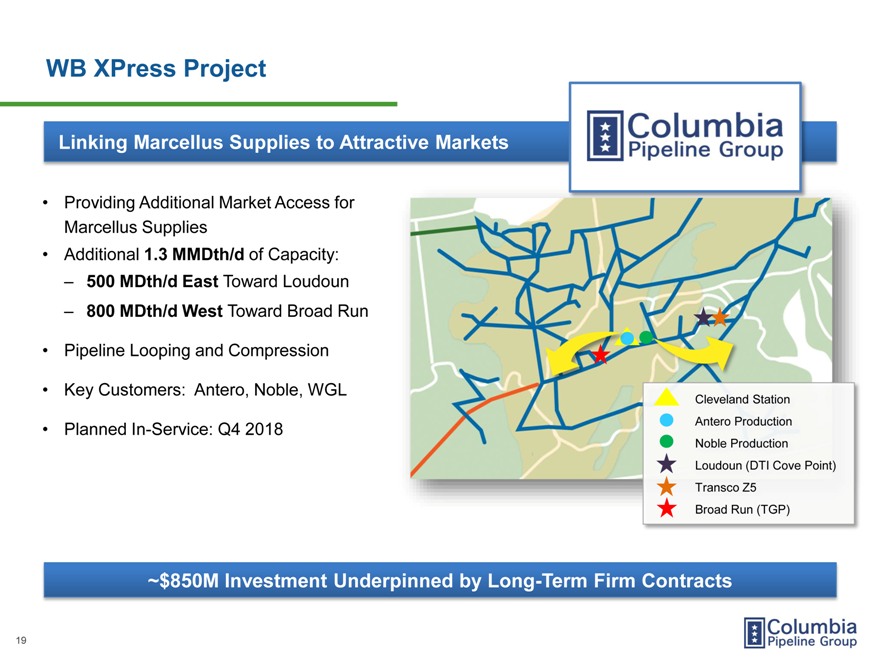
 Last week MDN brought you the news that a federal judge had dismissed a case brought by the Constitution Pipeline against the New York Dept. of Environmental Conservation (DEC) over the issue of denying water crossing permits for the project (see