
List of 218 O&G Companies Declaring Bankruptcy Since 2015
In November 2015 MDN brought you a list of 36 North America drillers that had, as of that time, declared bankruptcy (see List of 36 Oil & Gas Companies that Filed for Bankruptcy in 2015). In April, just three short months ago, the list stood at 59 bankruptcies (see List of 59 Oil & Gas Companies Filing for Bankruptcy in 2015/2016). The law firm compiling the list, Haynes and Boone, continued updating the list. In June it showed the list growing to 85 declared bankruptcies (see List of 85 Bankrupt O&G Companies Since 2015; 4 in Marc/Utica). The list was updated again just last week, and it now stands at 105 bankruptcies for E&Ps (drillers). We have the new list below. However, that single list doesn’t really tell the whole story. Until now we not noticed or highlighted two other lists also published by Haynes and Boone: a list of bankruptcies for midstream (pipeline) companies, and a list of bankruptcies for oilfield services companies. When you total all three lists, it shows 218 companies in the o&g industry that have, since the beginning of 2015, declared bankruptcy. We have all three lists below…
Read More “List of 218 O&G Companies Declaring Bankruptcy Since 2015”
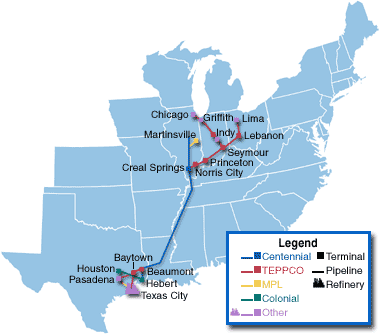 In September 2015 MDN brought you the news that two joint venture partners, MPLX (Marathon Petroleum) and Enterprise Products Partners, were actively evaluating a plan to reverse the flow of the 795-mile Centennial Pipeline to send natural gas liquids (NGLs) from the Utica/Marcellus to the Gulf Coast (see
  The world’s largest oilfield services company (OFS), Schlumberger, turned a profit in 3Q16 (see
  Range Resources, the very first company to sink a Marcellus well, issued their third quarter update yesterday. Among the highlights: Range lost $42 million for the quarter, which is a vast improvement over 3Q15 when the company lost $301 million. So things are getting better, financially. Marcellus production was 1,396 million cubic feet equivalent (Mmcfe) per day, a 9% increase over 3Q15. Range’s “Southern” division, in SWPA, saw a 23% increase in production, but because Range sold some assets in Bradford County, their “Northern” division saw a 39% decrease (year over year) in production. Range continues to focus its efforts in the southwest PA area, saying the company “continues to drill and complete outstanding wells, with peer-leading EURs, while continuing to drive costs lower.” Here is yesterday’s 3Q16 update from Range…
 Last week MDN reported that electric company FirstEnergy has begun construction of a new electric substation in Washington County, PA to provide electricity to “support two natural gas processing facilities being developed in the area” (see
  We’re always delighted when we spot a story or reference about a new company operating in the Marcellus/Utica that had heretofore escaped our finely-turned radar. Here’s one of those stories. In 2014, five people with experience in the oil and gas industry came together to form Evolution Energy Services. Based in Cadiz, OH, the company provides a range of services and products for the o&g industry–everything from porta potties to fracking chemicals to rig workers. We’ll call them an oilfield services company (OFS). We hadn’t heard of this upstart company until we spotted a brief reference that Evolution has just secured a $2 million load that will allow them to expand…
 “What is all the fuss over Pennsylvania’s Chapter 78a drilling rules going into effect anyway? We mean, come on, those rules were hashed out over the past five years! Can’t the drilling industry just bend over and take it like a man? It can’t be all that bad, can it?” With pleasure, we bring you a response to that line of thinking–a line of thinking YOU may have thought! The writer, Colin McNickle, is a former editorial page chief for the superb Pittsburgh Tribune-Review. McNickle tackles Chapter 78a head-on in this excellent rebuttal. It is nothing short of a declared war on shale gas and oil…
 The “best of the rest” – stories that caught MDN’s eye that you may be interested in reading. In today’s lineup: Marcellus/Utica production may not reach 40 Bcf after all; economics will force pipeline issue; OH rig count drops to 16; Braskem looks to expand Philly refinery; climate radicals exposed in Wikileaks email, plans to shame Rupert Murdoch; natgas price may have found its ceiling; Europeans dependent on Russia natgas, would like not to be; and more!
 MDN editor Jim Willis recently had the pleasure of addressing the Petroleum Club at the University of Pittsburgh’s Bradford, PA campus. Not in person, but via Skype video. When Jim asked the group, most of them in their second year of a two-year petroleum technology program about future job prospects, he got the impression they are concerned. The Marcellus industry has not been immune to layoffs. Graduating with a degree in an industry that’s seen 300,000+ layoffs over the past two years might make some question the wisdom of entering the program in the first place. Jim’s message to these eager young people bursting with potential? Don’t give up–and be encouraged. At the recent Shale Insight event and Benposium East event (both held in September), Jim had a number of conversations with those who either work in or invest in the o&g industry. His conclusion after speaking with industry insiders? Things are beginning to turn around. In fact, we can’t count the number of stories that talk about the coming shortage of good workers in the o&g industry. Today we spotted a press release from Energent Group promoting new research and wanted to highlight some of the information in that release–information that may be helpful to our new young friends at Pitt-Bradford, and for others in the industry looking for work. The research highlights the fact there are many drilled but uncompleted wells (DUCs), in all shale plays–but particularly in the oily Permian and Eagle Ford shale plays. According to the Energent research, workers probably stand the best chance of getting a job with a frac crew–because companies will first work on completing the already-drilled wells by fracking them. Makes sense to us!…
 One company that has been really smart and savvy when it comes to hedging is Antero Resources. Earlier this year when the average price of natural gas was selling for under $3 per thousand cubic feet (Mcf) on the benchmark Henry Hub, Antero averaged a sale price of $4.54/Mcf–in the Marcellus/Utica! Where prices are always BELOW the Henry Hub (see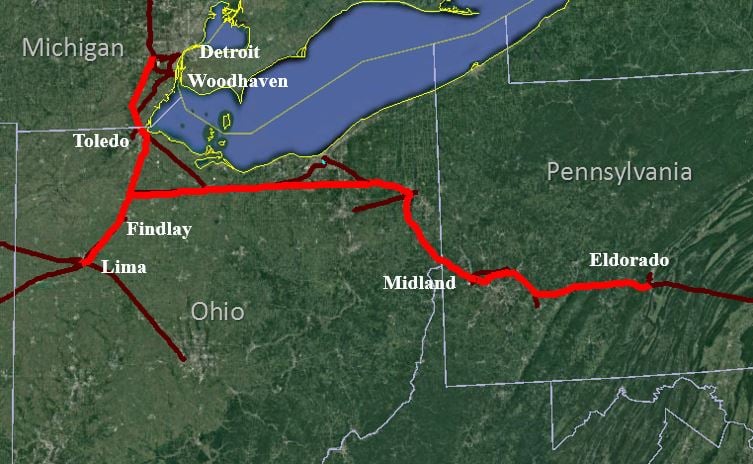

 We spotted what is, to us, a fascinating story about propane use across the country. There are those, like LP Gas magazine, that closely watch usage trends for propane. As you may know, propane is an NGL, or natural gas liquid. It is one of the hydrocarbons that comes out of a borehole drilled to extract either oil or natural gas. Along with oil and gas other hydrocarbons come out of the hole–NGLs like propane, ethane, butane, etc. One of the places propane is increasingly produced, and consumed, is in the northeast–because of Marcellus/Utica drilling. The sharp editors at LP Gas noticed an historically unusual trend–a spike way up in propane usage in one of the main regions tracked, in the northeast. The explanation for the spike up in usage? Propane is getting exported from the Marcus Hook refinery. Therefore much larger volumes of propane are being “consumed” by those exports. Which we find fascinating. We are producing AND consuming propane within the Marcellus/Utica region. That is, we’re generating wealth by exporting propane. We knew about ethane exports already happening at Marcus Hook (see
  Black & Veatch, a global engineering, consulting, construction, and operations company that is a major player in the oil and gas market, has just-released a new report: 2016 Strategic Directions: Natural Gas Industry Report (see a copy below). The new report tackles market outlooks for the upstream, midstream and downstream segments. One of the sections that caught our eye: power market opportunities, which explores how coal plant retirements and lower operating dispatch costs have moved natural gas to its place as the primary energy source in the United States. Also in the report, the attitudes of those working in the industry is optimistic. But the report authors issue a note of caution: “Yet, this optimism may be masking some substantial warning signs, particularly for upstream and midstream players. Tight controls on capital investments, tied to the low margins inherent in today’s pricing environment, have constrained new projects. Lower crude oil prices have revitalized petrochemical projects in the downstream sector, particularly in international markets, but investors still question long-term viability. This raises a key question for how organizations are, or are not, positioned to take advantage of an eventual pricing correction.” In other words, drillers and pipeline companies shouldn’t be popping the cork on the champagne bottle just yet. Here’s the fifth annual natgas update from B&V…
 Carrizo Oil & Gas, a Houston-based driller, actively drills in the Eagle Ford Shale in South Texas, the Delaware Basin in West Texas, the Niobrara Formation in Colorado, and until mid-year in 2015, they did have an active drilling program in the Ohio Utica and Pennsylvania Marcellus. No more. They haven’t drilled in Appalachia since 3Q15. That trend continues. It seems other plays have lured Carrizo’s heart, and money. Yesterday the company announced it is floating 6 million new shares of stock, hoping to raise $225 million. The reason? To buy another 15,000 acres of leases–in the Eagle Ford oil play in Texas. Once again Carrizo ignores the Mighty Marcellus. Their loss. Here’s an update on new stock and a new land deal in the Lone Star State…