
Cabot: Spending Up (Some) in 2019, Spending Down (Big) in 2020
 Cabot Oil & Gas is the only Marcellus/Utica driller that is profitable quarter after quarter and year after year. So the market pays attention to what Cabot does, because they’ve figured out how to make money in a low commodity price environment. Last Friday Cabot released second quarter numbers. CEO Dan Dinges talked about the balance of 2019 and even a bit about what to expect in 2020.
Read More “Cabot: Spending Up (Some) in 2019, Spending Down (Big) in 2020”
 The best teachers (people) and the best teacher (method of instruction) have the same thing in common: Hands on. As in tactile, doing stuff, rather than sitting in a chair attempting to learn by information dumping. Particularly with elementary-age kiddies. Cabot Oil & Gas and Southwestern Energy recently sponsored the annual Vehicular Career Day where 400 fifth graders from school districts across Susquehanna County climbed into big rigs, buses, and emergency vehicles. The shale industry was well-represented. Needless to say, the kids loved it.
 Several members of the Marcellus Shale industry spoke at a meeting of the Williamsport/Lycoming Chamber of Commerce yesterday, including MDN friend George Stark from Cabot Oil & Gas. George is director of external affairs. At the meeting he said the Marcellus industry has made tremendous strides in the last 10 years and will be around for decades to come. He said, “It’s booming in our area.” George also said Cabot is having trouble filling vacant jobs.
 The money-making Marcellus machine known as Cabot Oil & Gas continues to crank out the hits. On Friday Cabot held a conference call to discuss the company’s first quarter 2019 performance. And wow! What a performance! The company made $308 million in net income/profit (up 141% from $128 million in 1Q18), and produced 2.3 billion cubic feet per day equivalent (Bcfe/d) of mostly Marcellus (little bit of Haynesville) gas, up 21% from 1Q18.
 A second lawsuit we’re reporting on today that had previously slipped by our usually good radar. A former Cabot Oil & Gas employee filed a lawsuit in October 2017 alleging that he and a number of other “employees” had been stiffed out of overtime payments by Cabot–that Cabot had treated them as independent contractors rather than as employees. The lawsuit was granted class certification.
 We read on a regular basis in mainstream media that shale companies spend more money than they bring in, and that investors are growing tired of pumping money into companies without a return on their investment. We’ve recently noticed a renewed commitment on the part of major drillers to get their financial houses in order–spend less and drill less in order to make more money. We spotted an article by Reuters on the “shale drillers aren’t profitable/healthy” meme which got us investigating the financial health (or lack thereof) for Marcellus/Utica drillers. What we found may interest you.
 Last Friday Cabot Oil & Gas released its full year 2018 (and 4Q18) update, proclaiming 2018 was the best year ever for Cabot financially in the past almost 30 years the company has publicly traded shares of stock. The company hit new record natural gas production of 735 billion cubic feet equivalent (Bcfe) in 2018 (roughly 2 Bcfe/d), up 7% from 2017.
 Comments by Cabot Oil & Gas in their 2018 update issued Friday, along with added comments by CEO Dan Dinges during the earnings call on Friday, reveals the big news that Cabot has given up test drilling in Ohio Knox formation.
 A startling revelation came from yesterday’s court hearing in the tiny village of Montrose, PA. Some of the landowners from Dimock, PA who have traveled around the country claiming their water had been contaminated by Cabot Oil & Gas (remember the fraud “documentary” called Gasland?) were actually paid up to $5,000 *per month* by green groups to spread their lies.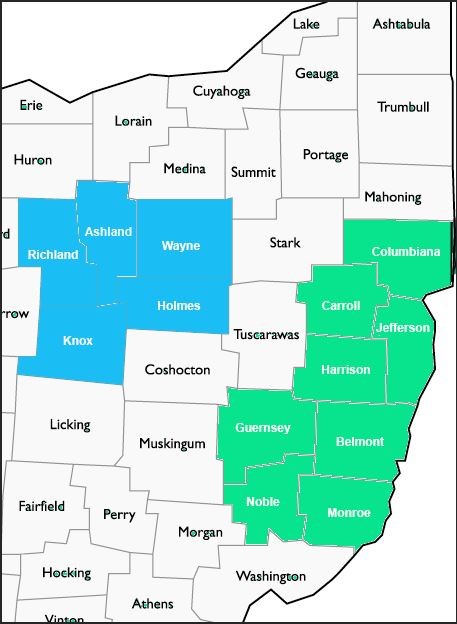
 The evidence continues to pour in that the addition of Williams’ Atlantic Sunrise Pipeline, a 200-mile greenfield pipeline from northeastern to southeastern PA where it joins the Transco Pipeline, is having a dramatic and ongoing effect on natural gas prices in northeastern PA. As in, the price drillers get for their gas has doubled. Atlantic Sunrise went online in early October (see
  The expert analysts at RBN Energy have just published their “fourth and final” in a series of posts looking in detail at E&Ps (exploration & production companies, or “drillers”). One of the groups of E&Ps they examine are “gas-weighted” E&Ps–or drillers who mostly extract natural gas. In looking through the list, you immediately realize every one of them has operations in the Marcellus and/or Utica Shale region. Yes, a few also have operations in other plays, but they all have at least some operations here. The real value in the article is an accompanying spreadsheet comparing various financial metrics (apples to apples)–things like total revenue, lifting costs, production costs, and “pre-tax income,” meaning profitability. How do our drillers compare with each other?
 Williams is expanding its mighty, 10,500-mile Transcontinental Gas Pipe Line Co (Transco), again. Sometime this month Williams will prefile a request with the Federal Energy Regulatory Commission for the Leidy South expansion project. The new project will bump up “compression” (either build new compressors or refit existing compressors) and build new “looping” pipeline in Pennsylvania, in order to increase capacity of Transco in the northeast Marcellus region by another 580 million cubic feet per day (MMcf/d).