
NatGas Trades Above $3/Mcf 1st Time in > 1 Yr, Still Low in M-U
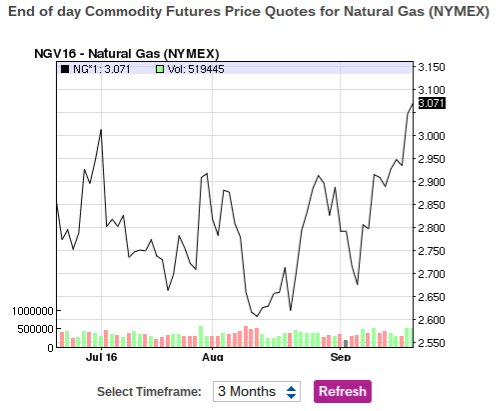 We’ve just hit a milestone worth mentioning. Yesterday the price of natural gas as traded at the benchmark Henry Hub delivery point (in southern Louisiana) closed at over $3 per thousand cubic feet (Mcf). It’s an important psychological barrier that gives traders (and drillers) hope for higher prices. However, before we begin popping the champagne corks here in the Marcellus/Utica, you should understand that there is no “the price” in natural gas. Gas is traded at hundreds of locations along major gas pipelines. The venerable Henry Hub is important because it is the benchmark, setting prices that many gas contracts are tied to. But the reality of natural gas prices for the Marcellus and Utica is one of low prices due to lack of pipeline capacity to move our oversupply to other markets. So while the price of gas trading at the Henry Hub yesterday closed at $3.08/Mcf (according to price experts Natural Gas Intelligence), the price of gas trading at the Tennessee Gas Pipeline Zone 5 300L in northeastern PA closed yesterday at $1.26/Mcf (NGI). Here’s more on yesterday’s important Henry Hub breaking through $3 story, and why the price is going higher right now…
Read More “NatGas Trades Above $3/Mcf 1st Time in > 1 Yr, Still Low in M-U”
 David Hill is a geologist and a driller located in Ohio (David R. Hill Inc.). At a recent Coffee and Commerce meeting sponsored by the Cambridge Area Chamber of Commerce, Hill offered his insights into when oil drilling may return to Guernsey County and eastern Ohio. As MDN recently reported, much of the focus on drilling in the Utica has lately turned to dry gas, or methane only (see
  S&P Global Market Intelligence recently conducted research on 10 of the largest Marcellus/Utica drillers to discover which have “hedged” their 2017 production, and for how much. Hedging is a concept of pre-selling the gas you produce at a price you agree to now, in advance. Although that may sound risky, it’s actually an exercise in risk avoidance. It’s less risky to lock in favorable prices in advance rather than wait and potentially get far less. How do these drillers know what the prices will be a year from now? They don’t know, for sure, but there is something called the forward market, that predicts what prices will be at future dates. In fact, traders create contracts now based on prices in the future, and those contracts are reported by various news and data services, like
  Is unconventional (i.e. shale) natural gas supply more responsive to price changes than conventional gas? A new research paper suggests that the answer is yes–specifically, almost three times as responsive, because shale gas wells are far more productive (2.7x more) than conventional gas wells. In “Trophy Hunting vs. Manufacturing Energy: The Price-Responsiveness of Shale Gas” (full copy below), researchers from Resources for the Future (RFF), a nonpartisan think tank devoted exclusively to natural resource and environmental issues, takes a look at how the “new way” of drilling multiple wells from a single pad, which is akin to a manufacturing process, is flattening out the supply curve. A flattened supply curve reduces price volatility–the wild up and down swings in the commodity price of natgas. While the focus of the paper is on how shale wells are leading to lower and more stable prices over the long term and does a deep dive into economic models, the paper also contains a good, basic primer on drilling a shale well. We found it a good read and wanted to share it with you…
 The ace reporters and analysts at Natural Gas Intelligence (NGI) recently came through yet another quarterly earnings season with their sanity mostly intact. 😉 MDN editor Jim Willis works with NGI expert analyst Patrick Rau on occasion. Pat is a terrific guy and one of the sharpest energy analysts Jim has had the pleasure of meeting. Pat sat through dozens of quarterly earnings calls for drillers, oilfield services companies and more over the past month or so. What did Pat learn from all those calls? Are there trends emerging? That was the upshot of an article written by NGI reporter Leticia Gonzales last week. It’s a must-read article (see


 In 2013, Dominion announced a 20-year deal to export 100% of the output from their planned Cove Point, MD LNG plant. All of the Marcellus gas from Cove Point will get exported to both India and Japan (see
  Last week BP released its annual Statistical Review of World Energy–the 65th edition! (We have a full copy embedded below.) A number of big energy companies, like Exxon Mobil, as well as government agencies, publish similar reports that characterize current and future world energy trends. However, one analyst we read says BP’s report is the best: “I have relied upon the BP World Energy report for years. It is not a report to be viewed with a partisan eye, but as merely one of the best, if not the best, energy trend device available anywhere. In comparison to government agencies like the U.S. Energy Information Administration (EIA) the global International Energy Association (IEA) or OPEC’s own World Oil Outlook, the BP report has proven itself to be far more valuable in finding investable trends. I would never recommend any oil sector without having the statistical evidence of the BP World Energy Report behind me.” In scanning a summary of this year’s report, one statistic stands out for us. Environmental radicals constantly prattle on that renewable energy sources could replace fossil fuels, if we only had the will to change. What utter rubbish, as proven by this stat: In 2015 renewable energy, mostly used to generate power, reached 2.8% of global energy consumption, up 2% in the last ten years. Did you get that? Only 2.8% of the energy used in the world is generated by wind, solar, etc. Fossil fuels are here to stay through not only our own lifetimes, but the lifetimes of our children and grandchildren. Someday maybe we’ll be famous for having been prescient in penning these words (we’ll be long dead and gone)–but mark our words, fossil fuels are not going away any time soon…
 Strong demand from electric power generators will push natural gas demand this summer up by an estimated 4 billion cubic feet per day (Bcf/d), according to a new report from the Natural Gas Supply Association (NGSA). However, even though there’s more demand, because supplies are so bountiful, the price of natural gas over the summer is actually expected to go down, not up. Using published data and independent analyses, NGSA evaluated the combined impact of weather, economic growth, customer demand, storage inventories and production activity on the direction of natural gas prices for the summer of 2016 compared to last summer. The NGSA says summer 2016 will see a “remarkable growth in demand.” Even so, NGSA expects “downward pressure on prices compared to last summer.” Bummer. It’s great news for consumers and power generating plants. But not so good news for drillers. Below we have a full copy of the NGSA report…
 CNBC, not known for being an objective news source (witness the Republican debate debacle earlier this year), conducted a survey among 22 strategists, traders and analysts on the topic of the price of oil. MDN sometimes covers oil stories because natural gas oil are joined at the hip. Often the same E&Ps that drill for oil also drill for gas. And when you drill a hole in the ground, you get what you get–not only oil, but “associated gas” and gas liquids. Hydrocarbons of all kinds come out of the holes drilled. So it pays to pay attention to the oil market and what’s happening with the price of oil. According to the CNBC survey, those responding said overall they expect drilling to pick back up with the price hitting $50 per barrel. But they also said it won’t really pick up in earnest until the price hits $60 per barrel. Roughly half expect the price of oil to remain in the $40-$50 range until the end of 2016, with the other half thinking it will go higher. Only 9% believe come Dec. 31 the price will be at or above $60/barrel…
 You know what magical thinking is? It’s when an analyst/consultant repeatedly predicted that the world had reached “peak oil” production and that oil production was/will soon decline, leading to insanely high prices for oil. Then the shale revolution happened. Oops. So much for the discredited “peak oil” theory. But the same analyst, for a long time, kept repeating his discredited theory. We call that magical thinking. That same analyst then predicted “peak natural gas”–that the shale revolution was a bubble and would soon end because shale wells peter out so quickly, dontcha know. The analyst never factored new technology, and new shale layers, would be discovered. Oops. More magical thinking. Now that same analyst says cheap shale gas will end soon–the price is about to go insanely high. Yet more magical thinking…
 What will it take for drillers to begin drilling again? That’s a question getting asked frequently by analysts on quarterly earnings calls with Marcellus/Utica drillers. The short answer is for the price of natural gas to go up and stay up. How high? Here’s some interesting economics from Southwestern Energy CEO Bill Way: every time the price of natural gas increases another quarter ($0.25), it translates into $185 million in cash flow for his company. If the price went up 50 cents, Southwestern would reactivate two drilling rigs. Another key factor in when drillers will start drilling again are DUCs–drilled but uncompleted wells. The DUC inventory is going down–but many drillers still have a year’s worth of DUCs they can leverage before they have to sink new holes…
 Fitch Ratings, one of the world’s top ratings services (rates stocks, bonds and more), issued a press release/opinion on Friday that tackles the issue of LNG (liquefied natural gas) and how the LNG market is rapidly and radically changing because of U.S. shale gas. Historically the price for LNG and oil have been linked. When the price of oil goes up or down, so too does LNG. But that’s now changing, because of the super abundance of U.S. shale gas. Fitch points out that with the U.S. now in the LNG export game, the link between LNG, natural gas and oil has “weakened.” They also say the U.S. natural gas market is “too big and too well supplied” for LNG exports to affect natgas prices here at home. In other words, we can export all of the LNG we want and it still won’t raise the domestic price of natural gas for consumers…