Half of UTOPIA Pipeline Jobs in OH May Go to “Foreigners”
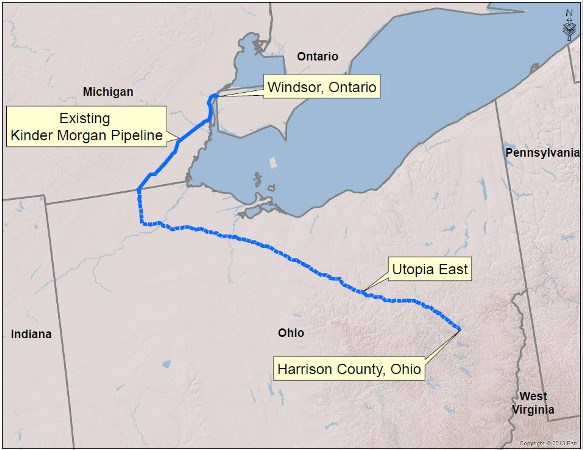
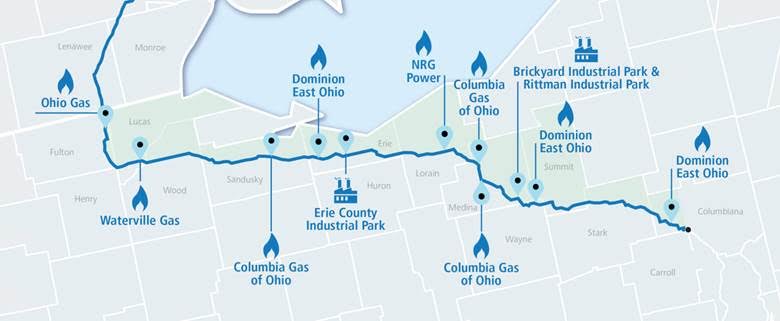
Now that Ohio Gov. John Kasich’s grandiose delusion of becoming the next president of the U.S. has been shattered and he’s had time to lick his wounds, it’s time to drag old “foreigner hunter” out for a new round of tracking down out-of-state workers. We have a mission for him: UTOPIA. As in Kinder Morgan’s UTOPIA ethane pipeline, planned to run 240 miles across Ohio. As pipelines go, it’s pretty small at only 12 inches in diameter. But ethane (a natural gas liquid) doesn’t need a huge pipeline to cart it across the Buckeye State. UTOPIA (named for Utica To Ontario Pipeline Access) will cross the state and connect to another pipeline that will carry Utica/Marcellus ethane to Michigan and on from there to Canada to feed the NOVA ethane cracker in Sarnia (see UTOPIA is Coming! The UTOPIA Pipeline, that is…). Kinder has just released a new study conducted by Kent State University researchers that outlines the huge economic benefits for Ohio in building UTOPIA. One of the interesting factoids: The pipeline will create over 2,000 temporary jobs–900 of them in construction. The report estimates that half of those construction jobs will go to out-of-state workers. Since Gov. Kasich is a jingoist with a problem employing out-of-state workers from exotic places like Texas and Louisiana (he calls them “foreigners,” see OH Gov. Kasich Continues Trash Talk Out-of-State Workers), we expect he’ll be prowling around to see if he can “fix” the situation…
Read More “Half of UTOPIA Pipeline Jobs in OH May Go to “Foreigners””
 Stark State College, located in North Canton, OH, has just been awarded a half million dollar grant from OH Gov. John Kasich’s Education Innovation program to provide ShaleNET education and training to students at Stark State’s sister schools, Eastern Gateway Community College in Steubenville, OH and Hocking College in Nelsonville, OH. MDN first reported on Stark’s new Well Site Training Center back in 2014 (see
  Last week MDN was the first to share the news that the California-based US Methanol is building at least two, rumored up to five, methanol plants in the Mountain State (see
  Last week MDN highlighted a survey from Evercore ISI looking at attitudes and behaviors of displaced workers in the oil and gas industry (see
  One of NGI’s ace reporters, Carolyn Davis, got her hands on a new report/survey conducted by Evercore ISI that looks at attitudes and behaviors of displaced workers in the oil and gas industry. The results are quite interesting. You may recall that something like 300,000+ o&g workers were laid off over the past several years. Many of them worked for oilfield services companies (OFS), like Halliburton, Baker Hughes and Schlumberger. In fact, our back-of-the-envelope tally says the vast majority of those layoffs came from just a handful of companies, namely those three. The Evercore survey found that many (most?) workers are not returning to the oil and gas industry, now that hiring has begun again. And that’s a problem. It means that there aren’t enough bodies to do the work. It seems the laid-off workers didn’t appreciate getting canned, tossed overboard like a piece of trash at the first sign of trouble–and many of them have gotten jobs in other industries. Who can blame them?! Here’s a few highlights from the survey…
 Although he still wants to tax the Marcellus Shale industry out of his state, Pennsylvania Gov. Tom Wolf (with the dubious title of “most liberal governor in the U.S.,” see
  Although we’ve begun to hear rumblings about jobs coming back to shale fields, like the Marcellus/Utica, this is the first time we’ve read about a massive comeback on the way. According to a news report, big investment bank Goldman Sachs is saying upward of 100,000 jobs are on the way back to oil and gas fields–after the industry lost 170,000 jobs since 2014. That’s still a 70,000-job deficit, but hey, we’ll take it. Here’s the good news that the job picture is about to turn around in our beloved industry…
 It’s not all doom and gloom in the Marcellus/Utica. Seems like for the best part of a year we’ve only heard about layoffs and companies filing for bankruptcy, due to the major slowdown in drilling in our neck of the woods. But that’s not an accurate picture. Take an old steel plant in the Wheeling, WV area that had been closed for 30 years. A new business now occupies the old Wheeling-Pittsburgh Steel Corp. plant in Benwood, WV. JLE Industries has set up shop in the old plant with (so far) 25 full-time workers to inspect and repair metal tubes used in shale drilling. Chris Harris, the owner/operator, believes the company will continue to grow…
 Can a single petrochemical facility, like Shell’s proposed ethane cracker plant in Beaver County, “rebirth” all of Pennsylvania’s moribund manufacturing base? That would be a resounding “Yes!” according to Marcellus Shale Coalition president Dave Spigelmyer and Pennsylvania Manufacturers’ Association president Dave Taylor. Writing a column in the Harrisburg Patriot-News, the two Daves make the case for just how big a hairy deal the coming Shell cracker in PA really is…
 There was lots of cracker talk at the first Northeast U.S. & Canada Petrochemical Construction Conference & Exhibition in Pittsburgh yesterday. According to NGI’s ace reporter for Shale Daily, Jamison Cocklin, excitement over the Shell cracker announcement from a few weeks ago was “palpable” at yesterday’s event. There was plenty of talk about the Shell cracker–but the talk coming from the event that interests MDN is talk about both the PTT Global Chemical cracker planned for Ohio, AND the Braskem cracker planned for West Virginia. These other two world class cracker plants (similar in size and scope to Shell’s project) “remain on track.” Now that is news!…
 The coming Shell ethane cracker plant complex in Monaca (Beaver County), PA, will create a lot of jobs–some in the near-term, but many in the medium-to-longer term. The plant won’t be complete for another five years. Between now and then it will take 6,000 temporary workers to build it. Once built, the plant will take 600 permanent employees to run it. Is Beaver County and the greater Pittsburgh region ready for that kind of jobs challenge? As of today, the answer would be “no.” But leaders in the area are working on it…
 The good vibes are still reverberating following Shell’s announcement that they will move forward with building a $3+ billion ethane cracker in Monaca, PA (see